
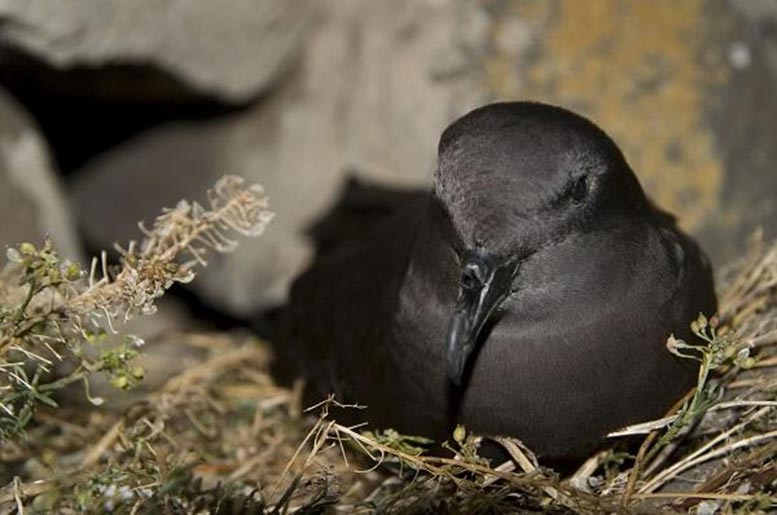
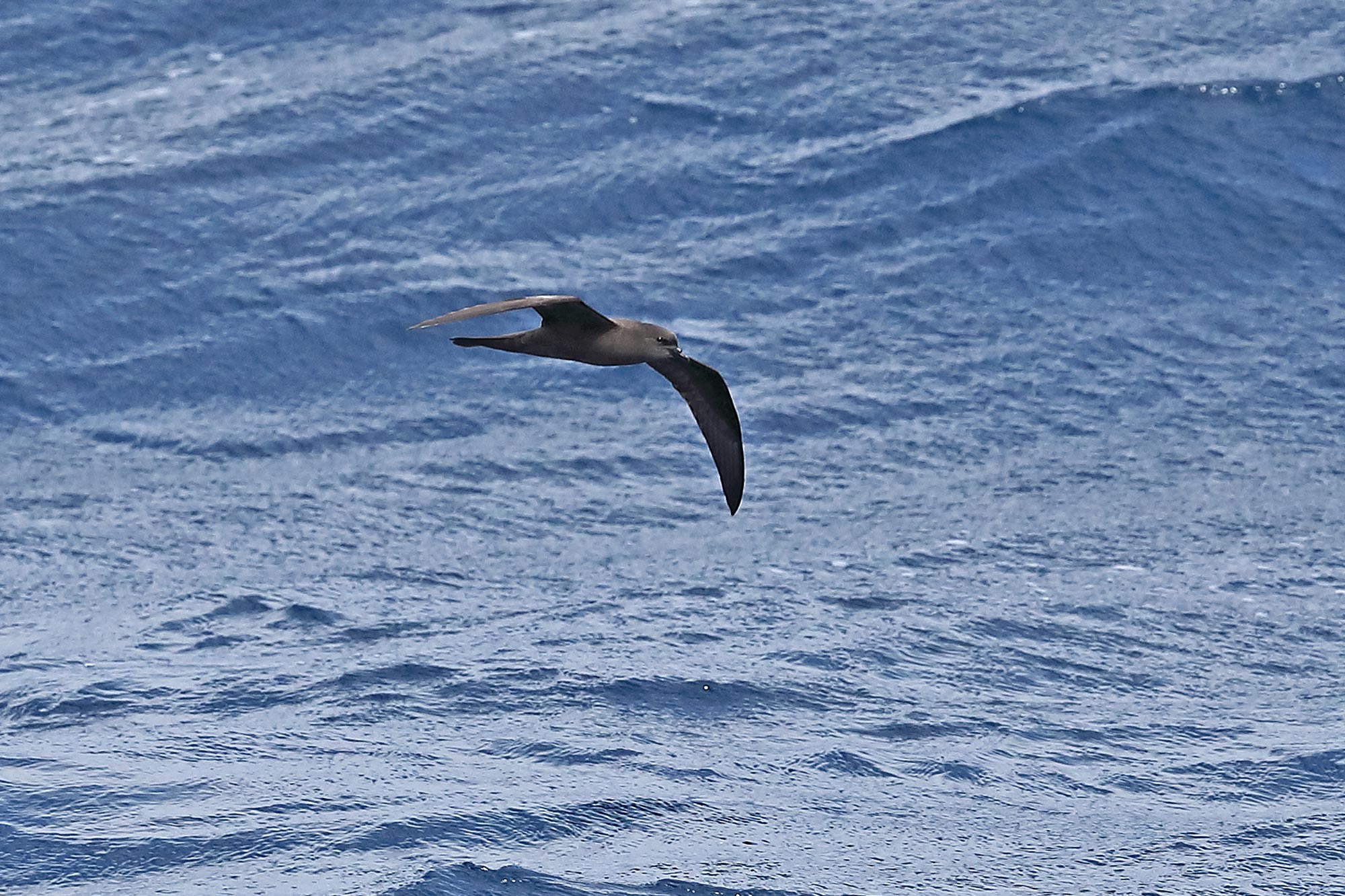
The migratory routes of a small seabird: Bulwer’s petrel can fly more than 1,800 kilometers over ocean waters to find food.
The Bulwer’s petrel reaches more than 1,800 kilometers (~1,100 miles) from the Canary archipelago up to the Azores on its route in search of food, according to data from a new scientific monograph based on the studies carried out from 2010 to 2018 by the Research Group of Ecology of Marine Birds of the Faculty of Biology and the Biodiversity Research Institute of the University of Barcelona (IRBio), under the supervision of Professor Jacob González-Solís.
The new study, carried out in the breeding colony in the Canary Island Montaña Clara, north of Lanzarote, shows the migratory routes as well as wintering areas of the Bulwer’s petrel. With the data researchers obtained from 105 birds with geolocation devices (GPS and GLS), 59 complete routes to find food, and 48,597 geographical positions, this is the most comprehensive scientific study ever published so far on the space ecology, diet, and daily and annual pattern of movements of the Bulwer’s petrel, a threatened species.
The new volume is the fourth monograph of the Migra program, promoted by SEO/BirdLife, with the collaboration of Iberdrola Spain Foundation. This monography, whose first author is Marta Cruz Flores, a researcher at UB-IRBIO and coordinator of the SEO/BirdLife Iberian Group for Marine Birds (GIAM), also counts on the participation of Raül Ramos, Mariona Sardà-Serra, Sofía López and Teresa Militão (UB-IRBio).
Featured on the red list of threatened birds in Spain
Most part of the global population of the Bulwer’s petrel (Bulweria bulwerii) lives in the Pacific Ocean. In the Atlantic, this marine bird breeds regularly in the archipelagos of the Canary Islands, Azores, Madeira and Cape Verde. This species, which spends most of the time at the open sea, gets closer to the land -mainly cliffs and stone quarries- during its mating season.
At the moment, predation by introduced mammals (rats and cats), loss of natural habitat due to coastal urbanization, and marine and light pollution -which confuses birds when flying- are the main threats to this species, listed as endangered according to the Red Book of Birds of Spain. There are about 1,000 bird couples in Spain.
Where are the petrels during the year?
The new study notes the two big migratory strategies described for the Bulwer’s petrel populations during wintering seasons: one towards the Central Atlantic and the other to Southern Atlantic, and these are always on ocean waters which are far from continental platforms.
From November to February, petrels are exclusively in these wintering areas, to which they come back to every year. In general, birds that winter in the Central Atlantic show a two-way migration to an only wintering area (between 20º N and 10º S latitude). Regarding the population that winters in the Southern Atlantic, those birds combine migratory periods with up to five migratory stops (over 15º S and sometimes 30º S).
Males and females take turns to incubate the only laid egg
During the breeding season -between May and August- the petrel flies around the Canary Islands and reaches the Azores in order to find food. These journeys take place over the ocean waters -where preys live- and are two-way journeys coming back to the breeding colony. Both males and females take turns up to 15 days to incubate the only laid egg, a strategy that enables them to reach large distances, up to 2,0
After the hatching of the egg -after 45 days of incubation- the bird has to be fed frequently and these routes are reduced to half of their usual extension. In both phases (incubation and breeding), petrels fly during a similar period of time during day and night, and there are no differences in time, distribution areas, and distances made by both genders.
The geolocation techniques also allowed researchers to know the daily activity of these birds over the year. Bulwer’s petrels rest in the surface waters during the day and show eating habits during the night. In particular, they feed from preys -fish, small cephalopods, and some crustaceans- that move to the surface to eat at night.
Challenge: improving the environmental management in marine ecosystems
Bulwer’s petrels’ threats in the open sea are not clear yet but there is no doubt the effect of climate change on the ocean is one of them. In order to shape the future impact of global warming on this species -its tropical populations will be the first affected ones- is essential to know the current distribution of the Bulwer’s petrel populations. Therefore, having a good environmental management of ocean waters where Bulwer’s petrels live during the year will be a determining element to improve the future preservation of these endangered species.
The monograph Migración y ecología especial de la población española de petrel de Bulwer will be presented on Friday, November 15, within the frame of the XXIV Spanish Conference and VII Iberian Ornithology Conference held in Cadiz from November 13 to 17. Asunción Ruiz, assistant director of SEO/BirdLife, Professor Jacob González-Solís and the expert Marta Cruz Flores, members of the Research Group of Ecology of Marine Birds (UB-IRBio) take part in the presentation.
This research team from the Department of Evolutionary Biology, Ecology and Environmental Sciences (UB-IRBio) also took part in the monograph Migración y ecología espacial de las poblaciones españolas de pardela cenicienta, published in 2018 and made in collaboration with IMEDEA and SEO/BirdLife.
Never miss a breakthrough: Join the SciTechDaily newsletter.
Follow us on Google and Google News.