

Freshwater reserves on land and underground have dramatically declined over the past decade, raising concerns that Earth’s continents have entered a persistently drier phase.
Scientists have discovered a significant drop in Earth’s freshwater supplies since 2014, influenced by factors including severe droughts, expanded agricultural demands, and climatic events such as El Niño. These observations, gathered through NASA and German satellite data, suggest a potentially long-term dry phase for the planet, exacerbating concerns over global warming’s impact on natural water storage and its availability for human and agricultural use.
Dramatic Shift in Global Freshwater
An international team of scientists, using data from NASA-German satellites, has found evidence of a significant and abrupt drop in Earth’s freshwater reserves starting in May 2014. This decline has persisted, suggesting that the planet’s continents may have entered a long-term drier phase, according to findings published in Surveys in Geophysics.
Between 2015 and 2023, satellite observations revealed that the average amount of freshwater stored on land—including surface water in lakes and rivers, as well as groundwater in aquifers—was 1,200 cubic kilometers (290 cubic miles) lower than the average levels recorded from 2002 to 2014. Matthew Rodell, a hydrologist at NASA’s Goddard Space Flight Center and one of the study’s authors, explained the significance: “That’s equivalent to losing two and a half times the volume of Lake Erie.”
During times of drought, along with the modern expansion of irrigated agriculture, farms and cities must rely more heavily on groundwater, which can lead to a cycle of declining underground water supplies: freshwater supplies become depleted, rain and snow fail to replenish them, and more groundwater is pumped. The reduction in available water puts a strain on farmers and communities, potentially leading to famine, conflicts, poverty, and an increased risk of disease when people turn to contaminated water sources, according to a United Nations report on water stress published in 2024.
Satellite Insights Into Global Water Changes
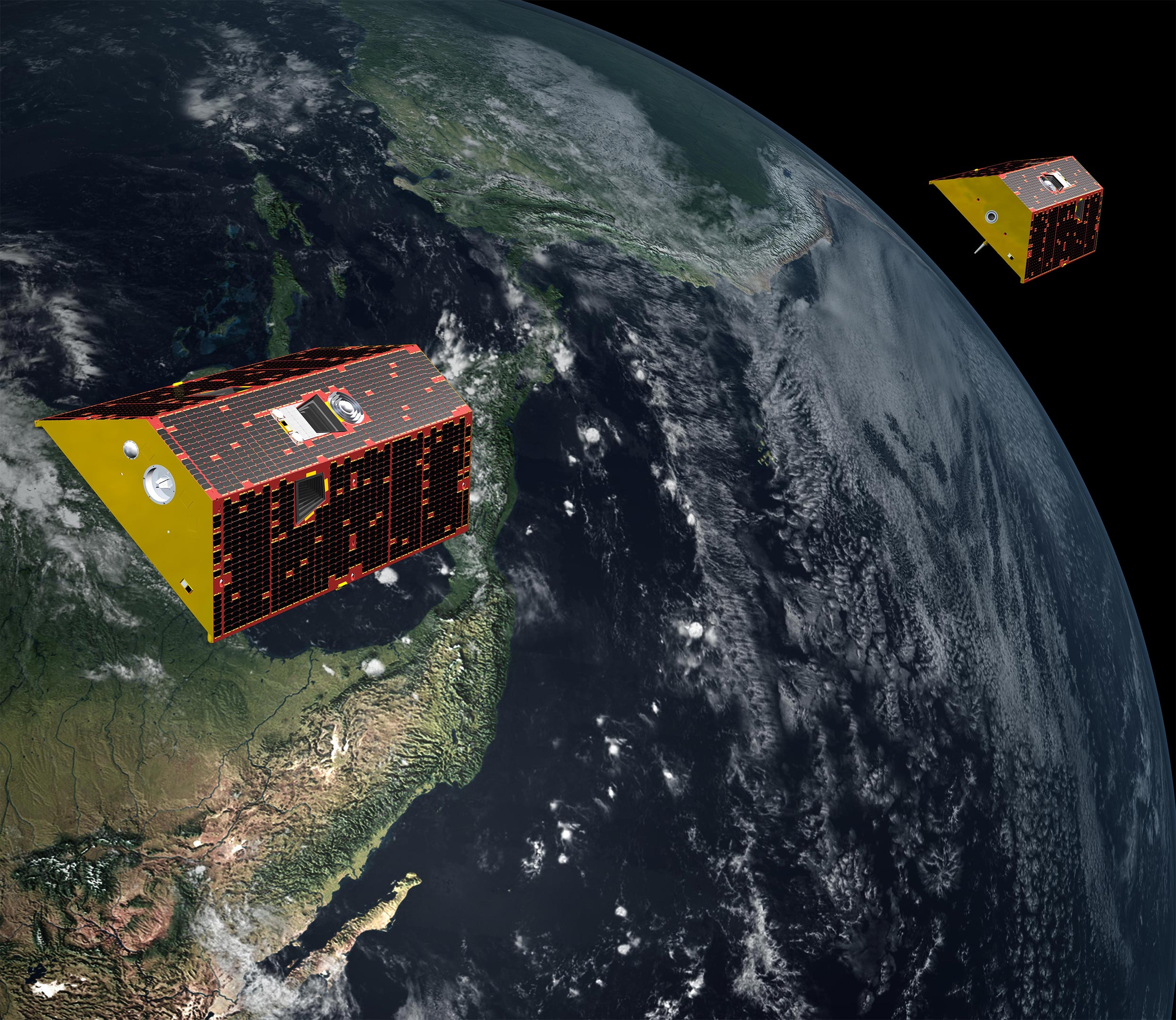
The team of researchers identified this abrupt, global decrease in freshwater using observations from the GRACE (Gravity Recovery and Climate Experiment) satellites, operated by the German Aerospace Center, German Research Centre for Geosciences, and NASA. GRACE satellites measure fluctuations in Earth’s gravity on monthly scales, revealing changes in the mass of water on and under the ground—also known as terrestrial water storage. The original GRACE satellites flew from March 2002 to October 2017, followed by the GRACE–FO (GRACE–Follow On) satellites launched in May 2018 and depicted in the artist’s rendering below.
The map at the top of this page shows the years in which the satellite data indicate terrestrial water storage hit a 22-year minimum at each location. The decline in global freshwater began with a massive drought in northern and central Brazil, followed shortly by a series of major droughts in Australasia, South America, North America, Europe, and Africa.
Climatic Influences and Persistent Drought
Warmer ocean temperatures in the tropical Pacific from late 2014 into 2016, culminating in one of the most significant El Niño events since 1950, led to shifts in atmospheric jet streams that altered weather and rainfall patterns around the world. However, even after El Niño subsided, global freshwater failed to rebound. In fact, Rodell and team report that 13 of the world’s 30 most intense droughts observed by GRACE occurred since January 2015. They suspect that global warming might be contributing to the enduring freshwater depletion.
Global warming leads the atmosphere to hold more water vapor, which results in more extreme precipitation, said NASA Goddard meteorologist Michael Bosilovich. While total annual rain and snowfall levels may not change dramatically, long periods between intense precipitation events allow the soil to dry and become more compact. That decreases the amount of water the ground can absorb when it does rain.
“The problem when you have extreme precipitation,” Bosilovich said, “is the water ends up running off,” instead of soaking in and replenishing groundwater stores. Globally, freshwater levels have stayed consistently low since the 2014-2016 El Niño, while more water remains trapped in the atmosphere as water vapor. “Warming temperatures increase both the evaporation of water from the surface to the atmosphere, and the water-holding capacity of the atmosphere, increasing the frequency and intensity of drought conditions,” he noted.
Challenges in Predicting Water Trends
While there are reasons to suspect that the abrupt drop in freshwater is largely due to global warming, it can be difficult to definitively link the two, said Susanna Werth, a hydrologist and remote sensing scientist at Virginia Tech who was not affiliated with the study. “There are uncertainties in climate predictions,” Werth said. “Measurements and models always come with errors.”
It remains to be seen whether global freshwater will rebound to pre-2015 values, hold steady, or resume its decline. Considering that the nine warmest years in the modern temperature record coincided with the abrupt freshwater decline, Rodell said, “We don’t think this is a coincidence, and it could be a harbinger of what’s to come.”
NASA Earth Observatory image by Wanmei Liang, using data from Rodell, Matthew, et al. (2024). Artist’s rendering of GRACE-FO by NASA/JPL-Caltech.
Never miss a breakthrough: Join the SciTechDaily newsletter.
Follow us on Google and Google News.