

This primitive, 85-million-year-old marine reptile was a fierce predator, measuring 12 meters in length. Unlike any known elasmosaur, it hunted its prey from above.
A group of elasmosaur fossils—among the most well-known in North America—have now been formally identified as belonging to a “very odd” new genus of marine reptile, unlike any previously described.
Named Traskasaura sandrae in a new study, this long-necked reptile measured 12 meters in length and had heavy, sharp, and robust teeth that were well suited for crushing.
Traskasaura named for its distinct traits
Findings published in the peer-reviewed Journal of Systematic Palaeontology describe Traskasaura as having a highly unusual combination of primitive and advanced traits, setting it apart from all other known elasmosaurs.
This unique set of features likely allowed the plesiosaur to hunt prey from above—a behavior not previously associated with this group. The research suggests that Traskasaura may have been one of the first plesiosaurs to adopt this hunting strategy.
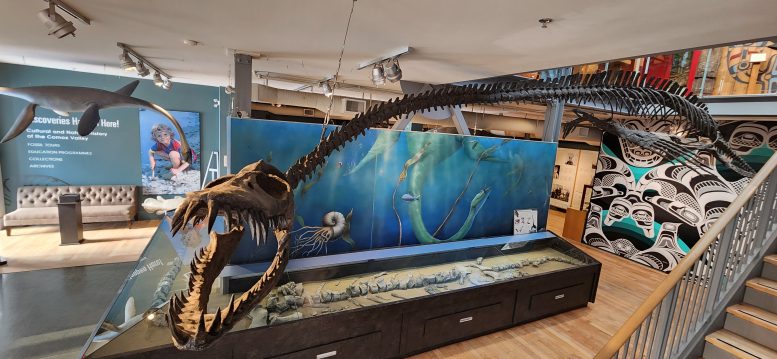
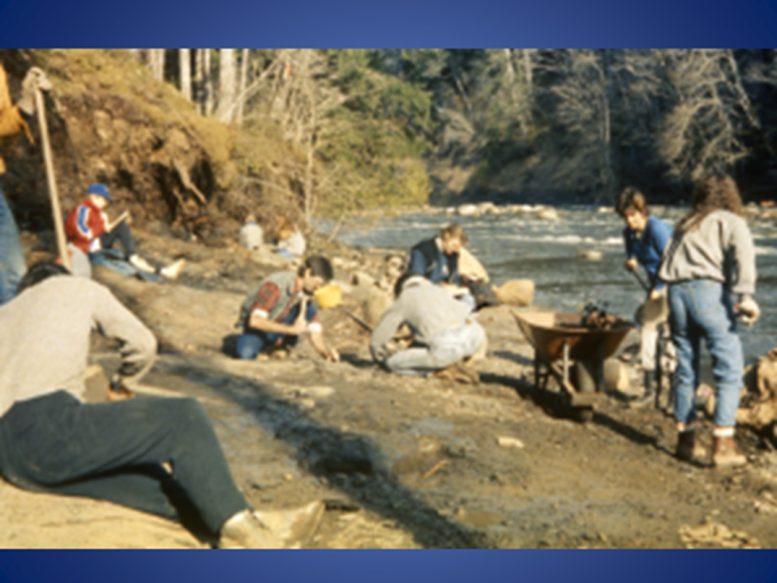
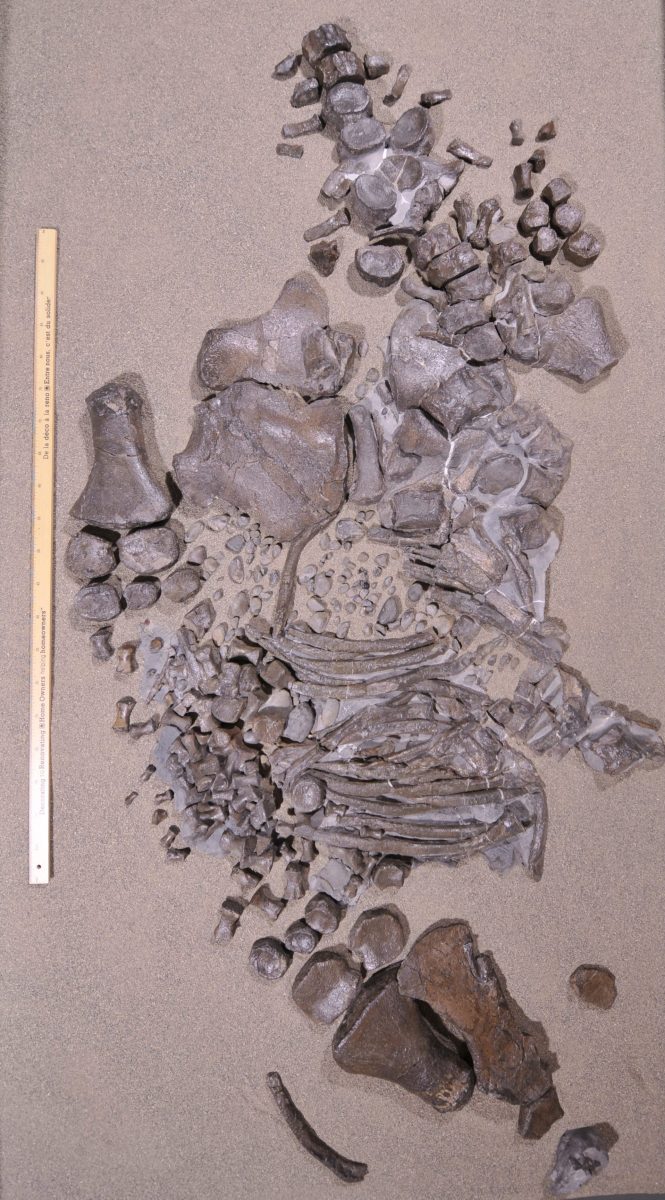
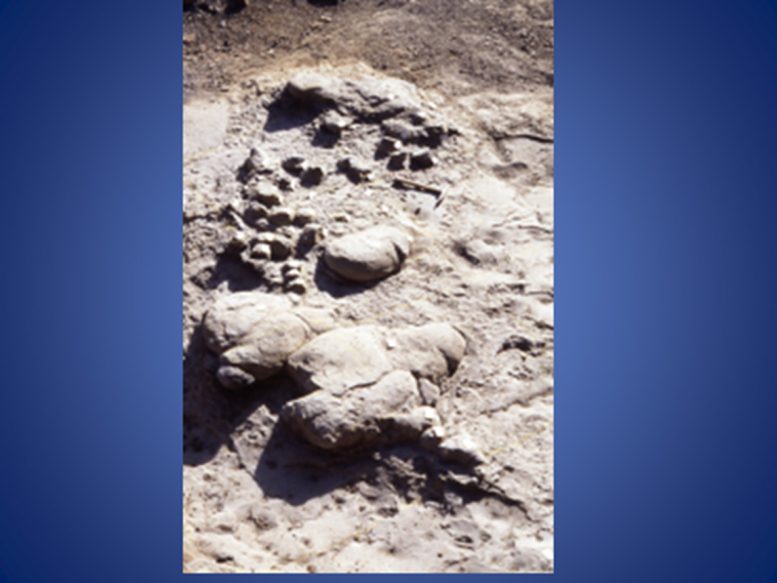
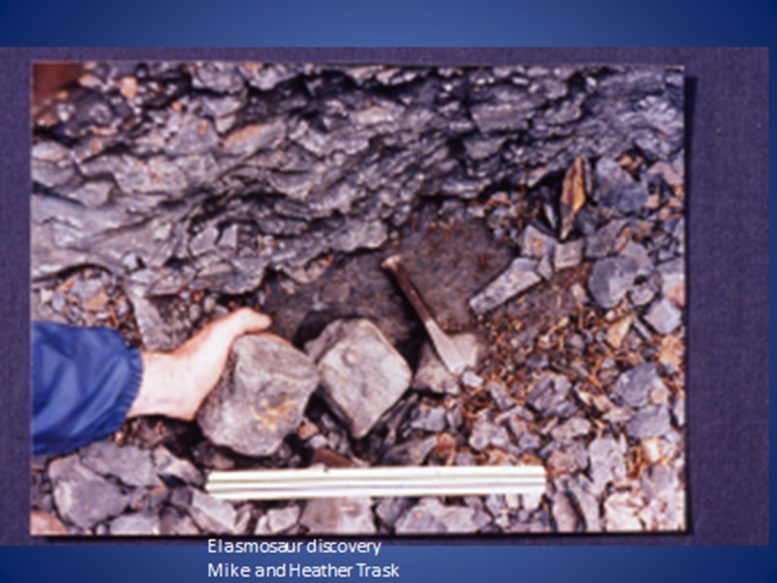
Although the fossils are 85 million years old, they are not new to science. The first fossil now identified as Traskasaura was discovered in 1988 in Late Cretaceous rock along the Puntledge River on Vancouver Island. Since then, more fossils have been recovered, including an isolated right humerus and a well-preserved juvenile skeleton containing parts of the thorax, shoulder girdle, and limbs. In total, three individuals from the Haslam Formation are featured in the new study.
First described in 2002, the fossils recently became famous, having been adopted by the Province of British Columbia and declared as the official fossil emblem of British Columbia (‘the Provincial Fossil of British Columbia’). They are currently on public display at The Courtenay and District Museum and Paleontology Center, Courtenay, British Columbia.
Community support and scientific mystery
The designation as the Provincial Fossil of British Columbia followed a five-year appreciation effort by paleontology enthusiasts and a province-wide public poll in 2018, in which the elasmosaur received 48% of the vote.
“Plesiosaur fossils have been known for decades in British Columbia,” explains lead author Professor F. Robin O’Keefe from Marshall University, in West Virginia, USA.
“However, the identity of the animal that left the fossils has remained a mystery, even as it were declared BC’s provincial fossil in 2023. Our new research finally solves this mystery.
“The scientific confusion concerning this taxon is understandable. It has a very odd mix of primitive and derived traits. The shoulder, in particular, is unlike any other plesiosaur I have ever seen, and I have seen a few.”
Professor O’Keefe, who is an expert on marine reptiles from the age of dinosaurs, adds: “With the naming of Traskasaura sandrae, the Pacific Northwest finally has Mesozoic reptile to call its own. Fittingly, a region known for its rich marine life today was host to strange and wonderful marine reptiles in the Age of Dinosaurs.”
“The fossil record is full of surprises. It is always gratifying to discover something unexpected. When I first saw the fossils and realized they represented a new taxon, I thought it might be related to other plesiosaurs from the Antarctic. My Chilean colleague Rodrigo Otero thought differently, and he was right; Traskasaura is a strange, convergently evolved, fascinating beast.”
Earlier hesitation to classify a new genus
In the initial, 2002 description of the fossils, experts were reluctant to erect a new genus based solely on the adult skeleton of the elasmosaur discovered.
Relatively few characters were “unambiguous” on this particular skeleton.
However, a new “excellently preserved” partial skeleton enabled this latest international team of scientists from Canada, Chile, and the United States to shed much new light on the morphology of the Puntledge River elasmosaur – and eventually identify it as a new genus and species.
Honoring discoverers and personal tributes
They have named Traskasaura in honour of Courtenay, BC, based Michael and Heather Trask, who discovered the original holotype specimen along the banks of the Puntledge river in 1988, and the Greek word sauros, lizard.
The species name sandrae honours Sandra Lee O’Keefe (nee Markey) – and like Elizabeth Nicholls (one of the team who identified the fossils in 2002) – who was “a valiant warrior in the fight against breast cancer. “In loving memory,” the team of authors writes.
Anatomy suggests a specialized predator
Traskasaura clearly had a very long neck – at least 36 well-preserved cervical vertebrae indicate at least 50 bones in the neck, and probably more.
And whilst not huge amounts are known about Traskasaura’s behaviour, the “fascinating and long list of autapomorphic characters” of the bones indicate strong capabilities for downward swimming.
Professor O’Keefe believes the combination of its unusual features relates to its hunting style – where it would use this capability for downward swimming to dive upon its prey from above.
This prey was likely the abundant ammonites known from the region. These would have been a “good candidate – due to Traskasaura’s robust teeth, ideal, possibly, for crushing ammonite shells,” Professor O’Keefe explains.
Summarizing their findings, the team says their hypothesis that the three individuals described do not belong to the same taxon “does deserve consideration.” However, all three individuals show diagnostic features of the new taxon, and therefore probably represent a single species.
Reference: “A name for the Provincial Fossil of British Columbia: a strange new elasmosaur taxon from the Santonian of Vancouver Island” by F. Robin O’Keefe, Elliott Armour Smith, Robert O. Clark, Rodrigo A. Otero, Anna Perella and Patrick Trask, 22 May 2025, Journal of Systematic Palaeontology.
DOI: 10.1080/14772019.2025.2489938
Never miss a breakthrough: Join the SciTechDaily newsletter.
Follow us on Google and Google News.