
Close Menu
    Facebook X (Twitter) Instagram
    SciTechDaily
    • Biology
    • Chemistry
    • Earth
    • Health
    • Physics
    • Science
    • Space
    • Technology
    Facebook X (Twitter) Pinterest YouTube RSS
    SciTechDaily
    Home»Biology»“Very Unusual” – Scientists Discover Bizarre Parasitic Creature Preserved in Amber
    Biology

    “Very Unusual” – Scientists Discover Bizarre Parasitic Creature Preserved in Amber

    By Steve Lundeberg, Oregon State UniversityJune 15, 2024No Comments3 Mins Read
    Facebook Twitter Pinterest Telegram LinkedIn WhatsApp Email Reddit
    Share
    Facebook Twitter LinkedIn Pinterest Telegram Email Reddit
    Parasitized Pseudoscorpion in Amber
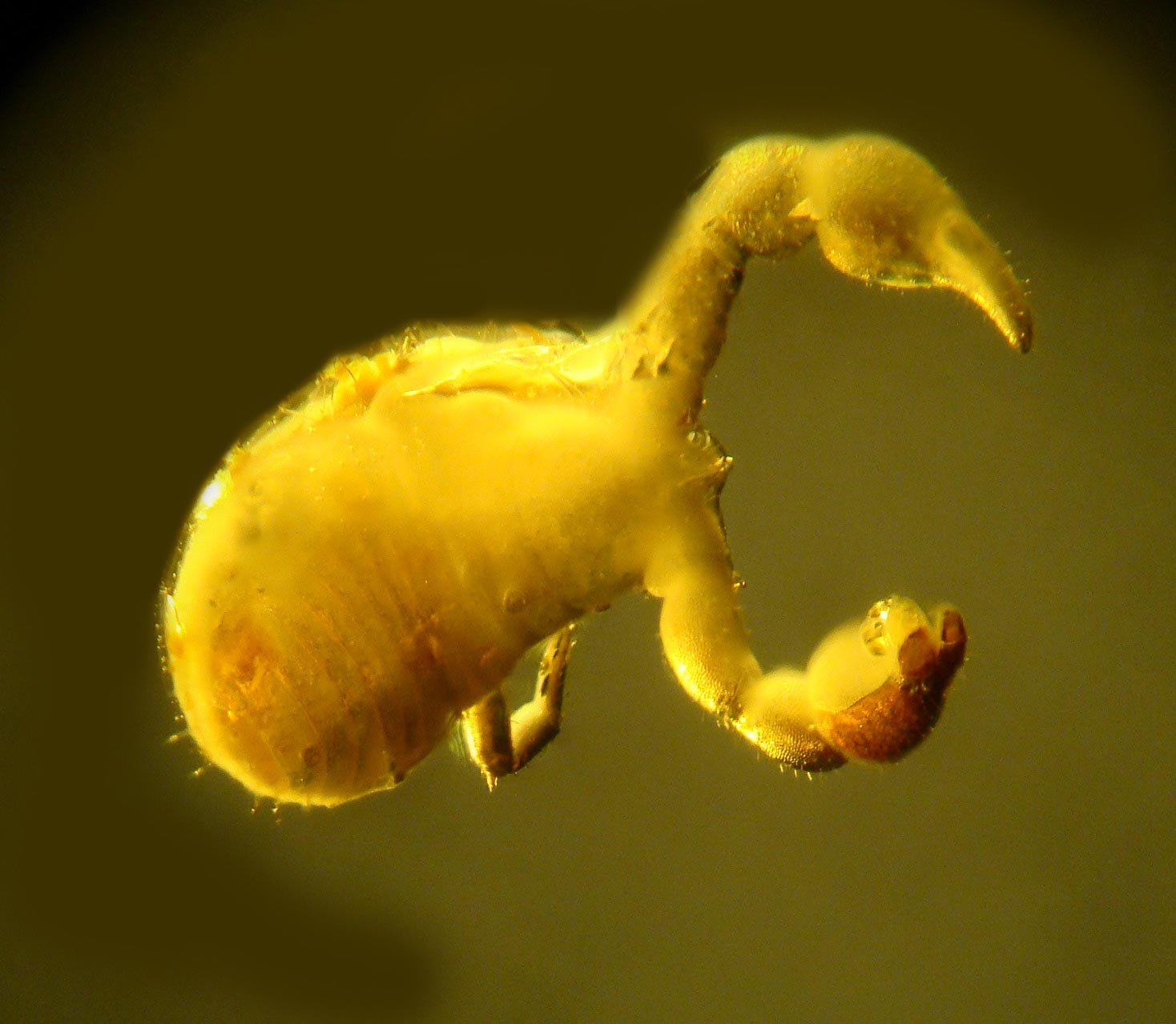
    In a parasitic first, a Baltic amber specimen has revealed that millions of years ago tiny worms known as nematodes were living inside of and feeding on the outer protective layer of pseudoscorpions. Credit: George Poinar Jr.

    A new study uncovers ancient nematodes that fed on pseudoscorpions, captured in Baltic amber fossils.

    The early bird gets the worm, but as fossil research by an Oregon State University scientist demonstrates, the early worm gets the arachnid. This intriguing finding comes from a study of a Baltic amber specimen which revealed that millions of years ago, tiny worms known as nematodes were living inside of and feeding on the outer protective layer of pseudoscorpions.

    “This is very strange,” remarked George Poinar Jr., an expert in analyzing life forms preserved in amber and a courtesy faculty in the OSU College of Science. “No other invertebrate-associated nematodes are known to have this specific habit.” These findings were detailed in the journal Historical Biology.

    Pseudoscorpion With Pointers to Parasites
    In a parasitic first, a Baltic amber specimen has revealed that millions of years ago tiny worms known as nematodes were living inside of and feeding on the outer protective layer of pseudoscorpions. Credit: George Poinar Jr.

    Pseudoscorpions and Nematodes: An Ancient Ecology

    Pseudoscorpions, as described by Poinar, are a diverse lineage of arachnids. Smaller than scorpions, they lack a stinger and tail and inhabit various environments worldwide. These creatures are associated with a wide array of parasitic organisms, including nematodes.

    Nematodes are among the planet’s most abundant animals, “free-living” in water, soil, and the Earth’s crust in addition to parasitizing a large collection of plant and animal species.

    The fossil nematodes studied by Poinar show well-developed spear-type structures known as stylets. Similar to a hypodermic needle, a nematode uses its stylet to pierce cells and pull out food – in this case from the pseudoscorpion’s hypodermis, part of the outer covering known as the integument.

    Fossil Classification and Research Implications

    “Aside from the stylets, and being able to determine that some females were still enclosing eggs, other pertinent characters are not clearly visible,” Poinar said. “So I placed the nematodes in the established collective group genus Vetus, which was established in 1935 for fossil nematodes that could not be placed in any known extant family.”

    Age estimates of Baltic amber vary widely, Poinar notes, from 23 million years to 55 million depending on who is doing the estimating and which method is used.

    “The fact that some nematodes were able to establish such unique parasitic associations as what we are seeing is very unusual,” Poinar said. “It is hoped that this initial paper will spur researchers to follow up and find more about the systematic placement of these nematodes.”

    Reference: “Ectoparasitic nematodes developing in the integument of a Baltic amber pseudoscorpion” by George Poinar, 19 May 2024, Historical Biology.
    DOI: 10.1080/08912963.2024.2341848

    Never miss a breakthrough: Join the SciTechDaily newsletter.
    Follow us on Google and Google News.

    Amber Oregon State University Parasites Popular
    Share. Facebook Twitter Pinterest LinkedIn Email Reddit

    Related Articles

    Mushroom Growing Out of 50-Million-Year-Old Fossilized Ant Reveals New Species of Fungal Parasite

    Watch Me Move It, Move It: Internal Motor Structure in Mycoplasma mobile Cells Revealed

    Bizarre Branching Worm With Dividing Internal Organs Discovered Growing in Sea Sponge

    Mysterious Killer of Bald Eagles Finally Identified

    Return of the Zombie Cicadas: Manipulative Qualities of Fungal-Infected Flyers Unearthed

    If You Eat Sashimi, Check for Worms: 283-Fold Increase in Sushi Parasites in Past 40 Years

    New Parasitoid Wasp Species Discovered That Can Manipulate Spider’s Behavior

    Zombie-Ant Fungus Faces Its Own Deadly, Specialized Parasites

    Microscopic Parasite Toxoplasma Gondii Linked to Personality Changes

    Leave A Reply Cancel Reply

    • Facebook
    • Twitter
    • Pinterest
    • YouTube

    Don't Miss a Discovery

    Subscribe for the Latest in Science & Tech!

    Trending News

    What if Time Isn’t Fundamental? Physicists Just Tested the Idea in the Lab

    Scientists Say We’ve Been Wrong About the Aging Brain

    68 Quadrillion Miles: Scientists Map Earth’s Vast Hidden Fungal Network for the First Time

    Hidden Damage From Youth May Explode Into Disease Later in Life

    Climate Models May Be Wrong About How Trees Store Carbon

    Scientists Discover Brain-Protecting Peptide That Could Change Parkinson’s Treatment

    This Copper Drug Clears Alzheimer’s Brain Toxins and Boosts Memory

    Adults Over 65 Lost Massive Amounts of Weight With Ozempic

    Follow SciTechDaily
    • Facebook
    • Twitter
    • YouTube
    • Pinterest
    • Newsletter
    • RSS
    SciTech News
    • Biology News
    • Chemistry News
    • Earth News
    • Health News
    • Physics News
    • Science News
    • Space News
    • Technology News
    Recent Posts
    • Scientists Discover Immune Cells That Can Fight Both Measles and Nipah
    • The Most Powerful Drug of All Isn’t Found in a Pill Bottle
    • Scientists Capture Immune Cells Eating Live Cancer Cells for the First Time
    • Scientists Just Found Something Weird Inside Moss
    • Scientists Just Repeated a Nobel Prize-Winning Experiment in a Creature Older Than Jellyfish
    Copyright © 1998 - 2026 SciTechDaily. All Rights Reserved.
    • Science News
    • About
    • Contact
    • Editorial Board
    • Privacy Policy
    • Terms of Use

    Type above and press Enter to search. Press Esc to cancel.