
Close Menu
    Facebook X (Twitter) Instagram
    SciTechDaily
    • Biology
    • Chemistry
    • Earth
    • Health
    • Physics
    • Science
    • Space
    • Technology
    Facebook X (Twitter) Pinterest YouTube RSS
    SciTechDaily
    Home»Space»Violent Neutron Star Collisions: Unlocking the Origins of Gold and Other Heavy Elements
    Space

    Violent Neutron Star Collisions: Unlocking the Origins of Gold and Other Heavy Elements

    By SpringerJuly 25, 2023No Comments3 Mins Read
    Facebook Twitter Pinterest Telegram LinkedIn WhatsApp Email Reddit
    Share
    Facebook Twitter LinkedIn Pinterest Telegram Email Reddit
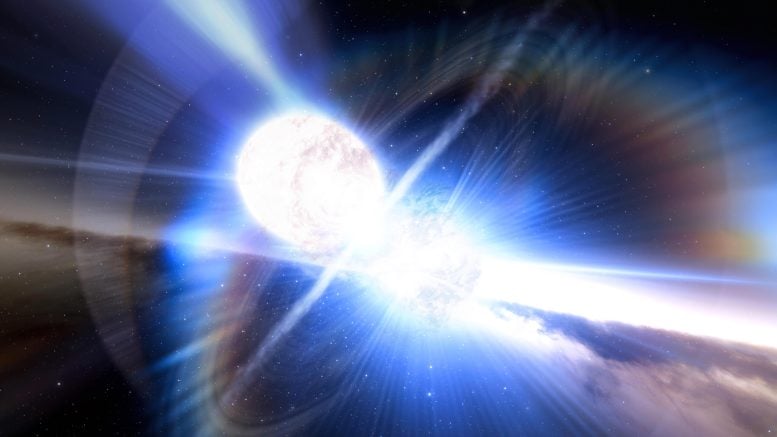
    Artist’s Impression of Colliding Neutron Stars
    This artist’s impression shows a kilonova produced by two colliding neutron stars. Credit: NOIRLab/NSF/AURA/J. da Silva/Spaceengine

    The gold that makes up your most precious jewelry may have been forged in a violent cosmic collision millions or billions of light years away between two neutron stars. New research seeks to better understand this process.

    There is only a single confirmed site in the Universe capable of generating conditions extreme enough to initiate the production process for many of the heaviest elements in the Universe, including gold, platinum, uranium – neutron star mergers. These mergers are the only event observed to date that can produce the incredible densities and temperatures needed to power the rapid neutron capture process.

    In a new paper in The European Physical Journal D, Andrey Bondarev, a postdoc researcher at Helmholtz Institute Jena, James Gillanders a postdoc researcher in Rome, and their colleagues examine the spectra from the kilonova AT2017gfo to investigate the presence of forged tin, by looking for spectral features caused by its forbidden transitions.

    “We have demonstrated that accurate atomic data, especially for forbidden magnetic dipole and electric quadrupole transitions, which are unknown for many elements, are important for kilonova analysis,” Bondarev says. “By calculating a large number of energy levels and rates of multipole transitions between them in singly ionized tin, using the method that combines linearised coupled-cluster and configuration interaction approaches, we generated an atomic data set that can be used for future astrophysical analysis.”

    Magnetic Dipole Transitions in Tin

    The team’s research shows that a magnetic dipole transition between the levels of the ground-state doublet of singly ionized tin leads to a prominent and observable feature in kilonova emission spectra.

    “Although this does not match any prominent features in the AT2017gfo spectra, it can nevertheless be used as a probe for future kilonova events,” Gillanders explains. “The more elements that can be positively identified, the closer we get to understanding these incredible cosmic explosions.”

    The team points out that kilonova events are only a recently observed phenomenon, with the first spectroscopic observations only obtained in 2017. Better atomic data such as that provided in this study will be essential in better understanding the explosive collisions associated with neutron star mergers.

    “We hope our work can contribute in some way to the advancement of our understanding of the process that produces the heaviest elements in the Universe,” Gillanders concludes. “We are eager for the discovery of new kilonovae and associated new sets of observations, which will allow us to develop our understanding of these events.”

    Reference: “Calculations of multipole transitions in Sn II for kilonova analysis” by A. I. Bondarev, J. H. Gillanders, C. Cheung, M. S. Safronova and S. Fritzsche, 3 July 2023, The European Physical Journal D.
    DOI: 10.1140/epjd/s10053-023-00695-5

    Never miss a breakthrough: Join the SciTechDaily newsletter.
    Follow us on Google and Google News.

    Astronomy Astrophysics Neutron Star Popular Springer
    Share. Facebook Twitter Pinterest LinkedIn Email Reddit

    Related Articles

    Stellar Collision Triggers Supernova Explosion – “This Is the First Time We’ve Actually Seen Such an Event”

    A Bug’s Life: Mountains on Neutron Stars May Be Only Fractions of Millimeters Tall

    A New Type of Cataclysmic Event in the Cosmos: Astrophysicists Detect First Black Hole-Neutron Star Mergers

    Reclusive Neutron Star May Have Been Found in Famous Supernova SN 1987A

    Chandra Studies Extraordinary Magnetar: Fastest Spinning and Possibly the Youngest Magnetar Known

    Mysterious, Repeating Radio Burst Identified in Our Own Galaxy for the First Time

    Ultrabright Radio Flashes Detected Coming From Inside Our Own Galaxy

    Galactic “Mystery Source” of Gamma Rays Identified: Record-Setting “Black Widow” Pulsar

    Astronomers Surprised by Lingering X-rays Years After Landmark Neutron Star Collision

    Leave A Reply Cancel Reply

    • Facebook
    • Twitter
    • Pinterest
    • YouTube

    Don't Miss a Discovery

    Subscribe for the Latest in Science & Tech!

    Trending News

    Sitting Up Straight Could Actually Help You Make Better Decisions

    Never-Before-Seen Vortices Are Swirling Across the Sun

    This Common Amino Acid May Help the Body Fight Cancer and Viruses

    Low-Protein “Longevity Diet” Linked to Fat Loss, Muscle Preservation, and Healthy Aging

    How Prehistoric Poop Changed Earth’s Ecosystems Forever

    This Fossil Upends a Decades-Old Debate About Snake Evolution

    A Blood Test Years Before Cancer May Reveal a Hidden Warning Sign

    Starlink Satellites Reveal a Hidden Atmosphere 300 Miles Above Earth

    Follow SciTechDaily
    • Facebook
    • Twitter
    • YouTube
    • Pinterest
    • Newsletter
    • RSS
    SciTech News
    • Biology News
    • Chemistry News
    • Earth News
    • Health News
    • Physics News
    • Science News
    • Space News
    • Technology News
    Recent Posts
    • Tiny Fossil Overlooked for Decades Reveals a New Ice Age Species
    • Melting Sea Ice Could Be Changing the Clouds Above the Arctic
    • Ancient Neanderthal DNA May Give Some People More Muscle
    • These Overlooked Immune Cells Supercharge the Fight Against Cancer
    • The Surprising Reason a UTI Hurts So Much – and Why That Might Be a Good Thing
    Copyright © 1998 - 2026 SciTechDaily. All Rights Reserved.
    • Science News
    • About
    • Contact
    • Editorial Board
    • Privacy Policy
    • Terms of Use

    Type above and press Enter to search. Press Esc to cancel.