
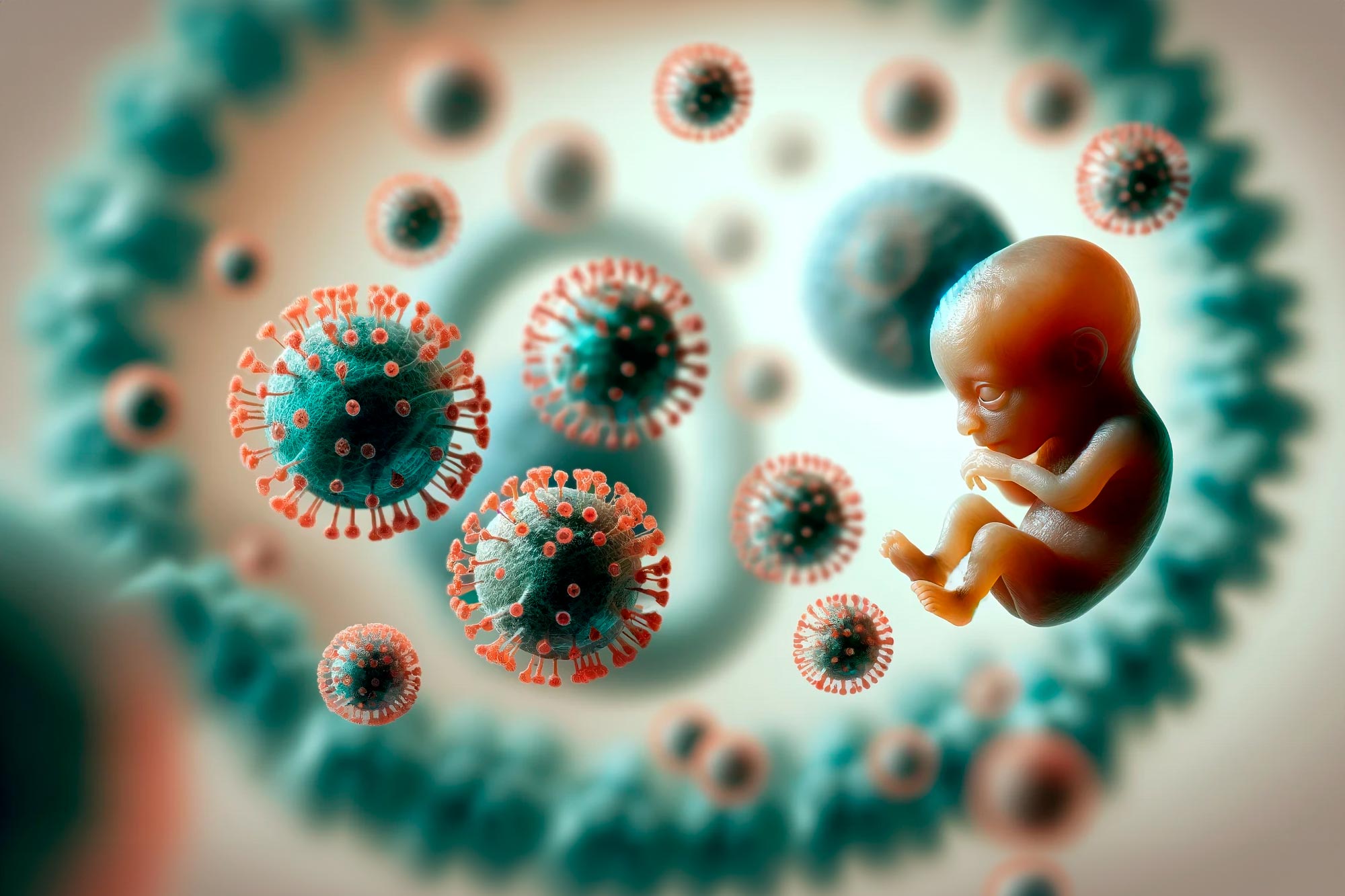
- At least 8% of the human genome is genetic material from viruses. It was considered ‘junk DNA’ until recently, but its role in human development is now known to be essential
- Researchers at the Spanish National Cancer Research Centre (CNIO) describe for the first time the role of these viruses in a key process in development, when cells become pluripotent few hours after fertilization
- The finding, published in Science Advances, is relevant for regenerative medicine and for the creation of artificial embryos
All animals have evolved thanks to the fact that certain viruses infected primitive organisms hundreds of millions of years ago. Viral genetic material was integrated into the genome of the first multi-cellular beings and is still in our DNA today. Researchers from the CNIO (Spanish National Cancer Research Centre) describe now in the journal Science Advances for the first time the role played by these viruses in a process that is absolutely vital for our development, and which occurs a few hours after fertilization: the transition to pluripotency, when the oocyte goes from having two to four cells.
Before this step, each of the two cells of the embryo is totipotent, i.e. it may develop inside an independent organism; the four cells of the next stage are not totipotent but are pluripotent, because they can differentiate into cells of any specialized tissue of the body.
For Sergio de la Rosa and Nabil Djouder, first author and senior author respectively, the finding is relevant for the field of regenerative medicine and the creation of artificial embryos, as it opens up a new way to generate stable cell lines in the totipotency phases. Djouder leads the Growth Factors, Nutrients, and Cancer Group at the CNIO.
We are 8% retrovirus
Genetic material from the now so-called ‘endogenous retroviruses’ was integrated into the genomes of organisms that may have been drivers of the Cambrian explosion, a period more than 500 million years ago when the world’s seas underwent a biodiversity boom. Over the past decade, genetic sequences from these viruses have been found to make up at least 8-10% of the human genome.
“Until recently, these viral remnants were considered to be ‘junk DNA’, genetic material that was unusable or even harmful,” explains De la Rosa. “Intuitively, it was thought that having viruses in the genome could not be good. However, in recent years we are starting to realize that these retroviruses, which have co-evolved with us over millions of years, have important functions, such as regulating other genes. It’s an extremely active field of research.”

The transition from totipotency to pluripotency, a question of pace
The research published in Science Advances shows that the MERVL endogenous retrovirus sets the pace in embryo development, especially during the specific step of the transition from totipotency to pluripotency, and explains the mechanism that makes this happen.
“It is a totally new role for endogenous retroviruses,” says Djouder. “We discovered a new mechanism that explains how an endogenous retrovirus directly controls pluripotency factors.”
This new action mechanism involves URI, a gene that Djouder’s group is researching in depth. Years ago, it was discovered that if URI is deleted in laboratory animals, embryos do not even get to develop. De la Rosa wanted to find out why, and which is how its link to the MERVL retrovirus was discovered.
A smooth transition
The findings show that one of the functions of URI is to enable the action of molecules essential for acquiring pluripotency; if URI does not act, neither do the pluripotency factors, and the cell remains in a state of totipotency. It turns out to be an endogenous retrovirus protein, MERVL-gag, which modulates the action of URI.
The researchers found that during the totipotency phase, when there are only two cells in the oocyte, expression of the MERVL-gag viral protein is high; this protein binds to URI and prevents it from acting. However, the levels gradually change, so that the levels of MERVL-gag viral protein go down and URI can enter into action: pluripotency appears.
As De la Rosa explains, “It’s a smooth transition. When there is a high expression of viral protein, there are fewer pluripotency factors; as ERV expression decreases, URI stabilizes such factors.”
Symbiotic co-evolution
“Our findings reveal symbiotic co-evolution of endogenous retroviruses with their host cells in order to guarantee the smooth and timely progression of early embryonic development,” explain the authors in Science Advances.
In other words, the three-way relationship between the viral protein, URI, and pluripotency factors is finely modulated, “to allow sufficient time for the embryo to adjust and coordinate the smooth transition from totipotency to pluripotency and cell lineage specification during embryonic development,” concludes Djouder.
Reference: “Endogenous retroviruses shape pluripotency specification in mouse embryos” by Sergio de la Rosa, María del Mar Rigual, Pierfrancesco Vargiu, Sagrario Ortega and Nabil Djouder, 24 January 2024, Science Advances.
DOI: 10.1126/sciadv.adk9394
Never miss a breakthrough: Join the SciTechDaily newsletter.
Follow us on Google and Google News.