
Close Menu
    Facebook X (Twitter) Instagram
    SciTechDaily
    • Biology
    • Chemistry
    • Earth
    • Health
    • Physics
    • Science
    • Space
    • Technology
    Facebook X (Twitter) Pinterest YouTube RSS
    SciTechDaily
    Home»Earth»Warmer Water Now Reaches Deep Into The Arctic Interior
    Earth

    Warmer Water Now Reaches Deep Into The Arctic Interior

    By Jim Shelton, Yale UniversityAugust 30, 20181 Comment2 Mins Read
    Facebook Twitter Pinterest Telegram LinkedIn WhatsApp Email Reddit
    Share
    Facebook Twitter LinkedIn Pinterest Telegram Email Reddit
    Heat Has Reached Deep Into The Arctic Interior
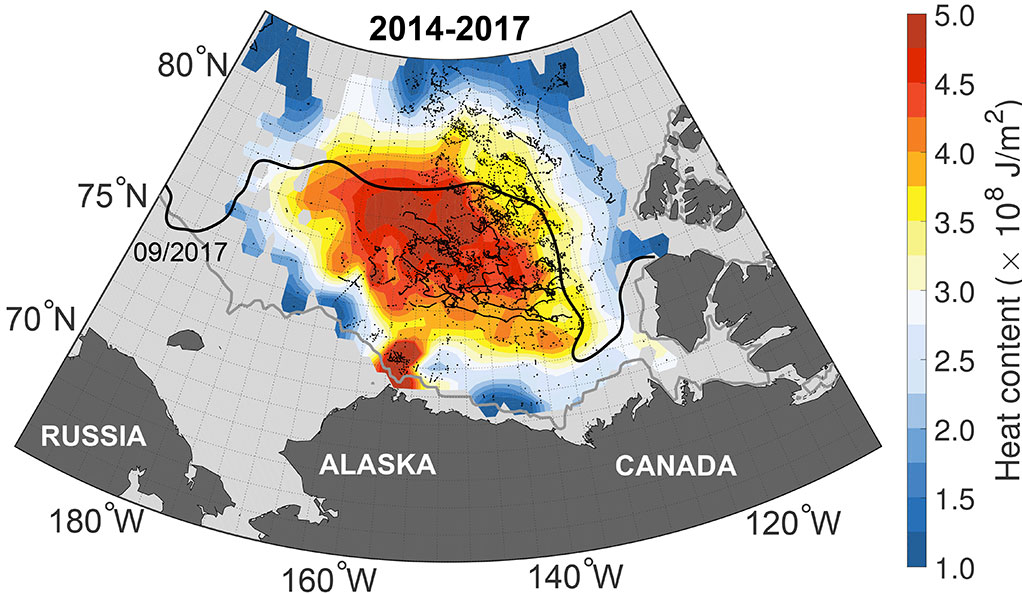
    Map of heat content in the BG warm halocline.

    Arctic sea ice isn’t just threatened by the melting of ice around its edges, a new study has found: Warmer water that originated hundreds of miles away has penetrated deep into the interior of the Arctic.

    That “archived” heat, currently trapped below the surface, has the potential to melt the region’s entire sea-ice pack if it reaches the surface, researchers say.

    The study appears online on August 29 in the journal Science Advances.

    “We document a striking ocean warming in one of the main basins of the interior Arctic Ocean, the Canadian Basin,” said lead author Mary-Louise Timmermans, a professor of geology and geophysics at Yale University.

    The upper ocean in the Canadian Basin has seen a two-fold increase in heat content over the past 30 years, the researchers said. They traced the source to waters hundreds of miles to the south, where reduced sea ice has left the surface ocean more exposed to summer solar warming. In turn, Arctic winds are driving the warmer water north, but below the surface waters.

    “This means the effects of sea-ice loss are not limited to the ice-free regions themselves, but also lead to increased heat accumulation in the interior of the Arctic Ocean that can have climate effects well beyond the summer season,” Timmermans said. “Presently this heat is trapped below the surface layer. Should it be mixed up to the surface, there is enough heat to entirely melt the sea-ice pack that covers this region for most of the year.”

    The co-authors of the study are John Toole and Richard Krishfield of the Woods Hole Oceanographic Institution.

    The National Science Foundation Division of Polar Programs provided support for the research.

    Reference: “Warming of the interior Arctic Ocean linked to sea ice losses at the basin margins” by Mary-Louise Timmermans, John Toole and Richard Krishfield, 29 August 2018, Science Advances.
    DOI: 10.1126/sciadv.aat6773

    Never miss a breakthrough: Join the SciTechDaily newsletter.
    Follow us on Google and Google News.

    Arctic Climate Science Earth Science Yale University
    Share. Facebook Twitter Pinterest LinkedIn Email Reddit

    Related Articles

    Scientists Provide Evidence for Why Earth’s Early Climate Was More Stable and Warmer

    Arctic Boreal Vulnerability Experiment Shows Arctic Carbon Cycle is Speeding Up

    Benefits Outweigh Costs of ‘Hidden’ Emissions from Wind and Solar Power

    Arctic Sea Ice Loss is Impacting Atlantic Ocean Water Circulation System

    New Study Shows Warmer Temperatures May Increase Emissions of Carbon Dioxide from Alaskan Tundra

    New Research Examines the Intersection of Weather and Climate

    NASA Shows Arctic Sea Ice Is Losing Its Bulwark Against Warming Summers

    Temperature of Ancient Seas May Shape Global Climate

    Yale Scientists Solve the Problem of Sea Ice Thickness Distribution

    1 Comment

    1. R. Wright on September 2, 2018 1:53 pm

      On August 30, 2018, shifting Arctic sea ice crushed and sank an 11 meter sailboat that was trying to make the Northwest Passage, at a location west of the middle of Greenland. Two sailors climbed onto the ice, and waited 11 hours for a helicopter to rescue them from the sea ice. The Canadian government is warning boats and ships to not attempt the Northwest Passage this year due to the current dense sea ice conditions.

      Reply
    Leave A Reply Cancel Reply

    • Facebook
    • Twitter
    • Pinterest
    • YouTube

    Don't Miss a Discovery

    Subscribe for the Latest in Science & Tech!

    Trending News

    New Study Reveals Why Ozempic Works Better for Some People Than Others

    Climate Change Is Altering a Key Greenhouse Gas in a Way Scientists Didn’t Expect

    New Study Suggests Gravitational Waves May Have Created Dark Matter

    Scientists Discover Why the Brain Gets Stuck in Schizophrenia

    Scientists Engineer “Tumor-Eating” Bacteria That Devour Cancer From Within

    Even “Failed” Diets May Deliver Long-Term Health Gains, Study Finds

    NIH Scientists Discover Powerful New Opioid That Relieves Pain Without Dangerous Side Effects

    Collapsing Plasma May Hold the Key to Cosmic Magnetism

    Follow SciTechDaily
    • Facebook
    • Twitter
    • YouTube
    • Pinterest
    • Newsletter
    • RSS
    SciTech News
    • Biology News
    • Chemistry News
    • Earth News
    • Health News
    • Physics News
    • Science News
    • Space News
    • Technology News
    Recent Posts
    • “Pretty Close to Home”: The Hidden Earthquake Threat Beneath Seattle
    • The Surprising Reason You Might Want To Sleep Without a Pillow
    • Household Cats Could Hold the Secret to Fighting Breast Cancer
    • Scientists Say This Natural Hormone Reverses Obesity by Targeting the Brain
    • This 15,000-Year-Old Discovery Changes What We Know About Early Human Creativity
    Copyright © 1998 - 2026 SciTechDaily. All Rights Reserved.
    • Science News
    • About
    • Contact
    • Editorial Board
    • Privacy Policy
    • Terms of Use

    Type above and press Enter to search. Press Esc to cancel.