
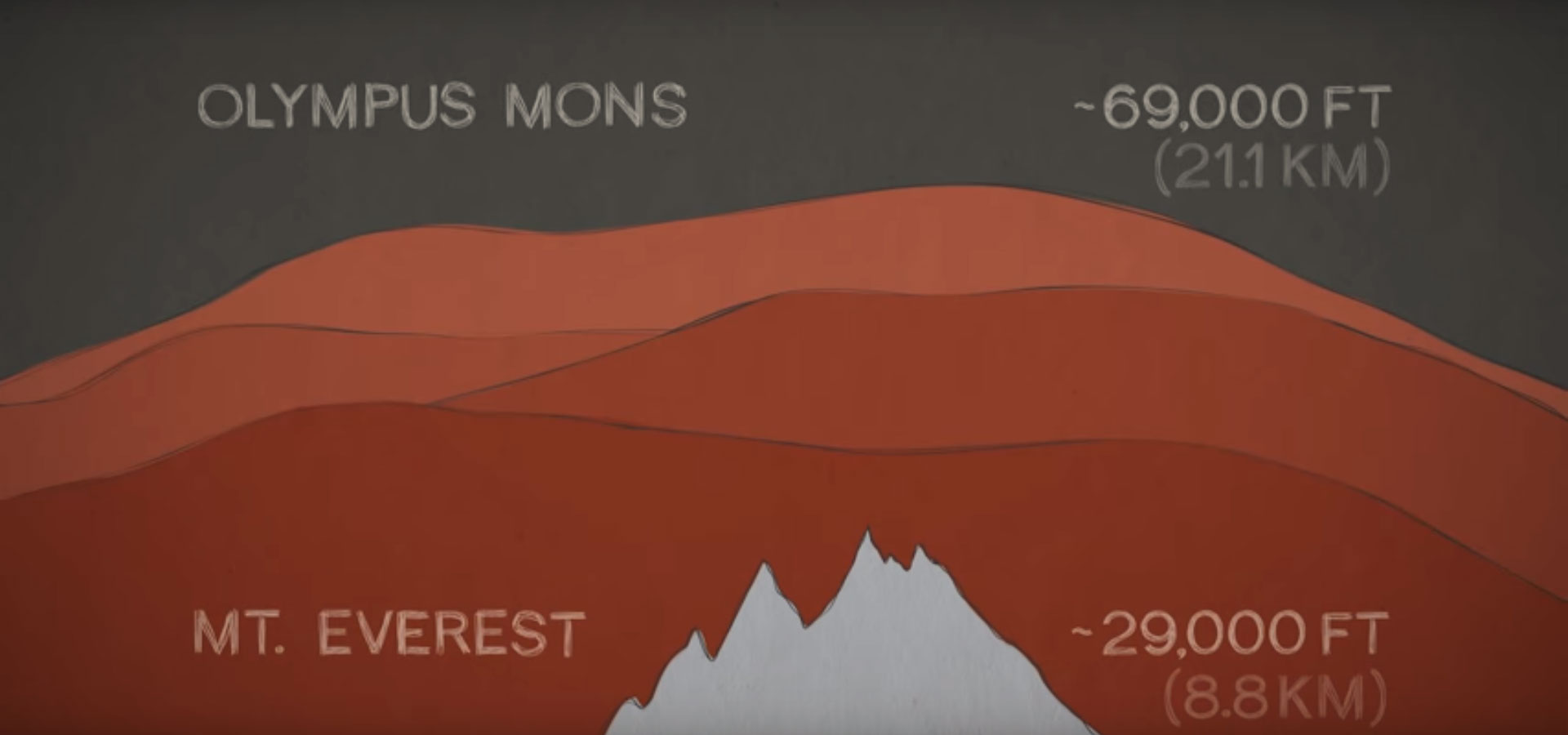
Ambitious climbers, forget Mt. Everest. Dream about Mars.
The Red Planet has some of the tallest mountains in the solar system. They include Olympus Mons, a volcano nearly three times the height of Everest. It borders a region called the Tharsis plateau, where three equally awe-inspiring volcanoes dominate the landscape.
But what geologic processes created these features on the Martian surface? Scientists have long wondered — and may soon know more.
NASA and DLR (German Aerospace Center) plan to take the planet’s temperature for the first time ever, measuring how heat flows out of the planet and drives this inspiring geology. Detecting this escaping heat will be a crucial part of a mission called InSight (Interior Exploration using Seismic Investigations, Geodesy and Heat Transport), managed by NASA’s Jet Propulsion Laboratory in Pasadena, California.
Why are the tallest peaks in the solar system found on one of its smallest worlds? Like any planet, how Mars looks outside is tied to what goes on inside. Dig into planetary formation in this 60-second video and by visiting mars.nasa.gov/insight .
InSight will be the first mission to study Mars’ deep interior, using its Heat Flow and Physical Properties Package (HP3) instrument to measure heat as it is conducted from the interior to the planet’s surface. This energy was in part captured when Mars formed more than 4 billion years ago, preserving a record of its creation. That energy is also due to the decay of radioactive elements in the rocky interior.
The way heat moves through a planet’s mantle and crust determines what surface features it will have, said Sue Smrekar of JPL, the mission’s deputy principal investigator and the deputy lead for HP3.
“Most of the planet’s geology is a result of heat,” Smrekar said. “Volcanic eruptions in the ancient past were driven by the flow of this heat, pushing up and constructing the towering mountains Mars is famous for.”
A mole for Mars
While scientists have modeled the interior structure of Mars, InSight will provide the first opportunity to find ground truth — by literally looking below the ground.
HP3, built and operated by DLR, will be placed on the Martian surface after InSight lands on November 26, 2018. A probe called a mole will pummel the ground, burying itself and dragging a tether behind it. Temperature sensors embedded in this tether will measure the natural internal heat of Mars.
That’s no easy task. The mole has to burrow deep enough to escape the wide temperature swings of the Martian surface. Even the spacecraft’s own “body heat” could affect HP3’s super-sensitive readings.
“If the mole gets stuck higher up than expected, we can still measure the temperature variation,” said HP3 investigation lead Tilman Spohn of DLR. “Our data will have more noise, but we can subtract out daily and seasonal weather variations by comparing it with ground-temperature measurements.”
In addition to burrowing, the mole will give off heat pulses. Scientists will study how quickly the mole warms the surrounding rock, allowing them to figure out how well heat is conducted by the rock grains at the landing site. Densely packed grains conduct heat better — an important piece of the equation for determining Mars’ internal energy.
Cooking up a new planet
For an example of planetary heat flow, imagine a pot of water on a stove.
As water heats, it expands, becomes less dense, and rises. The cooler, denser water sinks to the bottom, where it heats up. This cycling of cool to hot is called convection. The same thing happens inside a planet, churning rock over millions of years.
Just as expanding bubbles can push off a pot lid, volcanoes are lids being blown off the top of a world. They shape a planet’s surface in the process. Most of the atmosphere on rocky planets forms as volcanoes expel gas from deep below. Some of Mars’ biggest dry river beds are believed to have formed when the Tharsis volcanoes spewed gas into the atmosphere. That gas contained water vapor, which cooled into liquid and may have formed the channels surrounding Tharsis.
The smaller the planet, the faster it loses its original heat. Since Mars is only one-third the size of Earth, most of its heat was lost early in its history. Most Martian geologic activity, including volcanism, occurred in the planet’s first billion years.
“We want to know what drove the early volcanism and climate change on Mars,” Spohn said. “How much heat did Mars start with? How much was left to drive its volcanism?”
NASA’s orbiters have given scientists a “macro” view of the planet, allowing them to study Martian geology from above. HP3 will offer a first look at the inside of Mars.
“Planets are kind of like an engine, driven by heat that moves their internal parts around,” Smrekar said. “With HP3, we’ll be lifting the hood on Mars’ engine for the first time.”
What scientists learn during the InSight mission won’t just apply to Mars. It will teach them how all rocky planets formed — including Earth, its Moon, and even planets in other solar systems.
Never miss a breakthrough: Join the SciTechDaily newsletter.
Follow us on Google and Google News.