
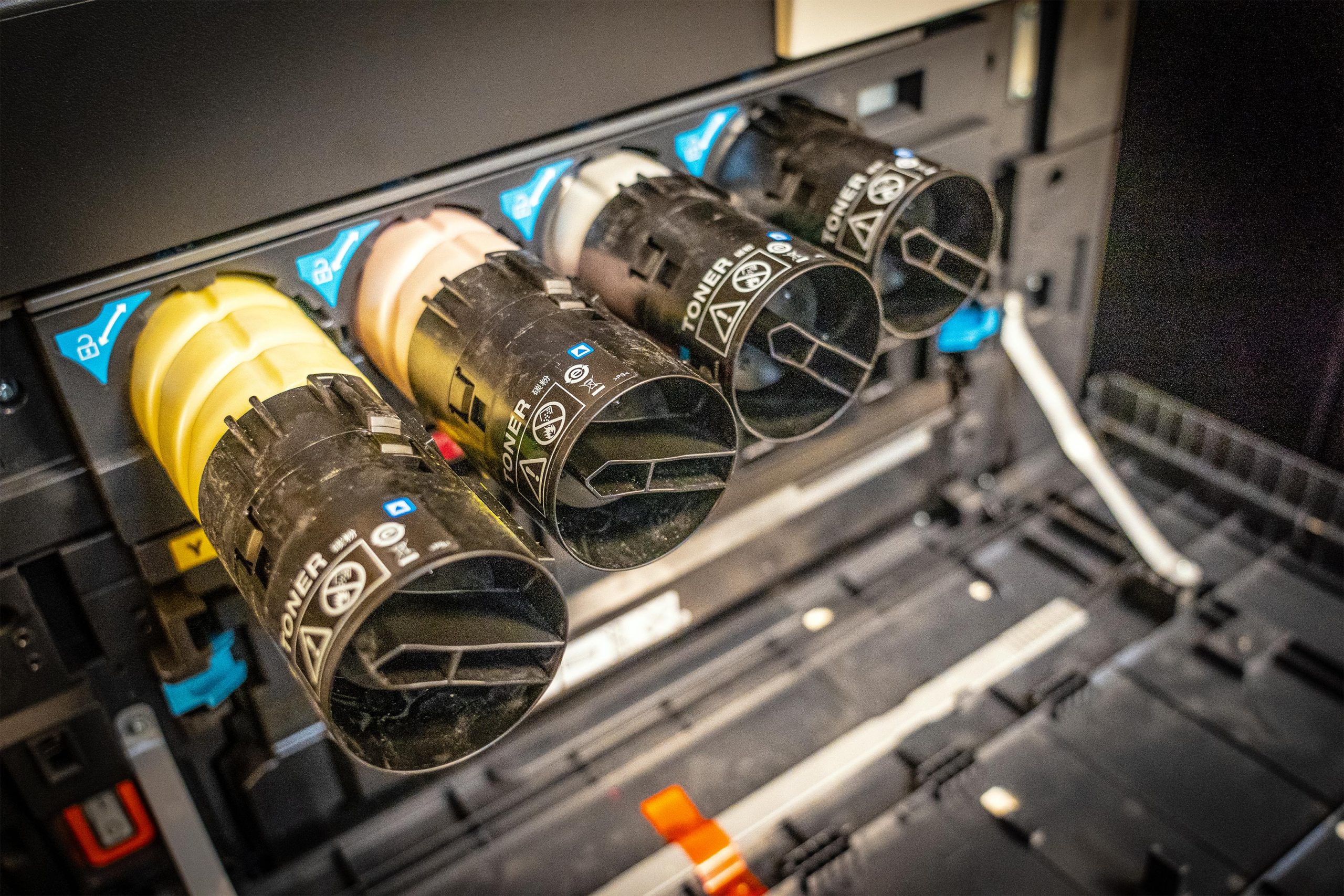
Getting printer toner on your hands is annoying. Getting it in your lungs may be dangerous.
According to a new study by West Virginia University researcher Nancy Lan Guo, the microscopic toner nanoparticles that waft from laser printers may change our genetic and metabolic profiles in ways that make disease more likely. Her findings appear in the International Journal of Molecular Sciences.
“The changes are very significant from day one,” said Guo, a professor in the School of Public Health and member of the Cancer Institute.
Guo and her colleagues placed rat models into the same chamber as a typical laser printer. The models stayed in the chamber for five hours a day, for 21 days, as the printer ran nonstop.
“The changes are very significant from day one.” Nancy Lan Guo
“It’s equivalent to an occupational setting,” Guo said. “A rat’s life expectancy is about one or two years. In our life, that would be more like four or eight years of five-hour-a-day exposure.”
Periodically, the researchers assessed the rats’ lung cells and blood to see if their genetic material had changed. The assessments took place every four days for 21 days. The analysis comprised every gene in the rat genome.
If something alters a rat’s—or a person’s—genetic material, it can disrupt how cells make proteins. And protein production is crucial to life itself. From lugging a load of laundry upstairs, to maintaining a regular heartbeat, “we do everything because certain proteins function in certain ways,” Guo said.

She and her team discovered that a single day of toner-particle exposure was enough to disturb the activity of genes associated with metabolism, immune response, and other essential biological processes in the rat models. Overall—taking into account all 21 days of exposure and testing—the researchers observed genomic changes linked to cardiovascular, neurological, and metabolic disorders.
“I don’t want to alarm people,” Guo said, “but special ventilation and exposure controls should be installed in rooms where laser printers are in heavy-duty use, because the concentration of nanoparticles released in the air during the printing and copying process is strongly correlated with the printing activities.
“In particular, there is one group I really think should know about this: pregnant women. Because once a lot of these genes are changed, they get passed on through the generations. It’s not just you.”
On the same days that the researchers assessed the rats’ genes, they also measured every metabolite available in their blood.
Metabolites are the molecules that emerge as the body digests food and uses it for fuel.
“Let’s say we eat something,” Guo said. “Where does the food go? It goes to metabolites. It gets absorbed. All these metabolites are involved in our function.”
The human body contains thousands of different metabolites, in fluctuating amounts. Some—like glucose—give us energy. Others—like oleic acid—help us create fatty acids.
The metabolic levels that the researchers detected reinforced their other findings. The same health risks that the genetic profiles pointed to were implicated by the metabolic profiles as well.
Building on these results, Guo and her colleagues have since investigated the genomic changes that Singaporean printing company workers have experienced. In many respects, the workers’ genomes changed the same way the rats’ genomes did. The results from these workers are included in a manuscript ready for submission to a journal.
“And they’re very young,” Guo said. “A lot of the workers ranged from 20 to their early 30s, and you’re already starting to see all of these changes.
“We have to work, right? Who doesn’t have a printer nowadays, either at home or at the office? But now, if I have a lot to print, I don’t use the printer in my office. I print it in the hallway.”
Reference: “Integrated Transcriptomics, Metabolomics, and Lipidomics Profiling in Rat Lung, Blood, and Serum for Assessment of Laser Printer-Emitted Nanoparticle Inhalation Exposure-Induced Disease Risks” by Nancy Lan Guo, Tuang Yeow Poh, Sandra Pirela, Mariana T. Farcas, Sanjay H. Chotirmall, Wai Kin Tham, Sunil S. Adav, Qing Ye, Yongyue Wei, Sipeng Shen, David C. Christiani, Kee Woei Ng, Treye Thomas, Yong Qian and Philip Demokritou, 16 December 2019, International Journal of Molecular Sciences.
DOI: 10.3390/ijms20246348
Research reported in this publication was supported by the National Institute for Occupational Safety and Health and the Consumer Protection Safety Commission (1007514R) and the NTU‐Harvard School of Public Health Initiative for Sustainable Nanotechnology (NTU‐HSPH 17001). The content is solely the responsibility of the authors and does not necessarily represent the official views of NIOSH or NTU-HSPH.
Never miss a breakthrough: Join the SciTechDaily newsletter.
Follow us on Google and Google News.