
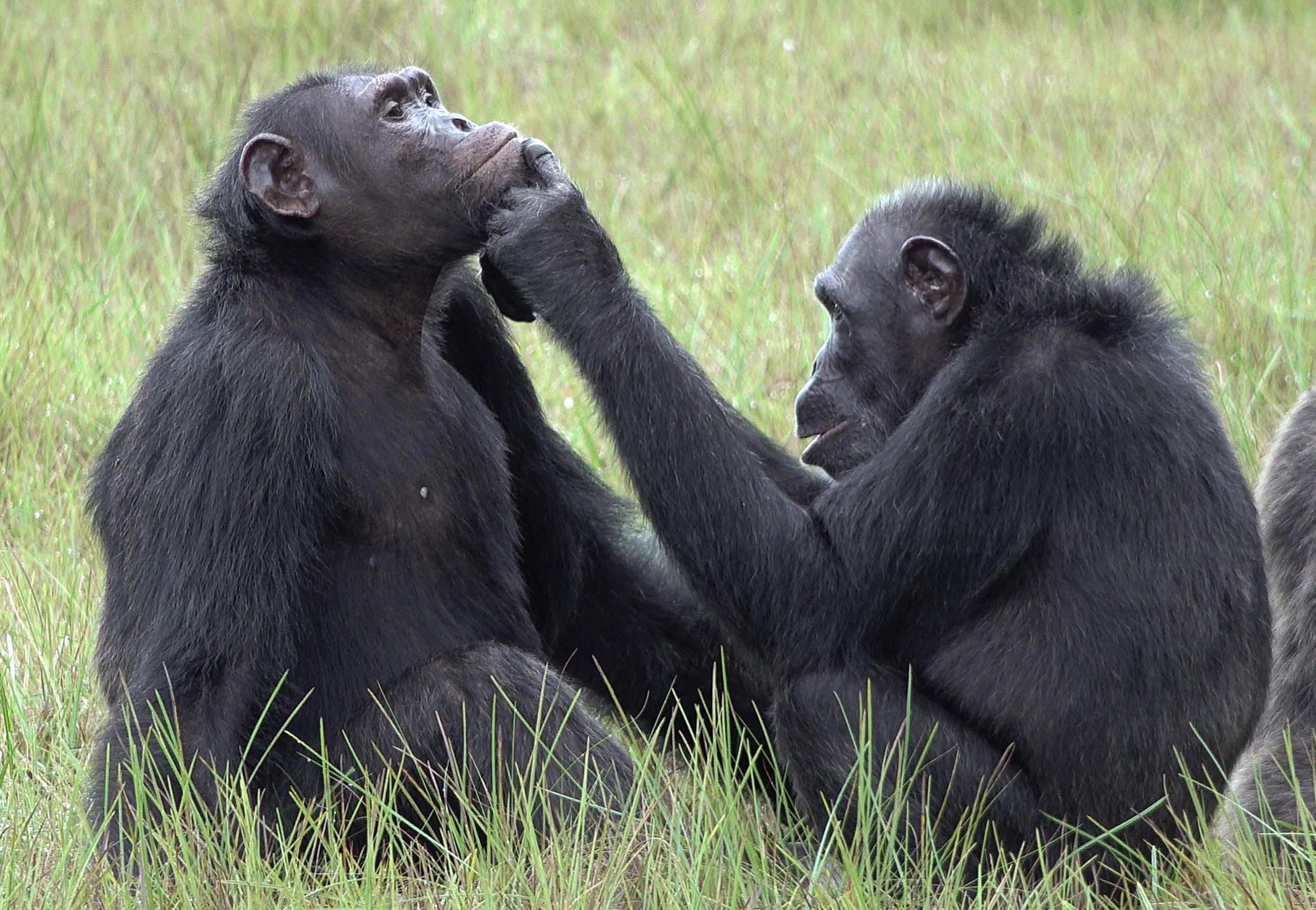
Chimpanzees were seen using insects for wound treatment, reflecting possible empathy-driven prosocial behavior.
For the first time, researchers observed chimpanzees in Gabon, West Africa applying insects to their wounds and the wounds of others. In a study published on February 7, 2022, in the journal Current Biology, scientists describe this wound-tending behavior and argue that it’s evidence that chimpanzees have the capacity for prosocial behaviors that are connected to empathy in humans.
In November 2019, Alessandra Mascaro, a volunteer at the Ozouga Chimpanzee Project, observed a chimpanzee named Suzee inspecting a wound on the foot of her adolescent son, Sia, catching an insect out of the air, putting it into her mouth, and then applying it onto the wound. Researchers of the Ozouga Chimpanzee Project had been studying this group of chimpanzees in Loango National Park for 7 years but hadn’t witnessed behavior like this before. Mascaro took a video of the mother and son and showed it to her supervisors, Tobias Deschner, a primatologist with the project, and Simone Pika, a cognitive biologist at Osnabrück University.
“In the video, you can see that Suzee is first looking at the foot of her son, and then it’s as if she is thinking, ‘What could I do?’ and then she looks up, sees the insect, and catches it for her son,’” Mascaro says. The Ozouga team started to monitor the chimpanzees for this type of wound-tending behavior, and over the next 15 months documented 76 cases of the group applying insects to wounds on themselves and others.
Insect Applications and Self-Medication in Nonhuman Animals
This wasn’t the first time that nonhuman animals had been observed self-medicating. Researchers have reported that bears, elephants, and bees do it too. What is remarkable is that so far, insect applications have never been observed and that the chimps not only treat their own, but also the wounds of others.
Pika argues that the act of applying an insect to another’s wounds is a clear example of prosocial behavior—behavior that acts in the best interests of others, rather than just oneself. “This is, for me, especially breathtaking because so many people doubt prosocial abilities in other animals,” she says. “Suddenly we have a species where we really see individuals caring for others.”
The research team doesn’t know exactly which insects the chimpanzees are using or what their medicinal properties are. “Humans use many species of insect as remedies against sickness—there have been studies showing that insects can have antibiotic, antiviral, and anthelmintic functions,” says Pika. The researchers have also theorized that the insects might have soothing properties that could provide pain relief.
The Ozouga team now aims to identify the insects being used by the chimpanzees and to document who is applying insects to whom. “Studying great apes in their natural environments is crucial to shed light on our own cognitive evolution,” says Deschner. “We need to still put much more effort into studying and protecting them and also protecting their natural habitats.”
For more on this research, see Chimpanzees Observed Applying Insects to Wounds.
Reference: “Application of insects to wounds of self and others by chimpanzees in the wild” by Alessandra Mascaro and Lara M. Sout, 7 February 2022, Current Biology.
DOI: 10.1016/j.cub.2021.12.045
This work was supported by the Max Planck Society and the European Research Council.
Never miss a breakthrough: Join the SciTechDaily newsletter.
Follow us on Google and Google News.
4 Comments
Interesting article about chimps applying insects to wounds.
Poor bugs can’t catch a break. They are eaten, stepped on, squashed and now used as band aids.
I have observed a when I was growing up that domestic dogs eat a certain type of grass when they are sick. It enduced them to vomit thus makes them feels better or help them get well. I have observed these several times.
Not very pro-social to not note what kind of insects. Such information might have benefitted their own species.