

NASA’s PUNCH mission, unveiled at an astronomical meeting, uses a four-satellite system to deliver stunning early images of CMEs and solar wind in motion. The spacecraft are poised to revolutionize our understanding of space weather in the coming months.
At a recent astronomy conference in Anchorage, Alaska, Dr. Craig DeForest of the Southwest Research Institute shared exciting early results from NASA’s PUNCH mission. Short for Polarimeter to Unify the Corona and Heliosphere, PUNCH is revealing powerful solar eruptions, known as coronal mass ejections (CMEs), as they burst from the Sun and race across the inner solar system.
“These preliminary movies show that PUNCH can actually track space weather across the solar system and view the corona and solar wind as a single system,” said DeForest, PUNCH principal investigator from SwRI’s Space Science and Exploration Division in Boulder, Colorado. “This big-picture view is essential to helping scientists better understand and predict space weather driven by CMEs, which can disrupt communications, endanger satellites, and create auroras at Earth.”
A Virtual Telescope Spanning 8,000 Miles
PUNCH is made up of four small, suitcase-sized spacecraft that work together like one giant camera spread 8,000 miles apart. This virtual telescope images the Sun’s outer layers as they transition into the solar wind—the stream of charged particles that constantly flows through our solar system.
“These first integrated images of our home in space are astonishing, but the best is yet to come,” DeForest said. “Once the spacecraft are in their final formation and the ground processing is fully sighted over the next few months, we’ll be able to track the solar wind and space weather in 3D throughout our neighborhood in space.”
Imaging CMEs Like Never Before
The SwRI-developed and -led Wide Field Imagers aboard three of the four PUNCH spacecraft collected high-resolution images of entire CMEs in greater detail than previously possible. These instruments are designed to observe the faint, outermost portion of the Sun’s atmosphere and solar wind.
Images of a June CME from PUNCH’s coronagraph, the Narrow Field Imager, aboard the fourth spacecraft allow scientists to see the details of the Sun’s atmosphere by blocking the Sun’s bright face.
On March 11, PUNCH launched into polar orbit to make global, 3D observations of the Sun’s outer atmosphere and the inner solar system to help understand how material released from the Sun becomes the solar wind. The mission will also provide scientists with new data about how potentially disruptive events from the Sun, like solar flares and CMEs, form and evolve. This information could lead to more accurate predictions about the arrival of space weather at Earth and how it impacts assets and explorers in space.
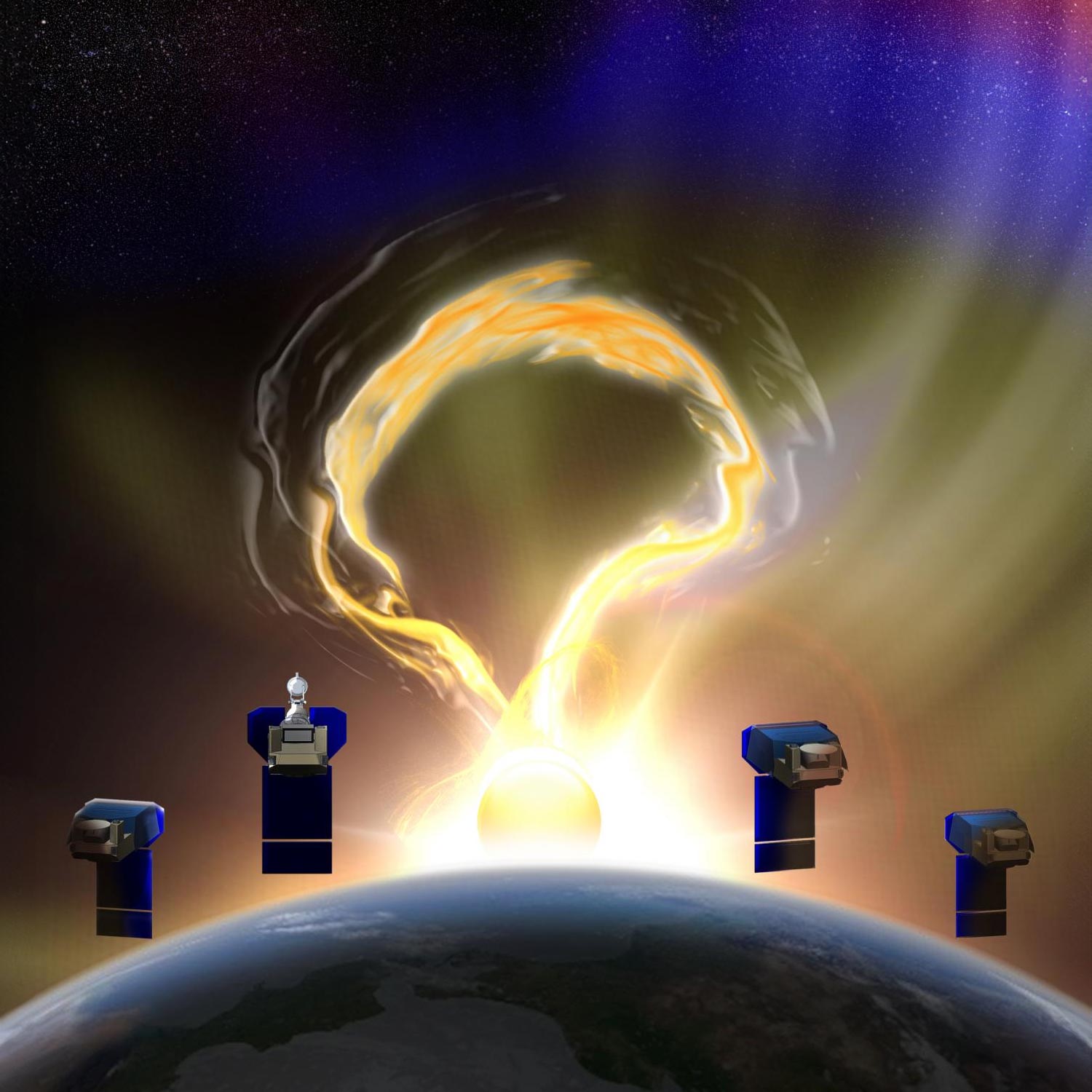
PUNCH (Polarimeter to Unify the Corona and Heliosphere) is a NASA mission designed to study how the Sun’s outer atmosphere, or corona, connects to the solar wind that fills our solar system. Using a formation of four suitcase-sized satellites flying in precise formation, PUNCH captures detailed, continuous images of solar phenomena such as coronal mass ejections (CMEs) as they erupt and travel through space. These observations help scientists better understand—and eventually predict—space weather that can affect Earth and space-based technologies.
The mission is led by Southwest Research Institute (SwRI), headquartered in San Antonio, Texas, with spacecraft operations conducted from SwRI’s Boulder, Colorado facilities. PUNCH is managed under NASA’s Explorers Program Office at Goddard Space Flight Center in Greenbelt, Maryland, on behalf of the Science Mission Directorate at NASA Headquarters in Washington, D.C.
Never miss a breakthrough: Join the SciTechDaily newsletter.
Follow us on Google and Google News.