
Close Menu
    Facebook X (Twitter) Instagram
    SciTechDaily
    • Biology
    • Chemistry
    • Earth
    • Health
    • Physics
    • Science
    • Space
    • Technology
    Facebook X (Twitter) Pinterest YouTube RSS
    SciTechDaily
    Home»Space»Watch NASA’s Lucy Slingshot Past Earth on a Bold Journey to Jupiter’s Ancient Asteroids
    Space

    Watch NASA’s Lucy Slingshot Past Earth on a Bold Journey to Jupiter’s Ancient Asteroids

    By NASADecember 11, 2024No Comments5 Mins Read
    Facebook Twitter Pinterest Telegram LinkedIn WhatsApp Email Reddit
    Share
    Facebook Twitter LinkedIn Pinterest Telegram Email Reddit
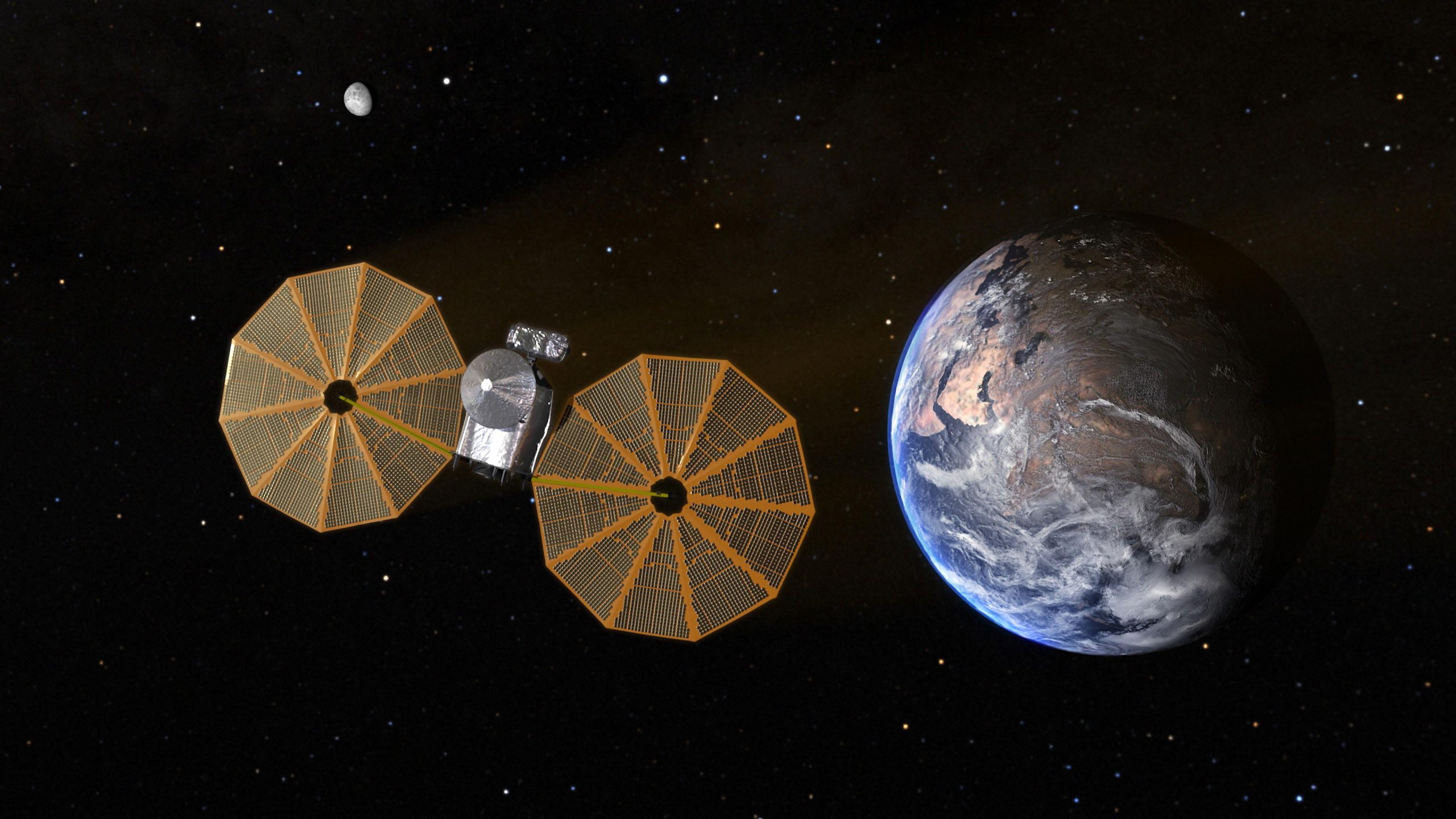
    NASA’s Lucy Earth
    On December 12, NASA’s Lucy spacecraft will use Earth’s gravity to redirect its course toward Jupiter’s Trojan asteroids, marking a key point in its extensive mission to explore distant asteroid groups. Credit: NASA’s Goddard Space Flight Center

    NASA’s Lucy spacecraft will perform a close flyby of Earth on December 12, utilizing a gravity assist to adjust its trajectory towards the Jupiter Trojan asteroids.

    This maneuver, the second such assist in its 12-year mission, follows an initial gravity boost in 2022. The spacecraft will pass only 220 miles above Earth, positioning it for subsequent encounters with main belt and Trojan asteroids. Observers may glimpse Lucy using telescopes in specific locations, though instrument calibrations will be inactive during this pass.

    Lucy’s Close Encounter with Earth

    On December 12 at 11:15 p.m. EST, NASA’s Lucy spacecraft will pass just 220 miles (360 kilometers) above Earth’s surface, skimming the planet’s atmosphere. This close flyby, known as a “gravity assist,” will adjust Lucy’s trajectory, sending it through the main asteroid belt and toward the Jupiter Trojan asteroids — a group of small celestial bodies that share Jupiter’s orbit around the Sun but have never been explored before.
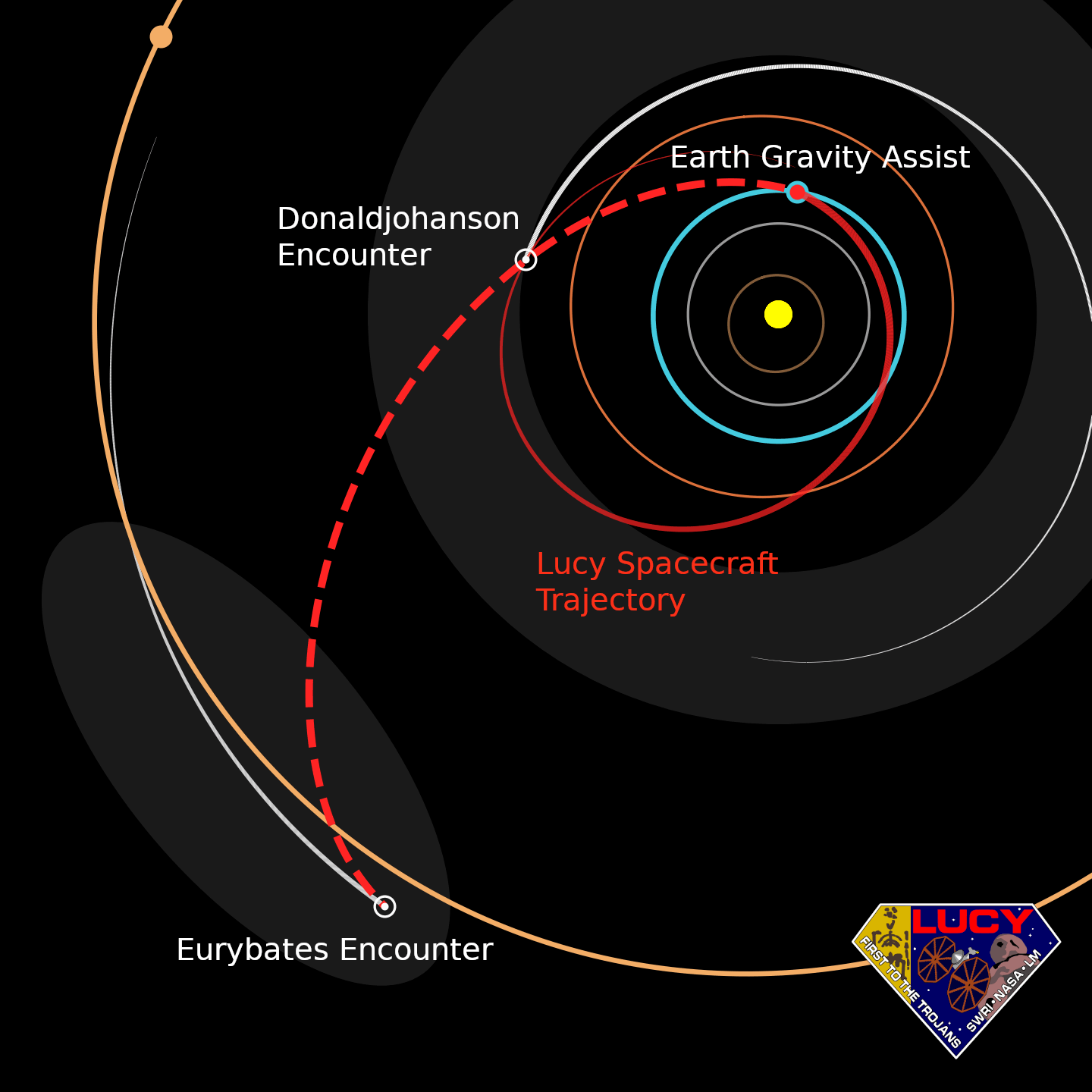
    NASA Lucy Spacecraft’s Second Earth Gravity Assist
    NASA Lucy Spacecraft’s second Earth gravity assist (EGA) dramatically alters the spacecraft’s trajectory, enabling it to travel through the Jupiter Trojan asteroids. Lucy’s trajectory prior to the EGA is shown in solid red, while the trajectory afterward is shown by a dashed red curve. The orbits of the nearby planets are shown for reference, and the grey regions indicate the approximate location of the main asteroid belt and the leading (L4) Jupiter trojan asteroids. The main belt asteroid, Donaldjohanson, and the Trojan asteroid, Eurybates, are shown at the time of Lucy’s encounters. Credit: NASA/SwRI

    This will be Lucy’s second Earth gravity assist, occurring three years into its planned 12-year mission. The first gravity assist took place on October 16, 2022, boosting the spacecraft from a one-year solar orbit into its current two-year orbit, which extends into the inner edge of the main asteroid belt. That maneuver set up Lucy’s first asteroid encounter with the small asteroid Dinkinesh and its companion, Selam.

    The upcoming gravity assist will propel Lucy into a six-year orbit that will take it deeper into the main asteroid belt, where it will pass the asteroid Donaldjohanson. From there, Lucy will head toward the Jupiter Trojan asteroids, beginning its first encounter with the leading group of these ancient bodies in 2027.

    Observational Challenges and Safety Measures

    During the gravity assist, the Lucy spacecraft, from Earth’s perspective, will approach from the direction of the Sun. This means that observers on Earth will not be able to see Lucy approaching, as it will be lost in the Sun’s glare.

    Lucy’s trajectory will bring the spacecraft very close to the Earth, even lower in altitude than the International Space Station (ISS). To ensure the safety of the spacecraft as it passes through this region full of Earth-orbiting satellites and debris, NASA has procedures to anticipate and avoid potential collisions.

    If needed, the spacecraft will execute a small trajectory correction maneuver 12 hours before closest approach to alter the time of closest approach by 1 or 2 seconds — enough to avoid a potential collision.

    NASA Lucy Spacecraft’s Second Earth Gravity Assist Trajectory
    The trajectory of NASA’s Lucy spacecraft during its second Earth gravity assist on December 12, 2024, as seen looking down on the Earth. The dots along the trajectory mark the position of the spacecraft every 10 minutes. Credit: NASA/SwRI.

    Shortly after sunset, keen observers in the Hawaiian Islands may be able to catch a glimpse of Lucy as the spacecraft approaches Earth before it passes into Earth’s shadow at 6:14 p.m. HST. Lucy will speed over the continental U.S. in darkness, traveling over 33,000 miles per hour (14.8 kilometers per second), and emerge from Earth’s shadow 20 minutes later at 11:34 p.m. EST.

    At that time, Lucy may be visible to observers with a telescope in the western regions of Africa and the eastern regions of South America as sunlight reflects off the spacecraft’s large solar panels (observers in the eastern United States will be looking at the much dimmer “back” side of the solar panels, making Lucy harder to see; go here for more information about observing Lucy during this gravity assist).

    Lucy will then rapidly recede from Earth and return to interplanetary space, the gravity assist having increased the spacecraft’s speed with respect to the Sun by over 16,000 miles per hour (7.31 kilometers per second).

    Upcoming Encounters and Instrument Calibration

    During the first Earth gravity assist in 2022, the spacecraft imaged the Earth and the Moon as part of an instrument calibration. As no further calibrations are needed at this time, the instruments will be off during this encounter. Lucy’s next asteroid encounter will be with the small main belt asteroid Donaldjohanson on April 20, 2025.

    Never miss a breakthrough: Join the SciTechDaily newsletter.
    Follow us on Google and Google News.

    Lucy Mission NASA NASA Goddard Space Flight Center
    Share. Facebook Twitter Pinterest LinkedIn Email Reddit

    Related Articles

    NASA’s Lucy Captures Ice Cream Cone–Shaped Asteroid That Defies Expectations

    Launch Preparations Underway for NASA’s First Mission to the Trojan Asteroids

    NASA Lucy Mission’s Message – Not for Unknown Aliens – But for the Future

    NASA’s Lucy Spacecraft Stretches Its Wings in Successful Solar Panel Deployment Test

    The Fascinating Story of How the Trojan Asteroids – Target of NASA’s Lucy Mission – Were Discovered and Named

    NASA’s Lucy Mission to the Trojan Asteroids Integrates its Second Scientific Instrument

    “Eagle Eyes” – First Scientific Instrument Installed on NASA’s Lucy Spacecraft

    NASA’s First Mission to Explore the Trojan Asteroids Passes Critical Milestone

    NASA’s Mission to Jupiter’s Trojan Asteroids Confirms Discovery of “Bonus” Exploration Opportunity

    Leave A Reply Cancel Reply

    • Facebook
    • Twitter
    • Pinterest
    • YouTube

    Don't Miss a Discovery

    Subscribe for the Latest in Science & Tech!

    Trending News

    New Study Reveals Why Ozempic Works Better for Some People Than Others

    Climate Change Is Altering a Key Greenhouse Gas in a Way Scientists Didn’t Expect

    New Study Suggests Gravitational Waves May Have Created Dark Matter

    Scientists Discover Why the Brain Gets Stuck in Schizophrenia

    Scientists Engineer “Tumor-Eating” Bacteria That Devour Cancer From Within

    Even “Failed” Diets May Deliver Long-Term Health Gains, Study Finds

    NIH Scientists Discover Powerful New Opioid That Relieves Pain Without Dangerous Side Effects

    Collapsing Plasma May Hold the Key to Cosmic Magnetism

    Follow SciTechDaily
    • Facebook
    • Twitter
    • YouTube
    • Pinterest
    • Newsletter
    • RSS
    SciTech News
    • Biology News
    • Chemistry News
    • Earth News
    • Health News
    • Physics News
    • Science News
    • Space News
    • Technology News
    Recent Posts
    • This 15,000-Year-Old Discovery Changes What We Know About Early Human Creativity
    • 35-Million-Year-Old Mystery: Strange Arachnid Discovered Preserved in Amber
    • Revolutionary Gas Turbine Generates Power Without Air Compression
    • Is AI Really Just a Tool? It Could Be Altering How You See Reality
    • JWST Reveals a “Forbidden” Planet With a Baffling Composition
    Copyright © 1998 - 2026 SciTechDaily. All Rights Reserved.
    • Science News
    • About
    • Contact
    • Editorial Board
    • Privacy Policy
    • Terms of Use

    Type above and press Enter to search. Press Esc to cancel.