
Close Menu
    Facebook X (Twitter) Instagram
    SciTechDaily
    • Biology
    • Chemistry
    • Earth
    • Health
    • Physics
    • Science
    • Space
    • Technology
    Facebook X (Twitter) Pinterest YouTube RSS
    SciTechDaily
    Home»Space»Launch Preparations Underway for NASA’s First Mission to the Trojan Asteroids
    Space

    Launch Preparations Underway for NASA’s First Mission to the Trojan Asteroids

    By NASA’s Goddard Space Flight CenterAugust 4, 2021No Comments4 Mins Read
    Facebook Twitter Pinterest Telegram LinkedIn WhatsApp Email Reddit
    Share
    Facebook Twitter LinkedIn Pinterest Telegram Email Reddit
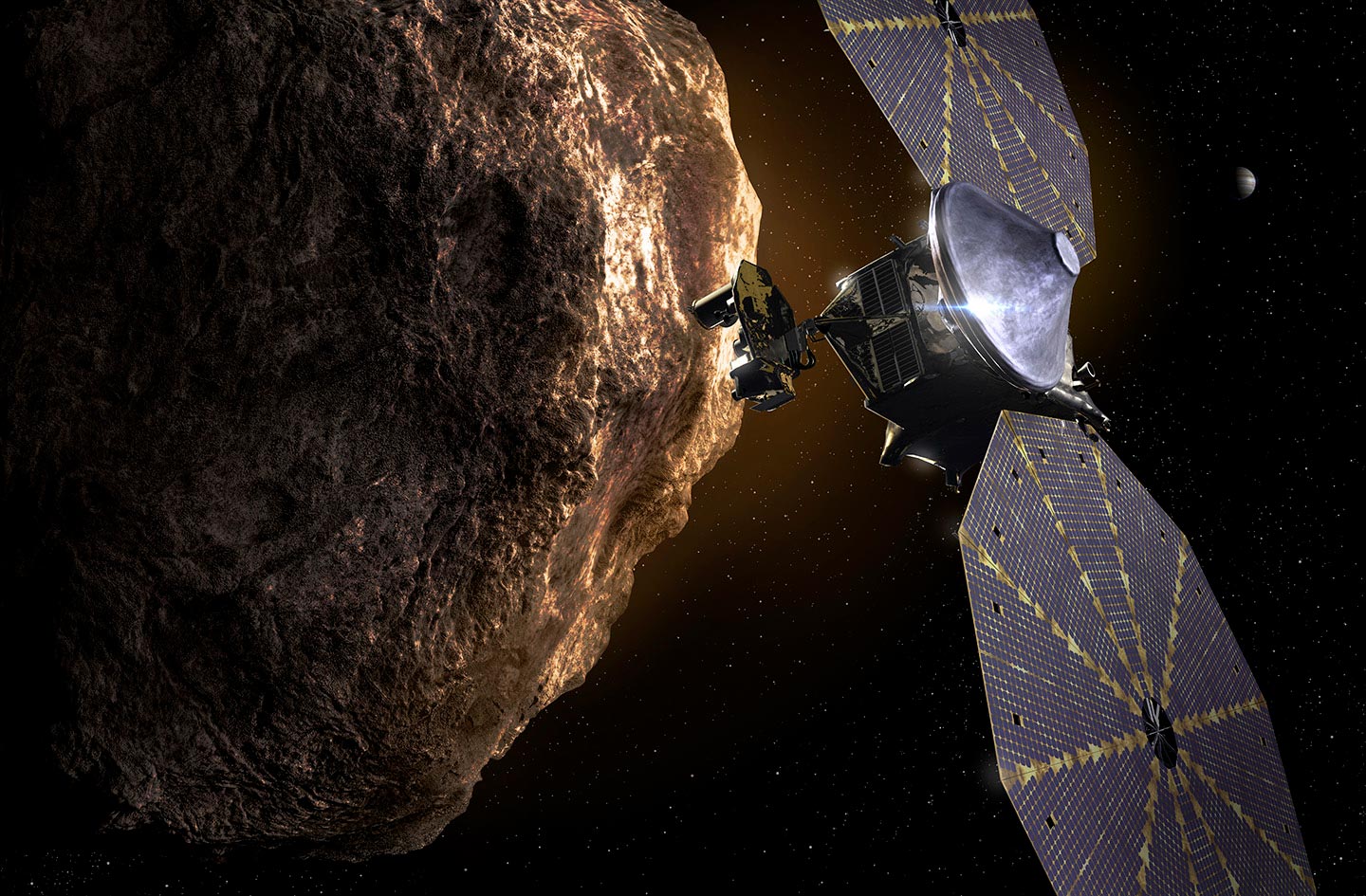
    Lucy Spacecraft at Trojan Asteroid
    Artist’s concept of Lucy spacecraft at Trojan asteroid. Credit: NASA

    NASA’s first spacecraft to explore the Trojan asteroids arrived Friday, July 30, at the agency’s Kennedy Space Center (KSC) in Florida. It is now in a cleanroom at nearby Astrotech, ready to begin final preparations for its October launch.

    The mission has a 23-day launch period beginning on October 16. Lucy will undergo final testing and fueling prior to being moved to its launch pad at Cape Canaveral Space Force Station.

    “The coronavirus pandemic required us to re-engineer the way we conducted assembly, integration, and testing,” said Donya Douglas-Bradshaw, Lucy project manager at NASA’s Goddard Space Flight Center in Greenbelt, Maryland. “When I think about where the project was a year ago and the challenges we faced, I couldn’t be prouder of the entire team. The fact that the spacecraft is safely at KSC is a testament to the sacrifice and dedication shown by every member of the team and their families.”

    The Lucy mission is the first space mission to explore a diverse population of small bodies known as the Jupiter Trojan asteroids. These small bodies are remnants of our early solar system, now trapped in stable orbits associated with the giant planet Jupiter, forming two “swarms” that lead in front of and trail behind Jupiter in its path around the Sun. These orbits are clustered around stable points of gravitational equilibrium known as Lagrange Points.
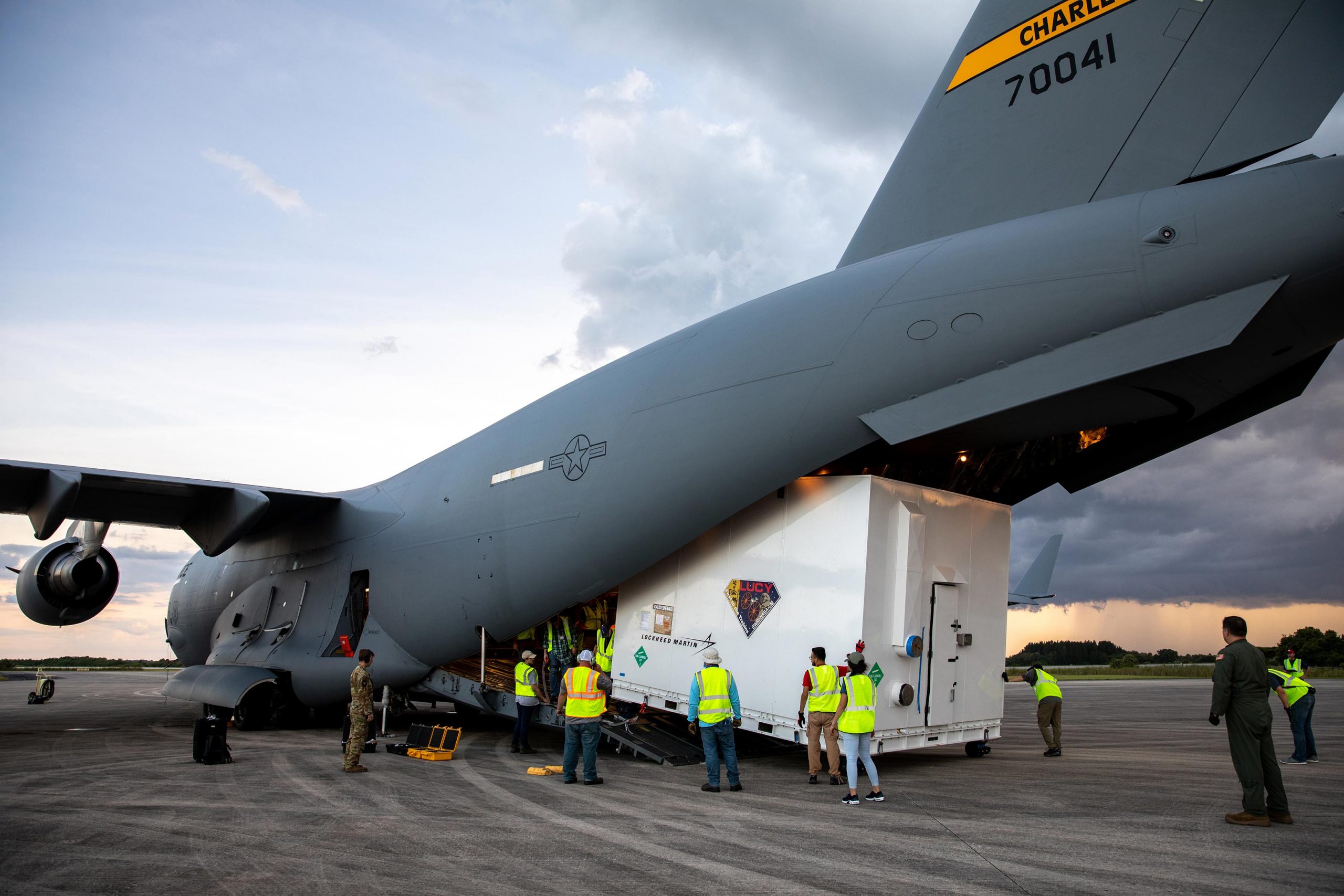
    NASA's Lucy Spacecraft Arrives by Cargo Plane
    NASA’s Lucy spacecraft arrives by cargo plane and is unloaded on the runway of the Launch and Landing Facility at Kennedy Space Center in Florida on July 30, 2021. From there, the Lucy spacecraft will move to the Astrotech Space Operations – Florida payload processing facility in nearby Titusville, Florida, before its scheduled launch on a United Launch Alliance (ULA) Atlas V rocket from Cape Canaveral Space Force Station on October 16, 2021. Credit: NASA/Kim Shiflett

    Over its twelve-year primary mission, Lucy will explore a record-breaking number of asteroids, flying by one main belt asteroid and seven Trojan asteroids. Lucy also incorporates three Earth-gravity assists to reach the Trojan swarms and accomplish these targeted encounters.

    The spacecraft was transported from Buckley Space Force Base in Aurora, Colorado, aboard a U.S. Air Force C-17 cargo plane. Lockheed Martin Space designed and built the spacecraft in its Littleton, Colorado, facility.

    “It takes a lot of coordination and careful planning to get this spacecraft to its launch site, and I’m very proud of the team who worked so tirelessly through a global pandemic to get us to this moment,” said Rich Lipe, Lockheed Martin Lucy program manager.

    Over the weekend, the team transferred the spacecraft from its shipping container into the Astrotech cleanroom and performed post-ship inspections, confirming that Lucy arrived in good condition. The spacecraft is now ready to begin its final round of testing and pre-launch checks, which include software tests, instrument and powered functional tests, propulsion propellent load tests, telecommunication tests, and spacecraft self-tests.

    “It is hard to believe that we are finally here after over seven years of hard work,” says Hal Levison, Lucy’s principal investigator from Southwest Research Institute in Boulder, Colorado. “We would not have made it without an extremely talented and dedicated team. It’s now time to get Lucy into the sky so that it can deliver its revolutionary science about the origin of our planetary system.”

    Southwest Research Institute in Boulder, Colorado is the principal investigator institution. NASA’s Goddard Space Flight Center in Greenbelt, Maryland provides overall mission management, systems engineering and safety and mission assurance. Lockheed Martin Space in Littleton, Colorado is building the spacecraft. Lucy is the 13th mission in NASA’s Discovery Program. NASA’s Marshall Space Flight Center in Huntsville, Alabama, manages the Discovery Program for the agency’s Science Mission Directorate in Washington, D.C.

    Never miss a breakthrough: Join the SciTechDaily newsletter.
    Follow us on Google and Google News.

    Asteroid Lucy Mission NASA NASA Goddard Space Flight Center
    Share. Facebook Twitter Pinterest LinkedIn Email Reddit

    Related Articles

    NASA’s Lucy Captures Ice Cream Cone–Shaped Asteroid That Defies Expectations

    NASA’s Record-Breaking Lucy Spacecraft Has a New Asteroid Target

    Moon Discovered Around Asteroid Polymele by NASA’s Lucy Team

    Watching the Blink of a Star to Size Up “Trojan” Asteroids for NASA’s Lucy Mission

    NASA’s Lucy Mission To Explore the Jupiter Trojan Asteroids – “It’s Almost Like We’re Traveling Back in Time”

    NASA’s Lucy Mission Prepares for Launch To Study “Fossils” of Planet Formation

    The Fascinating Story of How the Trojan Asteroids – Target of NASA’s Lucy Mission – Were Discovered and Named

    NASA’s First Mission to Explore the Trojan Asteroids Passes Critical Milestone

    NASA’s Mission to Jupiter’s Trojan Asteroids Confirms Discovery of “Bonus” Exploration Opportunity

    Leave A Reply Cancel Reply

    • Facebook
    • Twitter
    • Pinterest
    • YouTube

    Don't Miss a Discovery

    Subscribe for the Latest in Science & Tech!

    Trending News

    First-of-Its-Kind Discovery: Homer’s Iliad Found Embedded in a 1,600-Year-Old Egyptian Mummy

    Beyond Inflammation: Scientists Uncover New Cause of Persistent Rheumatoid Arthritis

    A Simple Molecule Could Unlock Safer, Easier Weight Loss

    Scientists Just Built a Quantum Battery That Charges Almost Instantly

    Researchers Unveil Groundbreaking Sustainable Solution to Vitamin B12 Deficiency

    Millions of People Have Osteopenia Without Realizing It – Here’s What You Need To Know

    Researchers Discover Boosting a Single Protein Helps the Brain Fight Alzheimer’s

    World-First Study Reveals Human Hearts Can Regenerate After a Heart Attack

    Follow SciTechDaily
    • Facebook
    • Twitter
    • YouTube
    • Pinterest
    • Newsletter
    • RSS
    SciTech News
    • Biology News
    • Chemistry News
    • Earth News
    • Health News
    • Physics News
    • Science News
    • Space News
    • Technology News
    Recent Posts
    • After Decades, MIT Researchers Capture the First 3D Atomic View of a Mysterious Material
    • Your Favorite Fishing Spot Is Turning Brown – and the Fish Are Changing
    • 380-Million-Year-Old Fish Fossil Reveals Secrets of Life’s First Steps Onto Land
    • Mezcal “Worm” in a Bottle Mystery: DNA Testing Reveals a Surprise
    • Scientists Turn Red Lettuce Green, Unlocking Hidden Nutrients
    Copyright © 1998 - 2026 SciTechDaily. All Rights Reserved.
    • Science News
    • About
    • Contact
    • Editorial Board
    • Privacy Policy
    • Terms of Use

    Type above and press Enter to search. Press Esc to cancel.