
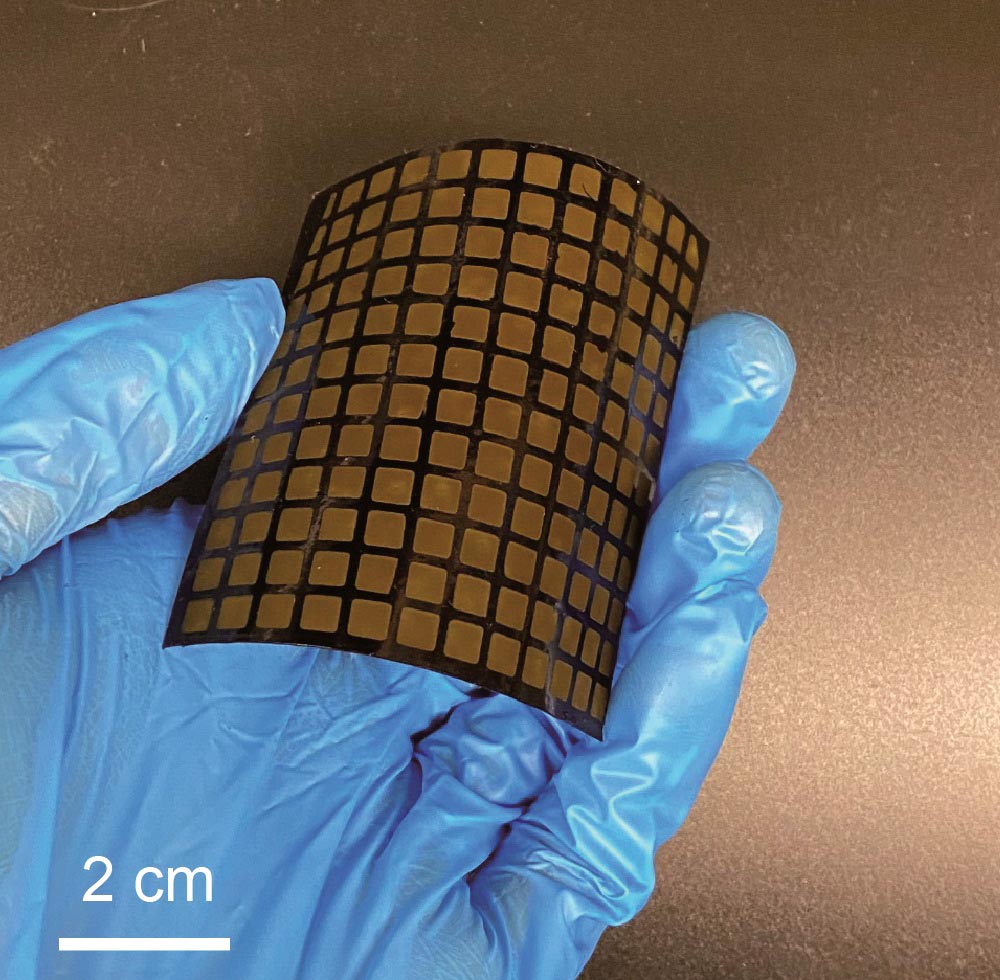
Flexible, lead-free MOF X-ray detectors could enable safer, wearable radiology devices.
X-ray imaging is a fast and painless way for doctors to see inside a person. But radiation detectors, which go under the body part being imaged, are rigid panels that contain harmful heavy metals, such as lead and cadmium. Now, researchers in ACS’ Nano Letters report a proof-of-concept wearable X-ray detector prepared from nontoxic metal-organic frameworks (MOFs) layered between flexible plastic and gold electrodes for high-sensitivity sensing and imaging.
Most X-ray detectors are integrated into big, immobile instruments, such as computerized tomography (known as CT) and mammography equipment, or are stiff, like the sharp-edged bitewing detectors used in dental offices. Detectors that could conform to rounded body parts or mold to the inside of confined spaces could be beneficial in some radiation monitoring and medical imaging applications.
Previous researchers have used MOFs for flexible radiation detectors because they are semiconducting materials that respond to electromagnetic radiation by creating an electrical current. However, some of these MOFs still include lead, just like the X-ray detectors that are currently in use. So, Shuquan Chang, Shenqiang Ren and colleagues wanted to create a heavy-metal-free MOF for a flexible X-ray detector and imager.
The researchers mixed a solution of nickel chloride salt and 2,5-diaminobenzene-1,4-dithiol (DABDT) for several hours, creating a MOF in which nickel linked the DABDT molecules.
In initial tests, the nickel-containing MOF was more sensitive than recently reported detectors when irradiated with 20 keV X-rays, equivalent to the energy released during medical diagnostic imaging. Then, to make a flexible X-ray radiation detector, the team sandwiched the nickel-containing MOF between gold film electrodes, one of which was on a flexible plastic surface. They used copper wires to transmit current from each pixel of a 12×12 array and covered the whole device with a silicone-based flexible polymer. Finally, they placed an aluminum letter “H” on the detector and irradiated it with X-rays, measuring a much lower current output underneath the H than under the unimpeded material.
The researchers say that their proof-of-concept device is promising for the next generation of radiology imaging equipment and radiation detection when wearable or flexible devices are needed.
Reference: “Flexible Lead-Free X-ray Detector from Metal–Organic Frameworks” by Zheng Li, Shuquan Chang*, Haiqian Zhang, Yong Hu, Yulong Huang, Lu Au and Shenqiang Ren,4 August 2021, Nano Letters.
DOI: 10.1021/acs.nanolett.1c02336
The authors acknowledge funding from the National Natural Science Foundation of China, Aeronautical Science Foundation, PAPD (A Project Funded by the Priority Academic Program Development of Jiangsu Higher Education Institutions) and China Scholarships Council.
Never miss a breakthrough: Join the SciTechDaily newsletter.
Follow us on Google and Google News.
1 Comment
“But radiation detectors, which go under the body part being imaged, are rigid panels that contain harmful heavy metals, such as lead and cadmium.”
That should be “potentially harmful.” The toxicity depends on the dose, which in turn, is related to the solubility of the material and the length of time it is in contact with the skin, if ever. That is, the “rigid panels” are protected with less troublesome materials and the patient us often wearing a gown. This skips right over the fact that X-rays themselves are problematic!
This article also ignores the fact that the metal nickel can be problematic as can the plasticizers usually found in polymers.
Flexibility in radiation detectors is good. However, trying to sell it on the idea that current detectors are bad because they aren’t edible isn’t good.