
Research on fossils reveals that ankylosaurs’ iconic tail weapons evolved much earlier than scientists had previously believed.
The world’s most unusual dinosaur is even stranger than scientists realized…
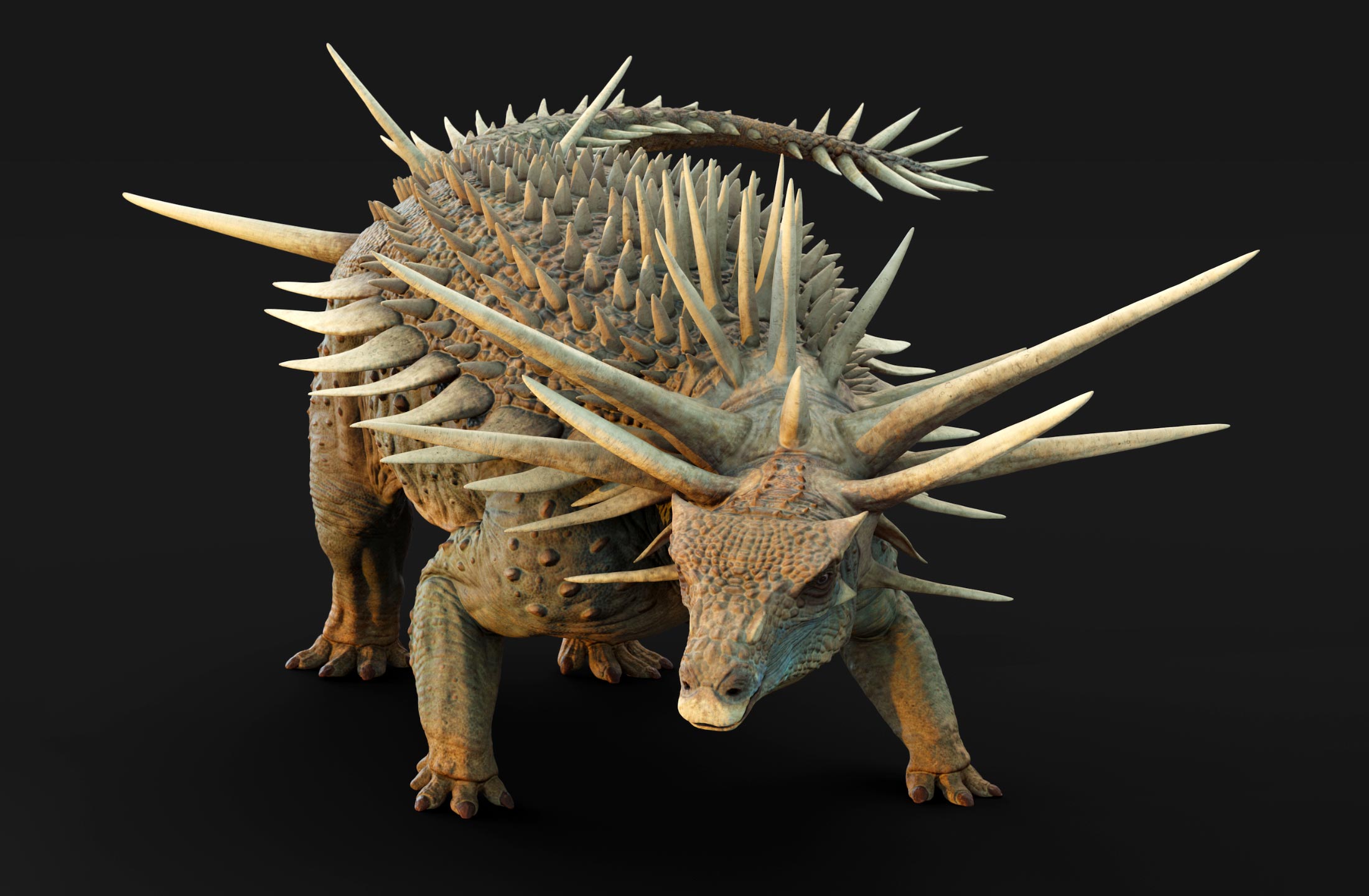
A new study published in Nature reveals that Spicomellus afer possessed a tail weapon more than 30 million years earlier than any other known ankylosaur. It also featured a distinctive bony collar lined with meter-long spikes extending outward from each side of its neck.
Spicomellus is recognized as the oldest ankylosaur ever discovered, dating back over 165 million years to the Middle Jurassic period. It lived near what is now the Moroccan town of Boulemane and represents the first ankylosaur found on the African continent.
Recently unearthed fossils of Spicomellus have allowed paleontologists to expand on the species’ original 2021 description, which was based solely on a single rib bone. The new findings reveal that the dinosaur’s ribs were fused with bony spikes that projected outward, an anatomical feature not seen in any other vertebrate, living or extinct. These spikes reached up to 87 centimeters in length and likely extended even farther in life, forming part of a protective collar that encircled the creature’s neck.
A Window Into Early Armored Evolution
Prof Susannah Maidment of Natural History Museum, London, and the University of Birmingham, who co-led the team of researchers said, “To find such elaborate armor in an early ankylosaur changes our understanding of how these dinosaurs evolved. It shows just how significant Africa’s dinosaurs are, and how important it is to improve our understanding of them.”
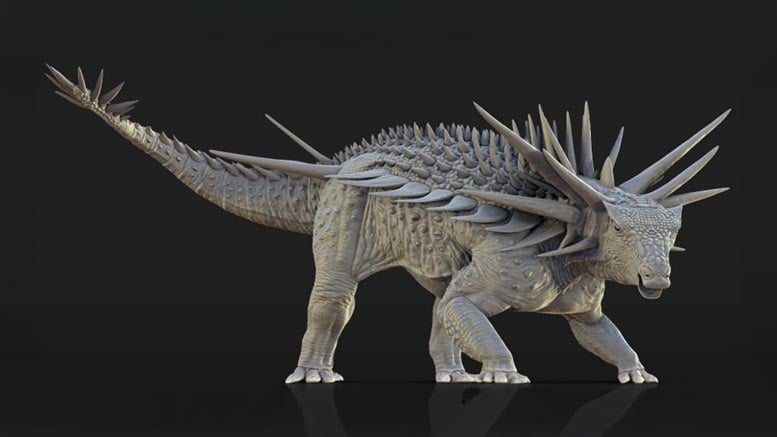
“Spicomellus had a diversity of plates and spikes extending from all over its body, including meter-long neck spikes, huge upwards-projecting spikes over the hips, and a whole range of long, blade-like spikes, pieces of armor made up of two long spikes, and plates down the shoulder. We’ve never seen anything like this in any animal before.”
“It’s particularly strange as this is the oldest known ankylosaur, so we might expect that a later species might have inherited similar features, but they haven’t.”
A Dinosaur Unlike Any Other
Project co-lead, Professor Richard Butler of the University of Birmingham, said, “Seeing and studying the Spicomellus fossils for the first time was spine-tingling. We just couldn’t believe how weird it was and how unlike any other dinosaur, or indeed any other animal we know of alive or extinct. It turns much of what we thought we knew about ankylosaurs and their evolution on its head and demonstrates just how much there still is to learn about dinosaurs”.
The authors postulate that this array of spikes would have been used for attracting mates and showing off to rivals. Interestingly, similar display armor has not yet been found in any other ankylosaur, with later species possessing armor that probably functioned more for defense.
One explanation for this is that as larger predatory dinosaurs evolved in the Cretaceous, as well as bigger carnivorous mammals, crocodiles, and snakes, the rising risk of predation could have driven ankylosaur armor to become simpler and more defensive.
One feature of early ankylosaurs that may have survived, however, is their tail weaponry. While the end of Spicomellus’ tail hasn’t been found, the bones that do survive suggest that it had a club or a similar tail weapon.
Some of the tail vertebrae are fused together to form a structure known as a handle, which has only been found in ankylosaurs with a tail club. However, all these animals lived millions of years later in the Cretaceous.
Ancient Innovation and Scientific Collaboration
The authors of the study believe that the combination of a tail weapon and an armored shield that protected the hips suggests that many of the ankylosaurs’ key adaptations already existed by the time of Spicomellus.
The discovery reinforces the importance of the fossil record in solving evolutionary puzzles and deepening our understanding of the geographic distribution of dinosaurs. It also helps to spark public imagination in dinosaurs as we learn more about the baffling characteristics of species like Spicomellus.
Professor Driss Ouarhache, lead of the Moroccan team from the Université Sidi Mohamed Ben Abdellah, who co-developed the research, says, “This study is helping to drive forward Moroccan science. We’ve never seen dinosaurs like this before, and there’s still a lot more this region has to offer.”
The Spicomellus afer remains that form the basis of this study were cleaned and prepared at the Department of Geology of the Dhar El Mahraz Faculty of Sciences in Fez, Morocco, using scientific equipment provided by the University of Birmingham’s Research England International Strategy and Partnership Fund. The fossils are now catalogued and stored on this site.
Reference: “Extreme armour in the world’s oldest ankylosaur” by Susannah C. R. Maidment, Driss Ouarhache, Kawtar Ech-charay, Ahmed Oussou, Khadija Boumir, Abdessalam El Khanchoufi, Alison Park, Luke E. Meade, D. Cary Woodruff, Simon Wills, Mike Smith, Paul M. Barrett and Richard J. Butler, 27 August 2025, Nature.
DOI: 10.1038/s41586-025-09453-6
Never miss a breakthrough: Join the SciTechDaily newsletter.
Follow us on Google and Google News.