
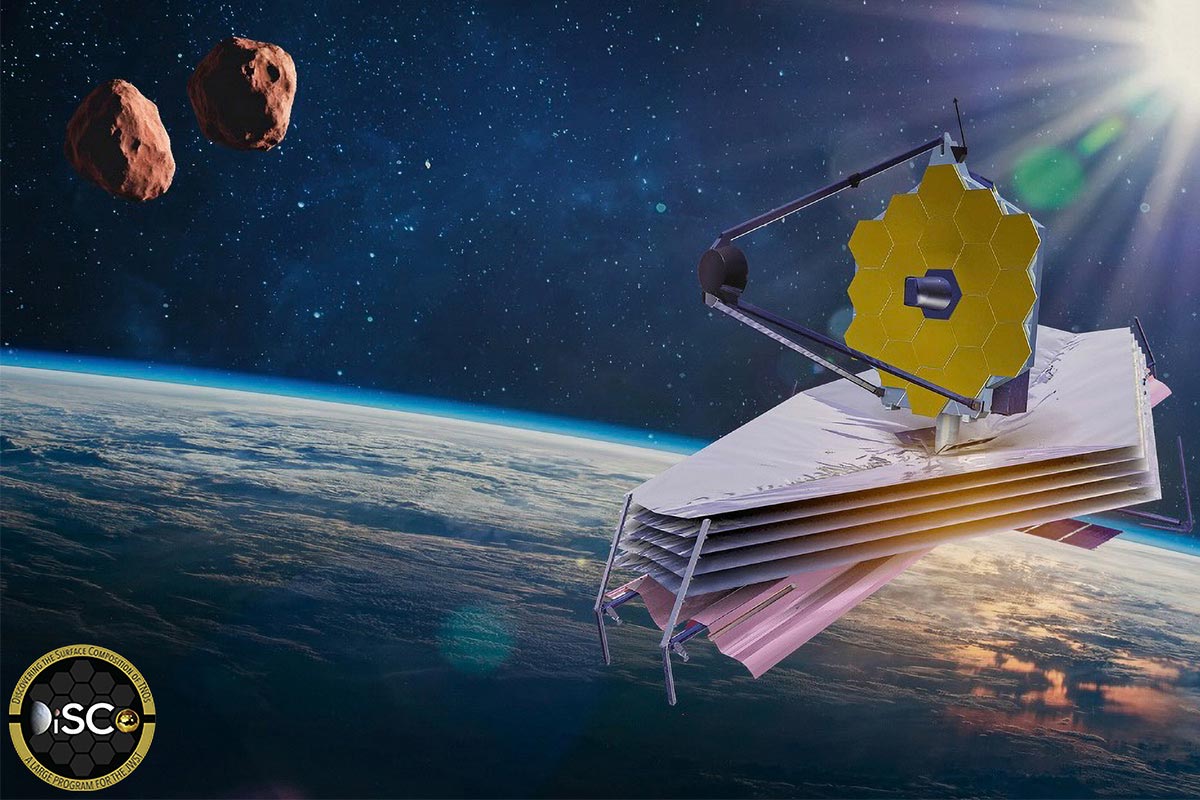
Researchers studying the binary asteroid Mors-Somnus in the Kuiper Belt have used the James Webb Space Telescope to gather unique data on trans-Neptunian objects, offering new insights into the formation of Neptune and the outer solar system’s dynamics.
A ring of icy rocks orbiting our sun just beyond Neptune may give us a glimpse of how Neptune — and other objects in the outskirts of our solar system — were formed.
Mors-Somnus, a binary duo comprised of a pair of icy asteroids bound by gravity, was recently concluded to have originated within the Kuiper Belt, meaning it can serve as a basis to study and enrich our understanding of the dynamical history of Neptune and celestial bodies known as trans-Neptunian objects (TNOs).
Groundbreaking Study With JWST
The promising study, published recently in the journal Astronomy & Astrophysics, marks the first time this has been achieved and serves as a significant landmark for the UCF-led Discovering the Surface Compositions of Trans-Neptunian Objects program — or DiSCo-TNOs — which is part of the first cycle of the James Webb Space Telescope’s (JWST) many programs focused on analyzing our solar system.
Ana Carolina de Souza Feliciano and Noemí Pinilla-Alonso, a postdoctoral fellow and professor in planetary science at UCF’s Florida Space Institute respectively, are co-authors of the study and part of the DiSCo team that studies unique spectral properties of small celestial bodies beyond Neptune within the Kuiper Belt.
What is unique to this work is that it is possible to study the surface composition of two components of the binary pair of small-sized TNOs, which had never been done before and can have implications for how we understand the whole region beyond Neptune.
New Insights Into TNOs
De Souza Feliciano led this particular study as part of Pinilla-Alonso’s greater DiSCo-TNOs program. The team used the JWST’s wide spectral capabilities to analyze the elemental composition of a half-dozen suspected closely related TNO surfaces to confirm that Mors-Somnus has much in common with its neighboring TNOs. These largely undisturbed TNOs are designated as “cold classical” and may serve as points of reference where Neptune didn’t disturb them during its migration.
Together, the binary objects and other nearby TNOs in the same dynamical group can act as an indicator to potentially track Neptune’s migration before it settled into its final orbit, the researchers say.
Binaries separated by distance, as Mors-Somnus is, rarely survive outside of areas bound by gravity and sheltered by other flecks of ice and rock such as the Kuiper Belt. To survive implantation in such areas, they require a slow transportation process toward their destination.
Due to the similar spectroscopic behavior of Mors and Somnus and their similarities with the cold-classical group, the researchers found compositional evidence for the formation of this binary pair beyond 30 astronomical units (nearly 2.7 billion miles away), as is also hypothesized in the previously published literature for the region where the cold-classic TNOs are also formed.
The steady stream of discoveries such as this was somewhat expected, as the first data from the DiSCo-TNOs studies on nearly 60 TNOs began to trickle in as early as late 2022.
“As we started to analyze the Mors and Somnus spectra, more data were arriving, and the connection between the dynamic groups and compositional behavior was natural,” de Souza Feliciano says.
More specifically, studying the composition of small celestial bodies such as Mors-Somnus gives us precious information about where we came from, Pinilla-Alonso says.
Implications and Future Research
“We are studying how the actual chemistry and physics of the TNOs reflect the distribution of molecules based on carbon, oxygen, nitrogen, and hydrogen in the cloud that gave birth to the planets, their moons, and the small bodies,” she says. “These molecules were also the origin of life and water on Earth.”
However, she says there still remains great opportunity to advance our knowledge of the history of the Trans-Neptunian region with the unprecedented spectral powers of JWST.
“For the first time, we can not only resolve images of systems with multiple components like the Hubble Space Telescope, but we can also study their composition with a level of detail that only Webb can provide,” Pinilla-Alonso says. “We can now investigate the formation process of these binaries like never before.”
Although Pinilla-Alonso conceived the DiSCo-TNOs program, she trusts her colleagues such as de Souza Feliciano to decipher the findings and generate valuable research.
“I am proud to have played a role in providing the necessary data and support to (Ana) Carol(olina), a brilliant UCF postdoctoral researcher who has been the true leader of this work,” Pinilla-Alonso says. “With the Webb telescope set to last for decades, this is an amazing opportunity for the next generation of researchers to step up and lead their science projects.”
Being a trailblazer for such incredible discoveries truly is exciting, de Souza Feliciano adds.
“Before JWST, there was no instrument able to obtain information from these objects in that wavelength range,” she says. “I feel happy to be able to participate in the era inaugurated by the JWST.”
Reference: “Spectroscopy of the binary TNO Mors–Somnus with the JWST and its relationship to the cold classical and plutino subpopulations observed in the DiSCo-TNO project” by A. C. Souza-Feliciano, B. J. Holler, N. Pinilla-Alonso, M. De Prá, R. Brunetto, T. Müller, J. Stansberry, J. Licandro, J. P. Emery, E. Henault, A. Guilbert-Lepoutre, Y. Pendleton, D. Cruikshank, C. Schambeau, M. Bannister, N. Peixinho, L. McClure, B. Harvison and V. Lorenzi, 23 January 2024, Astronomy & Astrophysics.
DOI: 10.1051/0004-6361/202348222
De Souza Feliciano received her doctorate in astronomy from Observatório Nacional de Rio de Janeiro, Brazil and is part of UCF’s Preeminent Postdoctoral Program. She works under the supervision of Pinilla-Alonso on the DiSCo-TNOs program.
Pinilla-Alonso is a professor at the Florida Space Institute and joined UCF in 2015. She received her doctorate in astrophysics and planetary sciences from the Universidad de La Laguna in Spain. Pinilla-Alonso also holds a joint appointment as a professor in UCF’s Department of Physics and has led numerous international observational campaigns in support of NASA missions such as New Horizons, OSIRIS-ReX and Lucy.
Never miss a breakthrough: Join the SciTechDaily newsletter.
Follow us on Google and Google News.