
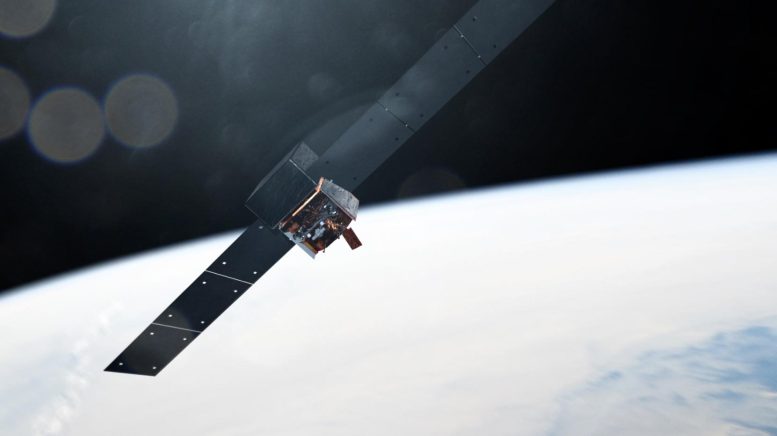
Fermi’s gamma-ray data uncovers eclipsing spider systems, revealing new insights into pulsar masses and binary system dynamics.
Scientists have discovered the first gamma-ray eclipses from a special type of binary star system using data from NASA’s Fermi Gamma-ray Space Telescope. These so-called spider systems each contain a pulsar – the superdense, rapidly rotating remains of a star that exploded in a supernova – that slowly erodes its companion.
An international team of scientists scoured over a decade of Fermi observations to find seven spiders that undergo these eclipses, which occur when the low-mass companion star passes in front of the pulsar from our point of view. The data allowed them to calculate how the systems tilt relative to our line of sight and other information.
“One of the most important goals for studying spiders is to try to measure the masses of the pulsars,” said Colin Clark, an astrophysicist at the Max Planck Institute for Gravitational Physics in Hannover, Germany, who led the work. “Pulsars are basically balls of the densest matter we can measure. The maximum mass they can reach constrains the physics within these extreme environments, which can’t be replicated on Earth.”
A paper about the study was published on January 26 in the journal Nature Astronomy.
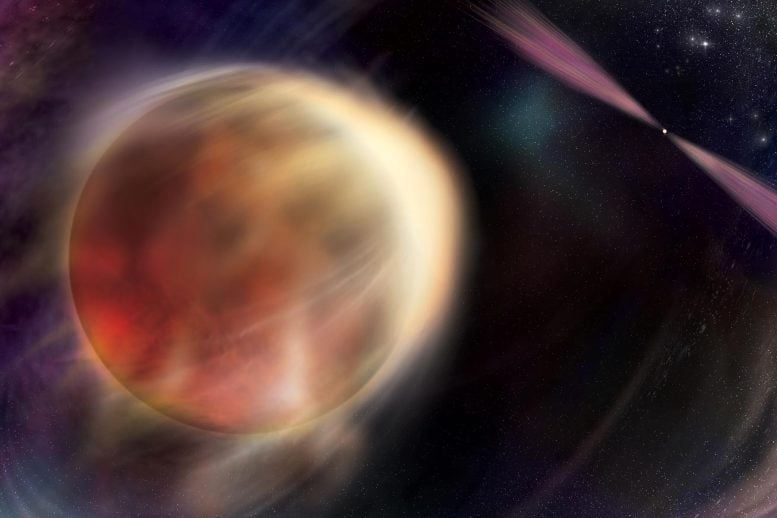
Spider Pulsars and Their Unique Behavior
Spider systems develop because one star in a binary evolves more swiftly than its partner. When the more massive star goes supernova, it leaves behind a pulsar. This stellar remnant emits beams of multiwavelength light, including gamma rays, that sweep in and out of our view, creating pulses so regular they rival the precision of atomic clocks.
Early on, a spider pulsar “feeds” off its companion by siphoning away a stream of gas. As the system evolves, the feeding stops as the pulsar begins to spin more rapidly, generating particle outflows and radiation that superheat the companion’s facing side and erode it.
Scientists divide spider systems into two types named after spider species whose females sometimes eat their smaller mates. Black widows contain companions with less than 5% of the Sun’s mass. Redback systems host bigger companions, both in size and mass, weighing between 10% and 50% of the Sun.
“Before Fermi, we only knew of a handful of pulsars that emitted gamma rays,” said Elizabeth Hays, the Fermi project scientist at NASA’s Goddard Space Flight Center in Greenbelt, Maryland. “After over a decade of observations, the mission has identified over 300 and collected a long, nearly uninterrupted dataset that allows the community to do trailblazing science.”
Measuring Pulsar Masses and System Orientation
Researchers can calculate the masses of spider systems by measuring their orbital motions. Visible light observations can measure how quickly the companion is traveling, while radio measurements reveal the pulsar’s speed. However, these rely on motion towards and away from us. For a nearly face-on system, such changes are slight and potentially confusing. The same signals also could be produced by a smaller, slower-orbiting system that’s seen from the side. Knowing the system’s tilt relative to our line of sight is vital for measuring mass.
The tilt’s angle is normally measured using visible light, but these measurements come with some potential complications. As the companion orbits the pulsar, its superheated side comes in and out of view, creating a fluctuation in visible light that depends on the tilt. However, astronomers are still learning about the superheating process, and models with different heating patterns sometimes predict different pulsar masses.
Gamma rays, however, are only generated by the pulsar and have so much energy that they travel in a straight line, unaffected by debris, unless blocked by the companion. If gamma rays disappear from the data set of a spider system, scientists can infer that the companion eclipsed the pulsar. From there, they can calculate the system’s tilt into our sight line, the stars’ velocities, and the pulsar’s mass.
Revisiting PSR B1957+20: A Paradigm Shift
PSR B1957+20, or B1957 for short, was the first-known black widow, discovered in 1988. Earlier models for this system, built from visible light observations, determined that it was tipped about 65 degrees into our line of sight and the pulsar’s mass was 2.4 times the Sun’s. That would make B1957 the heaviest-known pulsar, straddling the theoretical mass limit between pulsar and black hole.
By looking at the Fermi data, Clark and his team found 15 missing gamma-ray photons. The timing of the gamma-ray pulses from these objects is so dependable that 15 missing photons over a decade is significant enough that the team could determine the system is eclipsing. They then calculated that the binary is inclined 84 degrees and the pulsar weighs only 1.8 times as much as the Sun.
“There’s a quest to find massive pulsars, and these spider systems are thought to be one of the best ways to find them,” said Matthew Kerr, a co-author on the new paper and research physicist at the U.S. Naval Research Laboratory in Washington. “They’ve undergone a very extreme process of mass transfer from the companion star to the pulsar. Once we really get these models fine-tuned, we’ll know for sure whether these spider systems are more massive than the rest of the pulsar population.”
Reference: “Neutron star mass estimates from gamma-ray eclipses in spider millisecond pulsar binaries” by C. J. Clark, M. Kerr, E. D. Barr, B. Bhattacharyya, R. P. Breton, P. Bruel, F. Camilo, W. Chen, I. Cognard, H. T. Cromartie, J. Deneva, V. S. Dhillon, L. Guillemot, M. R. Kennedy, M. Kramer, A. G. Lyne, D. Mata Sánchez, L. Nieder, C. Phillips, S. M. Ransom, P. S. Ray, M. S. E. Roberts, J. Roy, D. A. Smith, R. Spiewak, B. W. Stappers, S. Tabassum, G. Theureau and G. Voisin, 26 January 2023, Nature Astronomy.
DOI: 10.1038/s41550-022-01874-x
The Fermi Gamma-ray Space Telescope is an astrophysics and particle physics partnership managed by Goddard. Fermi was developed in collaboration with the U.S. Department of Energy, with important contributions from academic institutions and partners in France, Germany, Italy, Japan, Sweden, and the United States.
Never miss a breakthrough: Join the SciTechDaily newsletter.
Follow us on Google and Google News.