
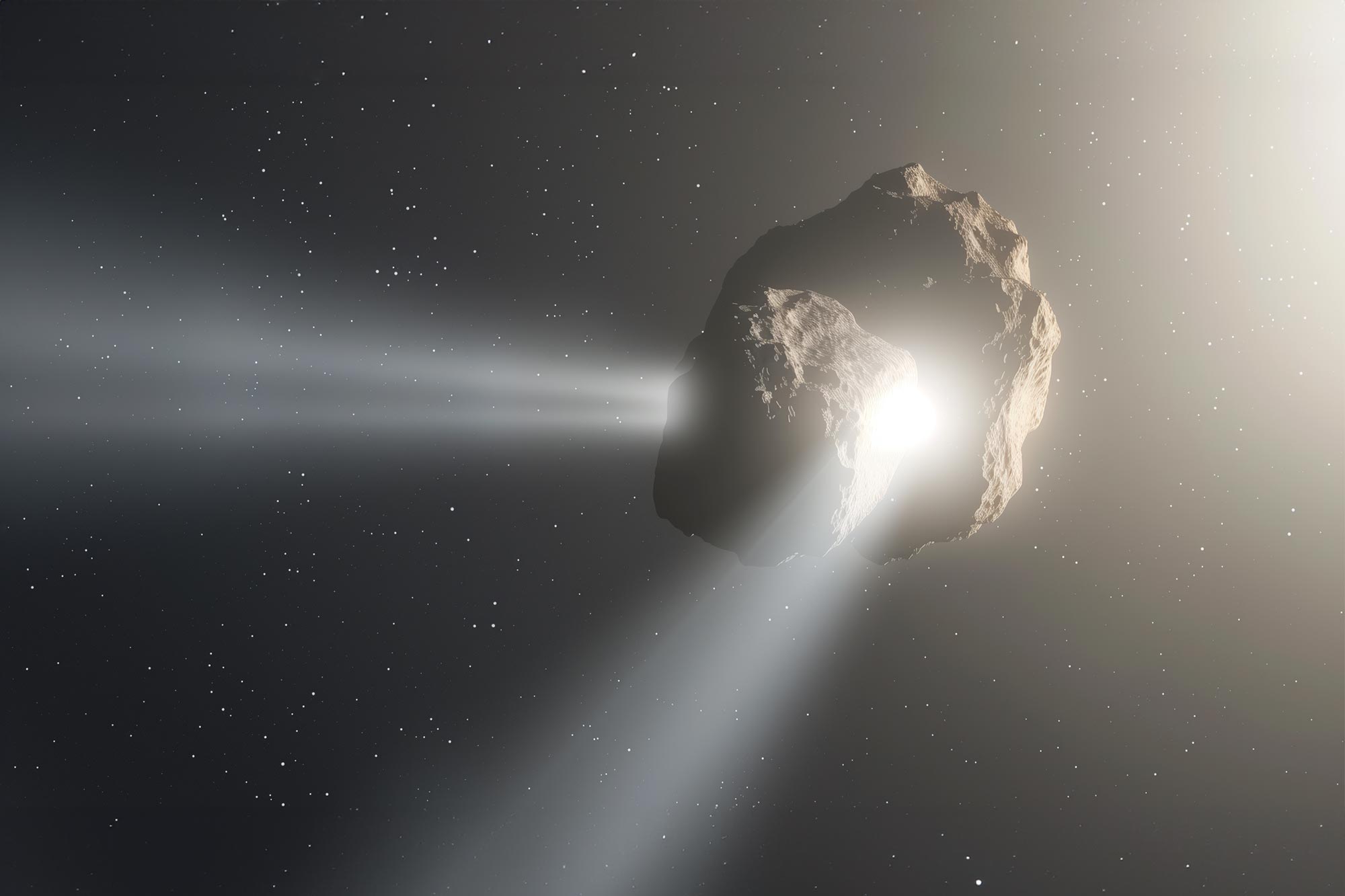
Scientists revealed unexpected outgassing from this object galloping across the outer solar system.
Similar to the Ancient Greek mythological creature of the same name, centaurs in astronomy are in an in-between dynamical phase: leaving their distant and stable orbits beyond Neptune and migrating to the inner solar system, while also entering an active cometary phase. Being stored for billions of years in the freezing confines of the outer solar system, they preserve key insights about the birth of our solar system, which are uniquely revealed as they slowly start to unfreeze in this transient stage.
Using NASA’s James Webb Space Telescope, a team of astronomers observed Centaur 29P/Schwassmann-Wachmann 1, one of the most active and intriguing objects in the outer solar system. The high degree of detail captured by the telescope led to the discovery of new, previously unknown jets of gas, which is helping inform theories about how centaurs and planets are formed.

Webb Space Telescope Reveals Unusual Jets of Volatile Gas From Icy Centaur 29P
Inspired by the half-human, half-horse creatures that are part of Ancient Greek mythology, the field of astronomy has its own kind of centaurs: distant objects orbiting the Sun between Jupiter and Neptune. NASA’s James Webb Space Telescope has mapped the gases spewing from one of these objects, suggesting a varied composition and providing new insights into the formation and evolution of the solar system.
Centaurs are former trans-Neptunian objects that have been moved inside Neptune’s orbit by subtle gravitational influences of the planets in the last few million years, and may eventually become short-period comets. They are “hybrid” in the sense that they are in a transitional stage of their orbital evolution: Many share characteristics with both trans-Neptunian objects (from the cold Kuiper Belt reservoir), and short-period comets, which are objects highly altered by repeated close passages around the Sun.
Understanding Centaur Composition and Activity
Since these small icy bodies are in an orbital transitional phase, they have been the subject of various studies as scientists seek to understand their composition, the reasons behind their outgassing activity — the loss of their ices that lie underneath the surface — and how they serve as a link between primordial icy bodies in the outer solar system and evolved comets.
A team of scientists recently used Webb’s NIRSpec (Near-Infrared Spectrograph) instrument to obtain data on Centaur 29P/Schwassmann-Wachmann 1 (29P for short), an object that is known for its highly active and quasi-periodic outbursts. It varies in intensity every six to eight weeks, making it one of the most active objects in the outer solar system. They discovered a new jet of carbon monoxide (CO) and previously unseen jets of carbon dioxide (CO2) gas, which give new clues to the nature of the centaur’s nucleus.

Webb’s Revelatory Observations
“Centaurs can be considered as some of the leftovers of our planetary system’s formation. Because they are stored at very cold temperatures, they preserve information about volatiles in the early stages of the solar system,” said Sara Faggi of NASA’s Goddard Space Flight Center in Greenbelt, Maryland, and American University in Washington, DC, lead author of the study. “Webb really opened the door to a resolution and sensitivity that was impressive to us — when we saw the data for the first time, we were excited. We had never seen anything like this.”
Centaurs’ distant orbits and consequent faintness have inhibited detailed observations in the past. Data from prior radio wavelength observations of Centaur 29P showed a jet pointed generally toward the Sun (and Earth) composed of CO. Webb detected this face-on jet and, thanks to its large mirror and infrared capabilities, also sensitively searched for many other chemicals, including water (H2O) and CO2. The latter is one of the main forms in which carbon is stored across the solar system. No clear indication of water vapor was detected in the atmosphere of 29P, which could be related to the extremely cold temperatures present in this body.
This is an animation portraying the outgassing activity of Centaur 29P/Schwassmann-Wachmann 1 based on data gathered by NASA’s James Webb Space Telescope’s NIRSpec (Near-Infrared Spectrograph) instrument. Centaur 29P is one of the most active objects in the outer solar system, undergoing quasi-periodic outbursts in brightness. The video begins by zooming in for a closer view of an artist’s concept of Centaur 29P. The scene is overlaid with graphics that help define the four different jets of gas before the centaur is rotated so the object can be examined from different angles. Credit: NASA, ESA, CSA, Leah Hustak (STScI)
Insights From Webb’s Data
The telescope’s unique imaging and spectral data revealed never-before-seen features: two jets of CO2 emanating in the north and south directions, and another jet of CO pointing toward the north. This was the first definitive detection of CO2 in Centaur 29P.
Based on the data gathered by Webb, the team created a 3D model of the jets to understand their orientation and origin. They found through their modeling efforts that the jets were emitted from different regions on the centaur’s nucleus, even though the nucleus itself cannot be resolved by Webb. The jets’ angles suggest the possibility that the nucleus may be an aggregate of distinct objects with different compositions; however, other scenarios can’t yet be excluded.
“The fact that Centaur 29P has such dramatic differences in the abundance of CO and CO2 across its surface suggests that 29P may be made of several pieces,” said Geronimo Villanueva, co-author of the study at NASA Goddard. “Maybe two pieces coalesced together and made this centaur, which is a mixture between very different bodies that underwent separate formation pathways. It challenges our ideas about how primordial objects are created and stored in the Kuiper Belt.”
Unanswered Questions and Future Research
The reasons for Centaur 29P’s bursts in brightness, and the mechanisms behind its outgassing activity through the CO and CO2 jets, continue to be two major areas of interest that require further investigation.
In the case of comets, scientists know that their jets are often driven by the outgassing of water. However, because of the centaurs’ location, they are too cold for water ice to sublimate, meaning that the nature of their outgassing activity differs from comets.
“We only had time to look at this object once, like a snapshot in time,” said Adam McKay, a co-author of the study at Appalachian State University in Boone, North Carolina. “I’d like to go back and look at Centaur 29P over a much longer period of time. Do the jets always have that orientation? Is there perhaps another carbon monoxide jet that turns on at a different point in the rotation period? Looking at these jets over time would give us much better insights into what is driving these outbursts.”
The team is hopeful that as they increase their understanding of Centaur 29P, they can apply the same techniques to other centaurs. By improving the astronomical community’s collective knowledge of centaurs, we can simultaneously better our understanding on the formation and evolution of our solar system.
These findings have been published in Nature.
Reference: “Heterogeneous outgassing regions identified on active centaur 29P/Schwassmann–Wachmann 1” by Sara Faggi, Geronimo L. Villanueva, Adam McKay, Olga Harrington Pinto, Michael S. P. Kelley, Dominique Bockelée-Morvan, Maria Womack, Charles A. Schambeau, Lori Feaga, Michael A. DiSanti, James M. Bauer, Nicolas Biver, Kacper Wierzchos and Yanga R. Fernandez, 8 July 2024, Nature Astronomy.
DOI: 10.1038/s41550-024-02319-3
The observations were taken as part of General Observer program 2416.
The James Webb Space Telescope is the world’s premier space science observatory. Webb is solving mysteries in our solar system, looking beyond to distant worlds around other stars, and probing the mysterious structures and origins of our universe and our place in it. Webb is an international program led by NASA with its partners, ESA (European Space Agency) and CSA (Canadian Space Agency).
Never miss a breakthrough: Join the SciTechDaily newsletter.
Follow us on Google and Google News.
3 Comments
I agree
My money is on those who will delve into the collection of asteroids that circle our solar system for a rock of suitable size, shape, and minerals wealth turn it into a vehicle for sustainable space travel.
All this is so mind blowing and shocking but I really can’t wait till the James webb telescope 🔭 finds life on another planet and other amazing things in the universe. Like another 🌎 world that can be inhabited.