
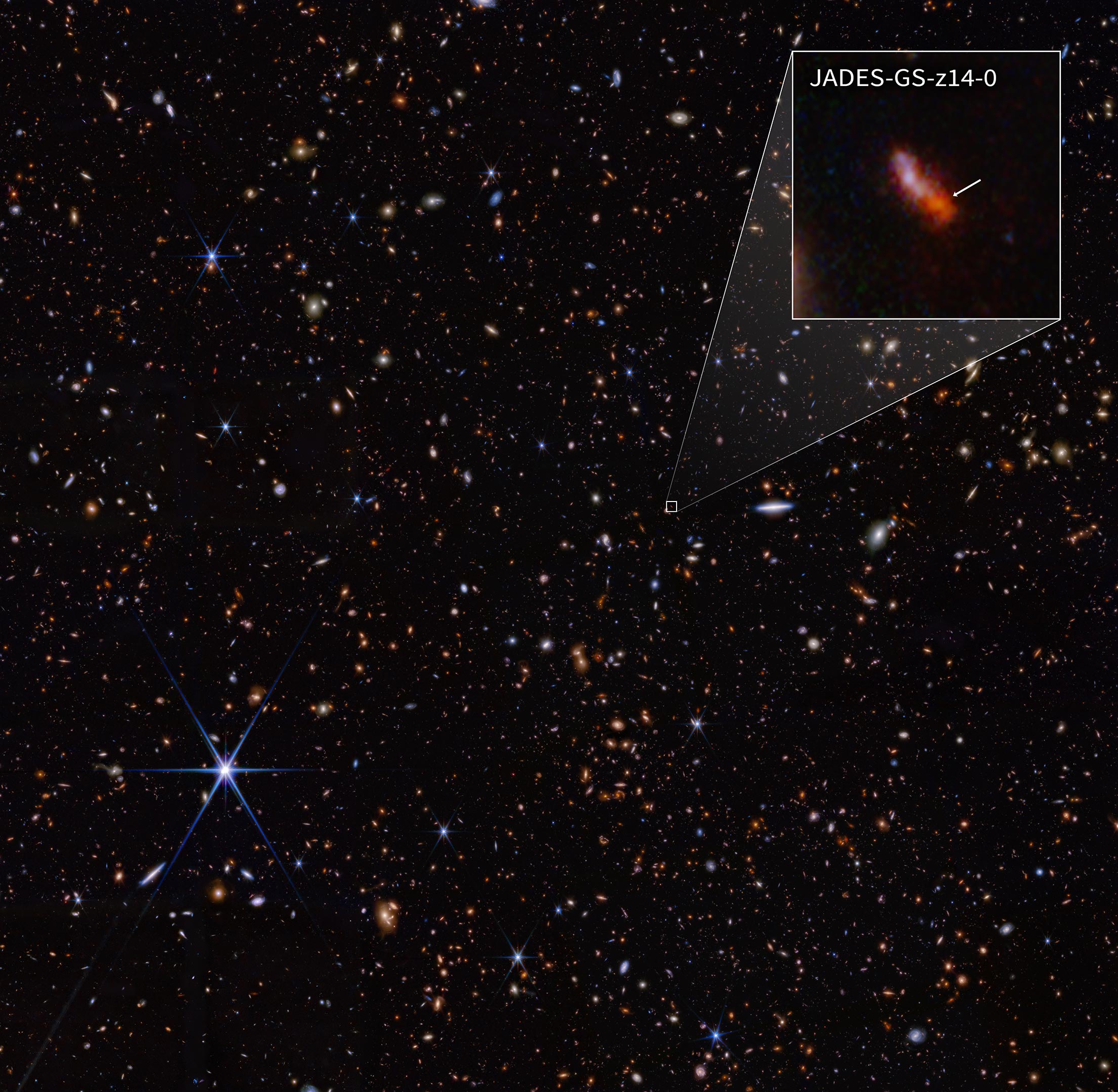
Astronomers using NASA’s James Webb Space Telescope have discovered the earliest and most distant galaxies known, dating back to just 300 million years after the Big Bang, a major milestone in understanding the universe’s early stages.
An international team of astronomers announced the discovery of the two earliest and most distant galaxies yet confirmed, dating back to only 300 million years after the Big Bang. This significant finding, achieved with NASA’s James Webb Space Telescope (JWST), marks a major milestone in the study of the early universe. These galaxies were discovered by the JWST Advanced Deep Extragalactic Survey (JADES) team, co-led by UC Santa Cruz astronomer Brant Robertson.
“This discovery is completely unanticipated and is likely to be seen as the most significant extragalactic discovery with JWST to date,” said Robertson, an astronomy and astrophysics professor who sits on the JADES steering committee. He is the lead author on the first of three papers reporting various aspects of the discovery.
In one paper, the authors conclude: “This demonstrates the immediate impact new JWST observations can have on our knowledge of the distant universe. With high-redshift galaxy populations now established fewer than 300 million years after the Big Bang, we have extended our reach into the cosmic past by 40% during the first eighteen months of JWST operations.”
“Redshift” refers to an effect caused by the expansion of the universe, where the wavelength of light from distant galaxies stretches as it travels. In these newly discovered galaxies, the effect is extreme—stretching by a factor of 15, and moving even the ultraviolet light of the galaxies to infrared wavelengths where only JWST has the capability to see it.

Chasing Early Galaxies
Modern theory holds that galaxies develop in special regions where gravity has concentrated cosmic gas and dark matter into dense lumps known as “halos.” These halos evolve quickly in the early universe, merging into more and more massive collections of matter. This rapid development is why astronomers are so eager to find yet earlier galaxies: Each small increment moves our eyes to a less developed period, where brighter galaxies are even more distinctive and unusual.
Found in a region near the Hubble Ultra Deep Field, the two newly discovered galaxies have been confirmed spectroscopically. In keeping with the collaboration’s standard naming practice, the galaxies are now known as JADES-GS-z14-0 and JADES-GS-z14-1, the former being the more distant of the two.
In addition to being the new distance record holder, JADES-GS-z14-0 is remarkable for how big and bright it is. JWST measures the galaxy at over 1,600 light-years in diameter. Many of the most luminous galaxies produce the bulk of their light via gas falling into a supermassive black hole, producing a quasar. But the team says the large size of JADES-GS-z14-0 means that the light must be produced by young stars.
Deeply Hidden Gems
And yet, the massive galaxy was a puzzle for the JADES team when they first spotted it over a year ago, as it appears close enough on the sky to a foreground galaxy that they couldn’t be sure that the two weren’t neighbors. But in October 2023, the JADES team conducted even deeper imaging—five full days with the JWST Near-Infrared Camera on just one field—to form the “JADES Origins Field.” With the use of filters designed to better isolate early galaxies, confidence grew that JADES-GS-z14-0 was indeed very distant.
In addition, the galaxy happened to fall in a region where the team had conducted ultra-deep imaging with the JWST Mid-InfraRed Instrument. These combined imaging results convinced the team to include the galaxy in what was planned to be the capstone observation of JADES, a 75-hour campaign to conduct spectroscopy on faint early galaxies. The spectroscopy confirmed their hopes that JADES-GS-z14-0 was indeed a record-breaking galaxy—and that the fainter candidate, JADES-GS-z14-1, was nearly as far away.
A New Era in Cosmic Exploration
The combination of the high luminosity and the stellar origin makes JADES-GS-z14-0 the most distinctive evidence yet for the rapid formation of large, massive galaxies in the early universe. “We could have detected this galaxy even if it were 10 times fainter, which means that we could see other examples yet earlier in the universe—probably into the first 200 million years,” Robertson said. “This galaxy is truly a gem, and it points at more hidden treasures in the early universe.”
Robertson’s paper, “Earliest Galaxies in the JADES Origins Field: Luminosity Function and Cosmic Star-Formation Rate Density 300 Myr after the Big Bang,” is accepted for publication in the Astrophysical Journal.
Reference: “Earliest Galaxies in the JADES Origins Field: Luminosity Function and Cosmic Star-Formation Rate Density 300 Myr after the Big Bang” by Brant Robertson, Benjamin D. Johnson, Sandro Tacchella, Daniel J. Eisenstein, Kevin Hainline, Santiago Arribas, William M. Baker, Andrew J. Bunker, Stefano Carniani, Courtney Carreira, Phillip A. Cargile, Stéphane Charlot, Jacopo Chevallard, Mirko Curti, Emma Curtis-Lake, Francesco D’Eugenio, Eiichi Egami, Ryan Hausen, Jakob M. Helton, Peter Jakobsen, Zhiyuan Ji, Gareth C. Jones, Roberto Maiolino, Michael V. Maseda, Erica Nelson, Pablo G. Pérez-González, Dávid Puskás, Marcia Rieke, Renske Smit, Fengwu Sun, Hannah Übler, Lily Whitler, Christina C. Williams, Christopher N. A. Willmer, Chris Willott, Joris Witstok, Accepted, Astrophysical Journal.
arXiv:2312.10033
The James Webb Space Telescope is an international program led by NASA with its partners, ESA (European Space Agency) and CSA (Canadian Space Agency).
Never miss a breakthrough: Join the SciTechDaily newsletter.
Follow us on Google and Google News.