

Researchers used Google’s quantum processor to simulate fundamental physics, offering a new way to study the universe’s basic forces and particles.
The fundamental forces that shape our universe are explained through intricate theoretical models. These models are notoriously difficult to study because accurately simulating them is far beyond what traditional supercomputers can handle.
Now, scientists from the Technical University of Munich (TUM), Princeton University, and Google Quantum AI have shown that quantum computers can serve as a powerful tool for exploring this challenging field, offering a window into the dynamics of nature’s most basic components.
Details of the study, published in the journal Nature, mark a significant advance in quantum computing. The team successfully used Google’s quantum processor to directly simulate fundamental interactions, highlighting the technology’s potential for future discoveries. This approach could help scientists uncover deeper insights into particle physics, quantum materials, and even the nature of space and time. At the heart of the work lies the goal of better understanding the universe at its most basic level, described through mathematical frameworks known as gauge theories.
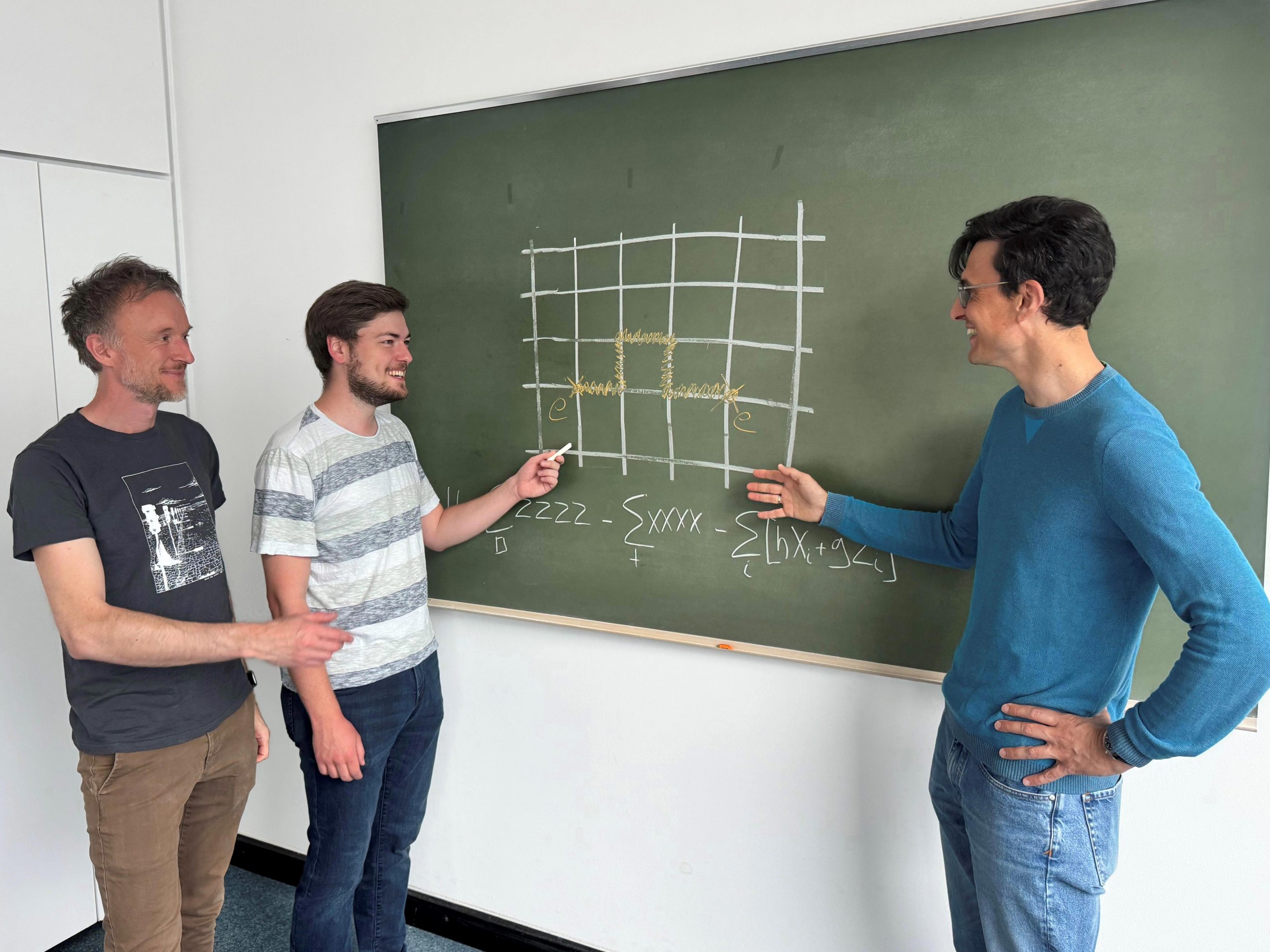
Testing the Universe’s Rules in the Lab
“Our work shows how quantum computers can help us explore the fundamental rules that govern our universe,” says co-author Michael Knap, Professor of Collective Quantum Dynamics at the TUM School of Natural Sciences. “By simulating these interactions in the laboratory, we can test theories in new ways.”
Pedram Roushan, co-author of this work from Google Quantum AI emphasizes: “Harnessing the power of the quantum processor, we studied the dynamics of a specific type of gauge theory and observed how particles and the invisible ‘strings’ that connect them evolve over time.”
Tyler Cochran, first author and graduate student at Princeton, says: “By adjusting effective parameters in the model, we could tune properties of the strings. They can fluctuate strongly, become tightly confined, or even break.” He explains that the data from the quantum processor reveals the hallmark behaviors of such strings, which have direct analogs to phenomena in high-energy particle physics. The results underscore the potential for quantum computers to facilitate scientific discovery in fundamental physics and beyond.
Reference: “Visualizing dynamics of charges and strings in (2 + 1)D lattice gauge theories” by T. A. Cochran, B. Jobst, E. Rosenberg, Y. D. Lensky, G. Gyawali, N. Eassa, M. Will, A. Szasz, D. Abanin, R. Acharya, L. Aghababaie Beni, T. I. Andersen, M. Ansmann, F. Arute, K. Arya, A. Asfaw, J. Atalaya, R. Babbush, B. Ballard, J. C. Bardin, A. Bengtsson, A. Bilmes, A. Bourassa, J. Bovaird, M. Broughton, D. A. Browne, B. Buchea, B. B. Buckley, T. Burger, B. Burkett, N. Bushnell, A. Cabrera, J. Campero, H.-S. Chang, Z. Chen, B. Chiaro, J. Claes, A. Y. Cleland, J. Cogan, R. Collins, P. Conner, W. Courtney, A. L. Crook, B. Curtin, S. Das, S. Demura, L. De Lorenzo, A. Di Paolo, P. Donohoe, I. Drozdov, A. Dunsworth, A. Eickbusch, A. Moshe Elbag, M. Elzouka, C. Erickson, V. S. Ferreira, L. Flores Burgos, E. Forati, A. G. Fowler, B. Foxen, S. Ganjam, R. Gasca, É. Genois, W. Giang, D. Gilboa, R. Gosula, A. Grajales Dau, D. Graumann, A. Greene, J. A. Gross, S. Habegger, M. Hansen, M. P. Harrigan, S. D. Harrington, P. Heu, O. Higgott, J. Hilton, H.-Y. Huang, A. Huff, W. Huggins, E. Jeffrey, Z. Jiang, C. Jones, C. Joshi, P. Juhas, D. Kafri, H. Kang, A. H. Karamlou, K. Kechedzhi, T. Khaire, T. Khattar, M. Khezri, S. Kim, P. Klimov, B. Kobrin, A. Korotkov, F. Kostritsa, J. Kreikebaum, V. Kurilovich, D. Landhuis, T. Lange-Dei, B. Langley, K.-M. Lau, J. Ledford, K. Lee, B. Lester, L. Le Guevel, W. Li, A. T. Lill, W. Livingston, A. Locharla, D. Lundahl, A. Lunt, S. Madhuk, A. Maloney, S. Mandrà, L. Martin, O. Martin, C. Maxfield, J. McClean, M. McEwen, S. Meeks, A. Megrant, K. Miao, R. Molavi, S. Molina, S. Montazeri, R. Movassagh, C. Neill, M. Newman, A. Nguyen, M. Nguyen, C.-H. Ni, K. Ottosson, A. Pizzuto, R. Potter, O. Pritchard, C. Quintana, G. Ramachandran, M. Reagor, D. Rhodes, G. Roberts, K. Sankaragomathi, K. Satzinger, H. Schurkus, M. Shearn, A. Shorter, N. Shutty, V. Shvarts, V. Sivak, S. Small, W. C. Smith, S. Springer, G. Sterling, J. Suchard, A. Sztein, D. Thor, M. Torunbalci, A. Vaishnav, J. Vargas, S. Vdovichev, G. Vidal, C. Vollgraff Heidweiller, S. Waltman, S. X. Wang, B. Ware, T. White, K. Wong, B. W. K. Woo, C. Xing, Z. Jamie Yao, P. Yeh, B. Ying, J. Yoo, N. Yosri, G. Young, A. Zalcman, Y. Zhang, N. Zhu, N. Zobrist, S. Boixo, J. Kelly, E. Lucero, Y. Chen, V. Smelyanskiy, H. Neven, A. Gammon-Smith, F. Pollmann, M. Knap and P. Roushan, 4 June 2025, Nature.
DOI: 10.1038/s41586-025-08999-9
Never miss a breakthrough: Join the SciTechDaily newsletter.
Follow us on Google and Google News.
6 Comments
Tyler Cochran, first author and graduate student at Princeton, says: “By adjusting effective parameters in the model, we could tune properties of the strings. They can fluctuate strongly, become tightly confined, or even break.” He explains that the data from the quantum processor reveals the hallmark behaviors of such strings, which have direct analogs to phenomena in high-energy particle physics. The results underscore the potential for quantum computers to facilitate scientific discovery in fundamental physics and beyond.
VERY GOOD.
A generation severely poisoned by so-called peer-reviewed publications. In today’s physics, so-called peer-reviewed publications, including Physical Review Letters, Nature, Science, etc., stubbornly insist on and promote:
1. Although θ and τ particles show differences in experiments, physics can assume that they are the same type of particle. This is science.
2. Although topological vortices have the same structure and opposite rotation direction as their anti vortices, physics can define their structures and directions as completely different. This is science.
3. Although two sets of cobalt-60 reverse rotation experiments showed asymmetry, physics can still define them as two objects that are mirror images of each other. This is science.
, etc. They openly define the Differences as the Same while the Same as the Differences, and deceive the public with so-called impact factors (IF), never knowing what shame is.
The universe is not a God, nor is it merely Particles; moreover, it is not Algebra, Formulas, or Fractions. The universe is the superposition, deflection, entanglement, and locking of spacetime vortex geometries, the interaction and balance of topological vortices and their fractal structures. Topological invariants are the identical intrinsic properties between two isomorphic topological spaces. Different civilizations may create distinct mathematical codes or tools to describe the universality and specificity of these topological invariants under different physical laws.
Topology provides stability blueprints, but specific physics (spatial features, gravitational collapse, fluid viscosity, quantum measurement) dictates vortex generation, evolution, and decay. If researchers are interested in this, please visit https://zhuanlan.zhihu.com/p/1933484562941457487 and https://zhuanlan.zhihu.com/p/1925124100134790589.
“spacetime” is a false notion. Starts with thinking there unique aspects that math and numbers can describe – and mathematically conjoining any two such concepts leads to acclaim and accolade. When the universe is one thing – where animal mind concepts bring easy illusions – which we add and subtract and divide and over which we become quite satisfied with ourselves. The whole time the universe is utterly more than we comprehend.
Secondly, we are always cock sure an idea is true and conform our math against experiment to prove the idea – when the idea was based on ignorance in the first place. We try to prove what was wrong and only stumble forward. – It makes for long, stumbling science careers.
We think there is space – but that is the one aspect that doesn’t exist as we have been thinking. And time is another animal brain thing. However, the subject is the universe – not animal brain concepts.
The fact they said space and time and not spacetime is a huge tell. Time is a field and it powers everything. That will be the revolutionary finding.
Dilation is real, there is immense proof- GPS sattelites requiring adjustment, for example. If dilation is real, something is energetically altering atomic process. If time is compressed by both velocity and mass. The answer becomes obvious- time is a field and it powers the atom. Zero point energy is actually temporal power.
Lucas, very perceptive. However, in 2009 I was surprised to ‘insight’ much of the nature of gravity. For more than a decade, now, I’ve been controversially demonstrating various aspects of gravity in low-budget videos and, most recently, inertia (e.g., https://odysee.com/@charlesgshaver:d/5Gravity:c). In my model of the universe space just ‘is’ and time just ‘isn’t.’ Again, here and now, as elsewhere previously, “time” is just an arbitrary label for an incredibly brief and rapid sequence of now moments interspaced with an incredibly brief and rapid sequence of intervals. As to time dilation, when one compels a ‘subject’ clock (mechanical or atomic) to travel faster through a field of induced radiant pulsing angular lines of gravity force than an identical ‘control’ clock, it is the subject clock, not time, that slows down. Ultimately, for any quantum computer to accurately define the “Rules of the Universe,” it must first be programmed with adequate accurate laws, rules and data, as are the bio-supercomputers between our ears, which occurs naturally ‘within,’ during the normal courses of our lives.
My prediction is that it will tell us we have got maths only half right. The reflection point between entropy and coherence can be found here at the liminal point between -0 and +0. Try it out its really good at resolving a paradox. It is recursive of course but that’s only a problem if the universe isn’t…
here’s another: relativity tells us a constant contracts a product – but this means all the numbers employed are contracted – and that therefore, so employed, no number is the same quantity. All numbers are different size depending on the quantities used.
And then there’s the sticky notion that humans create the thoughts and images they have the habit of thinking with.