
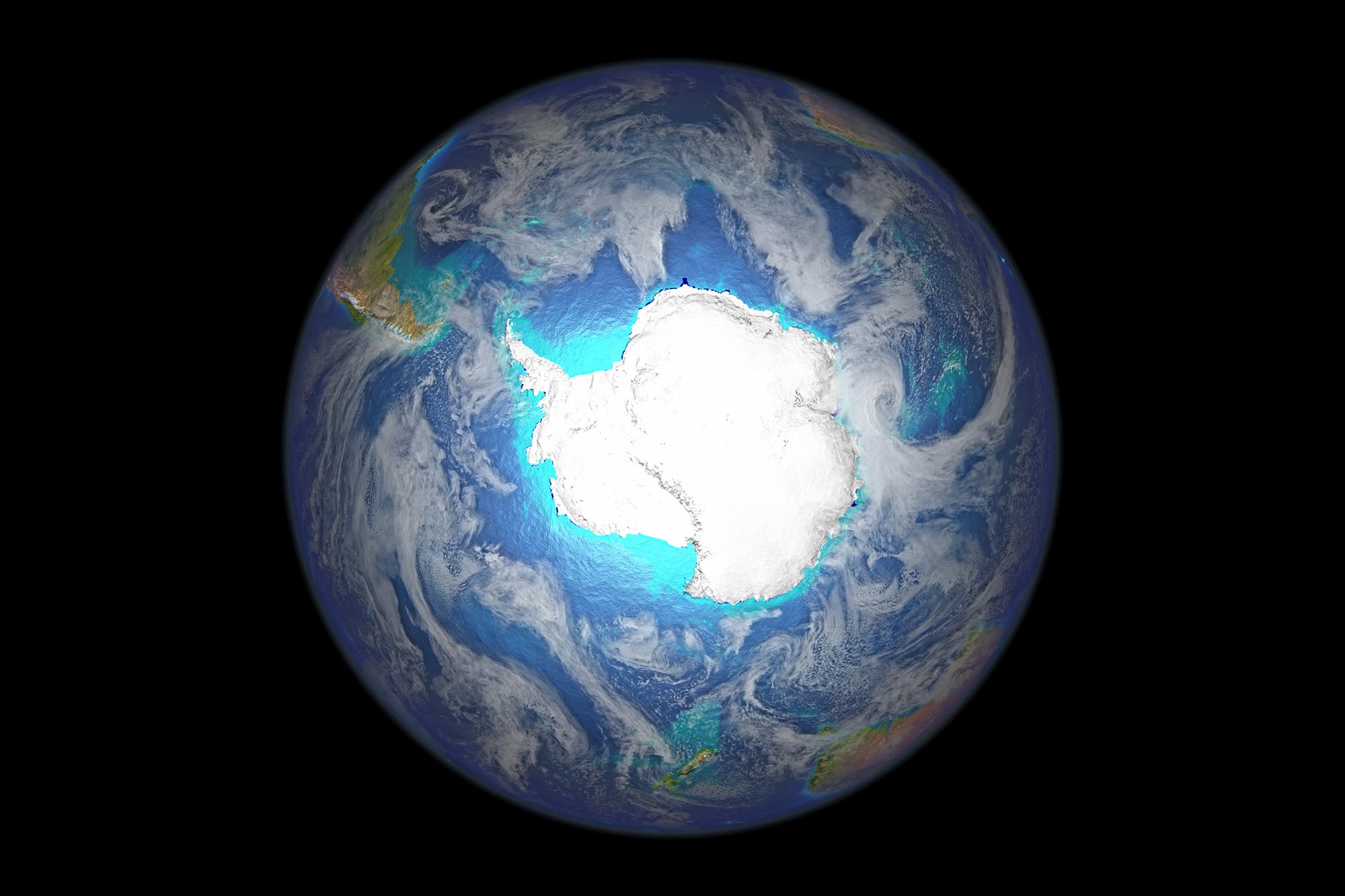
A mysterious dip in Earth’s gravity beneath Antarctica traces back to slow-moving rocks deep underground.
Gravity feels dependable and unchanging, something we rarely question. Yet the planet behaves in strange ways defies intuition.
In reality, gravity is not uniform across Earth’s surface. Its strength shifts from place to place, and once the effects of Earth’s rotation are taken into account, it reaches its lowest point beneath Antarctica.
New research shows that this so called Antarctic gravity hole developed because of extremely slow movements of rock deep within the planet over tens of millions of years. The study also found that changes in this gravity low occurred during the same broad window of time as major shifts in Antarctica’s climate. Scientists say future investigations may determine whether evolving gravity patterns played a role in the expansion of the massive ice sheets that define the continent today.
“If we can better understand how Earth’s interior shapes gravity and sea levels, we gain insight into factors that may matter for the growth and stability of large ice sheets,” said Alessandro Forte, Ph.D., a professor of geophysics at the University of Florida and co-author of the new study recreating the Antarctic gravity hole’s past.
Why Small Gravity Changes Matter for the Oceans
These gravity differences stem from variations in the density of rocks buried far below Earth’s surface. Although the changes are subtle in absolute terms, they can meaningfully influence the oceans. Water naturally shifts toward areas where gravity is slightly stronger. As a result, in regions where gravity is weaker, the ocean surface sits a bit lower relative to Earth’s center. Around Antarctica, this effect produces a measurable drop in sea surface height compared with what would otherwise be expected.
The findings, recently published in Scientific Reports, come from work by Forte and Petar Glišović, Ph.D., of the Paris Institute of Earth Physics. The researchers charted the Antarctic gravity hole and traced its development over millions of years. To do so, they relied on a global scientific effort that merges earthquake data with physics-based computer models to reconstruct the three-dimensional structure of Earth’s interior.
“Imagine doing a CT scan of the whole Earth, but we don’t have X-rays like we do in a medical office. We have earthquakes. Earthquake waves provide the ‘light’ that illuminates the interior of the planet,” Forte said.
Using seismic waves to identify different rock structures inside the planet and applying physics-based calculations to estimate their gravitational effects, the team generated a map of Earth’s gravity field. Their results closely matched highly accurate satellite measurements, which are considered the benchmark for tracking gravity worldwide. That strong agreement suggests the models realistically capture what lies deep beneath the surface.
Rewinding 70 Million Years of Slow Rock Flow
The next step was even more challenging: reconstructing how the Antarctic gravity hole formed over vast stretches of geologic time. Using advanced computer simulations, the researchers applied physics-based reconstructions to reverse the slow movement of rocks deep inside Earth. Their models traced these changes back 70 million years, reaching as far as the age of dinosaurs.
The simulations showed that the gravity hole was initially much less pronounced. Between roughly 50 million and 30 million years ago, however, it intensified significantly. This period coincides with major shifts in Antarctica’s climate, including the beginning of widespread glaciation across the continent.
Looking ahead, Forte plans to investigate whether this timing reflects a direct link. He aims to use updated models that connect gravity, sea level, and changes in continental elevation to determine whether the strengthening gravity low may have influenced the development of Antarctica’s massive ice sheets.
The aim is to address one big question: “How does our climate connect to what’s going on inside our planet?” Forte said.
Reference: “Cenozoic evolution of earth’s strongest geoid low illuminates mantle dynamics beneath Antarctica” by Petar Glišović, and Alessandro M. Forte, 19 December 2025, Scientific Reports.
DOI: 10.1038/s41598-025-28606-1
Never miss a breakthrough: Join the SciTechDaily newsletter.
Follow us on Google and Google News.