
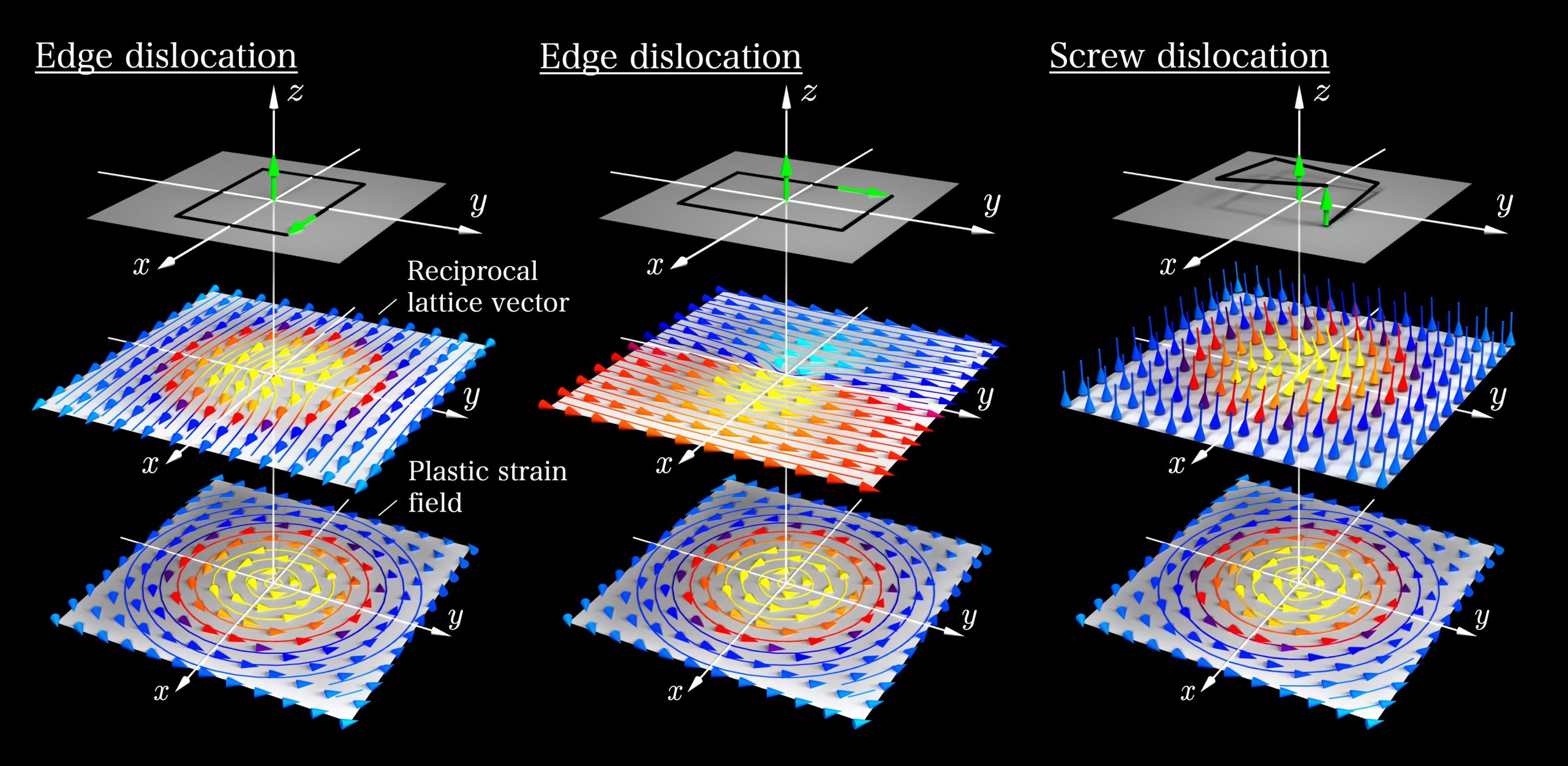
Researchers at Osaka University have revealed a link between the equations describing strain caused by atomic dislocations in crystalline materials and a well-established formula from electromagnetism, an insight that could advance research in condensed matter physics.
A fundamental goal of physics is to explain a wide range of natural phenomena using the fewest possible fundamental principles. Strikingly, problems that appear unrelated on the surface often share the same mathematical structure. For example, the equation describing heat flow closely resembles the one used to model the diffusion of particles.
Similarly, wave equations govern diverse phenomena such as the motion of water and the propagation of sound. Physicists actively search for these kinds of connections, which reflect the deep “universality” of the physical laws that govern different systems.
In a study published in Royal Society Open Science, researchers at Osaka University revealed an unexpected link between the equations describing defects in crystal lattices and a well-known formula from electromagnetism.
They demonstrated that the fields representing the strain generated around lattice dislocations in crystalline materials, modeled by Cartan’s First Structure Equation, obey the same equations as the more familiar Biot-Savart law. The former can be quite complex and challenging to visualize, while the latter describes how electric currents generate magnetic fields, and is essential for understanding numerous modern devices, including electric motors.
Bridging Concepts Through Universality
“Searching for Universality relationships can be valuable in emerging scientific fields, especially when the governing equations are newly established, and the nature of their solutions remains elusive,” explains lead author of the study Shunsuke Kobayashi.
The Biot-Savart law states that an electrical current flowing through a wire will generate a magnetic field around itself represented by vectors that twist around like a vortex. Similarly, the effect of certain types of atomic dislocation in a crystalline lattice will induce a strain vector field on the surrounding atoms.
Using the analogous Biot-Savart law from electromagnetism, it will be possible to analytically determine the effect of dislocations, instead of the more arcane Cartan Structure Equations. “This discovery is expected to serve as a fundamental theory for describing the plastic deformation of crystalline materials, opening the way for a wide range of applications in material science,” senior author Ryuichi Tarumi says. The researchers also believe that finding these kinds of connections across areas of study can spur new discoveries.
Reference: “Biot–Savart law in the geometrical theory of dislocations” by Shunsuke Kobayashi and Ryuichi Tarumi, 1 March 2025, Royal Society Open Science.
DOI: 10.1098/rsos.241568
The study was funded by the Japan Society for the Promotion of Science and the Japan Science and Technology Agency.
Never miss a breakthrough: Join the SciTechDaily newsletter.
Follow us on Google and Google News.