

General relativity helps explain the lack of planets around tight binary stars by driving orbital resonances that eject or destroy close-in worlds. This process naturally creates a “desert” of detectable circumbinary planets.
Among the more than 4,500 stars known to host planets, one trend stands out as especially puzzling. Nearly all stars are expected to form with planets, and a large fraction of stars are born as pairs. Yet planets that orbit two stars at once are surprisingly uncommon.
Astronomers have confirmed more than 6,000 extrasolar planets, or exoplanets, so far, with most discoveries coming from NASA’s Kepler Space Telescope and the Transiting Exoplanet Survey Satellite (TESS). Of all these worlds, only 14 are known to circle binary stars. Based on what scientists know about planet formation, there should be hundreds. The question remains: where are the real-life versions of two-sun worlds like Tatooine in Star Wars?
Astrophysicists at the University of California, Berkeley, and the American University of Beirut have proposed an explanation for why so few circumbinary exoplanets have been found, and they point to Einstein’s general theory of relativity as the key factor.
How Orbital Motion Becomes Unstable
In most binary systems, the two stars are close in mass but not perfectly equal, and they revolve around each other along elongated, elliptical paths. A planet orbiting both stars feels a constantly changing gravitational pull, which causes its orbit to slowly rotate over time. This gradual rotation is known as orbital precession and is similar to the way a spinning top wobbles as it turns.
The stars themselves also experience orbital precession, but for a different reason. In their case, general relativity plays a dominant role. As time passes, tidal forces between the two stars draw them closer together. This tightening has two important consequences: the stars’ orbital precession speeds up, while the planet’s precession rate slows down. When these two rates become equal, a resonant interaction occurs. At that point, the planet’s orbit stretches dramatically, carrying it much farther away at one point and dangerously close at another.
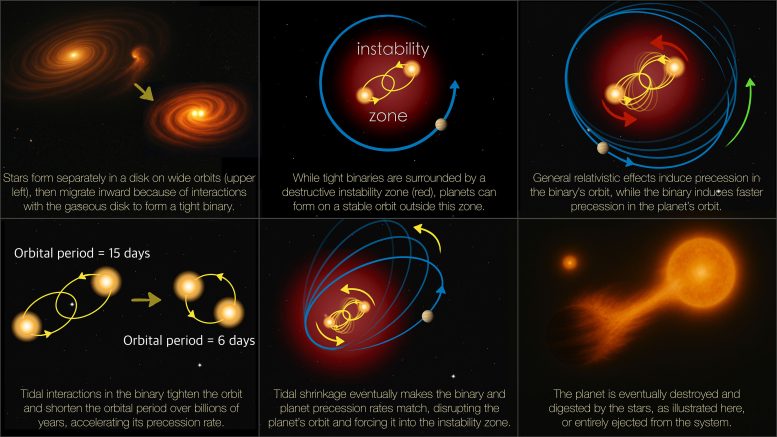
“Two things can happen: Either the planet gets very, very close to the binary, suffering tidal disruption or being engulfed by one of the stars, or its orbit gets significantly perturbed by the binary to be eventually ejected from the system,” said Mohammad Farhat, a Miller Postdoctoral Fellow at UC Berkeley and first author of the paper. “In both cases, you get rid of the planet.”
Why Surviving Planets Are Hard to Find
This process does not mean that binary stars lack planets altogether, Farhat emphasized. Instead, only planets that orbit at large distances manage to survive. Unfortunately, those distant worlds are far less likely to pass in front of their stars from our point of view, making them extremely difficult to detect using the transit methods employed by Kepler and TESS.
“There are surely planets out there. It’s just that they are difficult to detect with current instruments,” said co-author Jihad Touma, a physics professor at the American University of Beirut.
They published their findings in The Astrophysical Journal Letters.
The Circumbinary Planet “Desert”
Both Kepler and TESS search for exoplanets by measuring the slight dip in a star’s brightness when a planet crosses in front of it. Kepler also identified roughly 3,000 eclipsing binary systems, where one star periodically passes in front of the other. Since about 10% of sun-like stars host large planets, astronomers expected a similar fraction of binary systems to do the same, amounting to roughly 300 planet-hosting binaries. Instead, researchers identified only 47 candidate planets in such systems, with just 14 confirmed.
None of these 14 exoplanets occur around tight binaries orbiting one another in less than about seven days.
“You have a scarcity of circumbinary planets in general and you have an absolute desert around binaries with orbital periods of seven days or less,” Farhat said. “The overwhelming majority of eclipsing binaries are tight binaries and are precisely the systems around which we most expect to find transiting circumbinary planets.”
Instability Zones and Failed Planet Formation
According to Farhat, binary systems are surrounded by regions of orbital instability where planets simply cannot survive. Inside these zones, complex gravitational interactions between the two stars and a planet either eject the planet from the system or pull it inward until it merges with or is torn apart by the stars. Interestingly, 12 of the 14 known circumbinary planets orbit just beyond this unstable region. This suggests that they formed farther away and later migrated inward, since building a planet near the instability boundary would be extremely difficult.
“Planets form from the bottom up, by sticking small-scale planetesimals together. But forming a planet at the edge of the instability zone would be like trying to stick snowflakes together in a hurricane,” he said.
Farhat had previously collaborated with Touma on the formation and evolution of planetary orbits in various star systems, including our own. But Touma also had an interest in the orbits of binary black holes and binary stars. He realized 10 years ago that general relativity should change how planets move around double-star systems, but he didn’t know if the effect was strong enough to matter. After digging deeper into exoplanets, however, he suggested that the subtle pushes and pulls from relativity—combined with the stars slowly spiraling closer together—might explain the mystery of the missing planets around tight binaries.
General Relativity Clears Out Close-In Planets
Using detailed mathematical calculations and computer simulations, Farhat and Touma showed that general relativity dramatically alters the long-term survival of circumbinary planets. Their results indicate that relativistic effects disrupt about eight out of every ten planets orbiting tight binaries, and roughly 75% of those disrupted planets are destroyed outright.
Albert Einstein introduced general relativity in 1915, describing gravity as the bending of spacetime by mass. A familiar example comes from Mercury, which orbits closer to the sun than any other planet and experiences an extra amount of orbital precession that Newton’s laws could not explain. Einstein’s theory correctly accounted for this discrepancy and provided one of its earliest confirmations.
From Mercury to Binary Stars
The same physics applies whenever massive objects orbit close together, including compact binary stars. These stars likely begin their lives far apart, but interactions with surrounding gas during formation can gradually pull them closer over tens of millions of years. As they draw nearer, tidal forces continue to shrink their orbit over billions of years. Once their orbital period drops to about a week or less, relativistic precession becomes increasingly important. The point of closest approach, known as periastron, begins to rotate more rapidly as the stars tighten their orbit.
A circumbinary exoplanet also sees its elliptical axis precess, in this case because of the gravitational tug of the two stars — a strictly Newtonian process. However, as the binaries move closer to one another, their perturbation of the planet gradually weakens, and the precession slows down.
As the orbital precession of the binary stars increases and that of the exoplanet decreases, at some point they match and enter a state of resonance. At this point, calculations show, the exoplanet’s orbit starts to elongate, taking it farther from the binary at the extreme point of its orbit but closer at periastron. When periastron enters the zone of instability, the exoplanet is either exiled to the far reaches of the system or approaches too close to the binary and is engulfed. Because this disruption occurs quickly, taking a few tens of millions of years within the multibillion-year lifetime of a star, exoplanets around tight binaries end up being very rare.
Resonance, Ejection, or Destruction
“A planet caught in resonance finds its orbit deformed to higher and higher eccentricities, precessing faster and faster while staying in tune with the orbit of the binary, which is shrinking,” Touma said. “And on the route, it encounters that instability zone around binaries, where three-body effects kick into place and gravitationally clear out the zone.”
“Just the natural way you form these tight binaries, these sub-seven-day binaries, you get rid of the planet naturally, without invoking additional disruption from a nearby star or other mechanisms,” Farhat said.
Touma added that the same mechanism likely removes multiple planets from binary systems, particularly those that would otherwise be detectable by Kepler or TESS.
Broader Implications Beyond Exoplanets
The researchers are now applying their models to other extreme environments, including clusters of stars orbiting pairs of supermassive black holes. They are also exploring whether similar relativistic effects could help explain why planets are rare around binary pulsars, which are pairs of rapidly spinning neutron stars that emit precisely timed radio signals. These findings highlight the continuing importance of Einstein’s theory even in systems once thought to be fully explained by Newtonian gravity.
“Interestingly enough, nearly a century following Einstein’s calculations, computer simulations showed how relativistic effects may have saved Mercury from chaotic diffusion out of the solar system. Here we see related effects at work disrupting planetary systems,” Touma said. “General relativity is stabilizing systems in some ways and disturbing them in other ways.”
Reference: “Capture into Apsidal Resonance and the Decimation of Planets around Inspiraling Binaries” by Mohammad Farhat and Jihad Touma, 8 December 2025, The Astrophysical Journal Letters.
DOI: 10.3847/2041-8213/ae21d8
Farhat is supported by the Miller Institute for Basic Research in Science at UC Berkeley.
Never miss a breakthrough: Join the SciTechDaily newsletter.
Follow us on Google and Google News.