
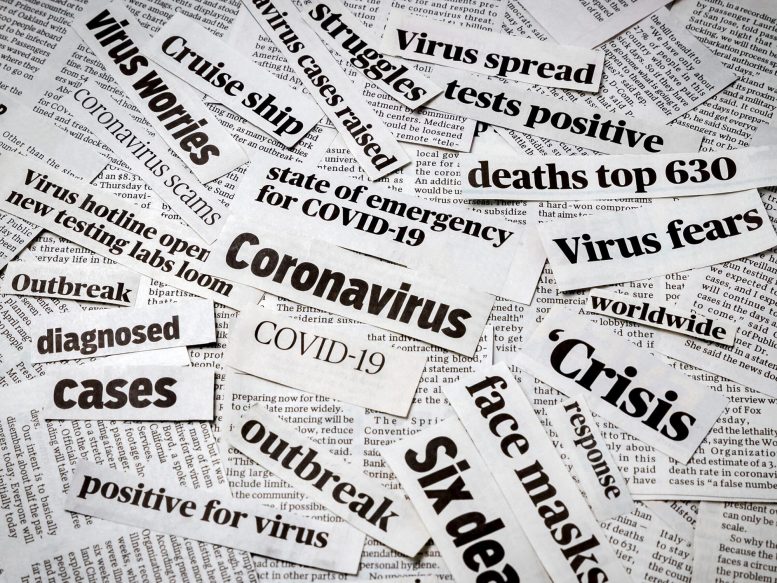
The COVID-19 pandemic in the U.S. has been characterized by rapidly changing information, a high degree of uncertainty, and conflicting information about transmission, vulnerability, and mitigation methods. Several studies focused on public perceptions of the pandemic and the impact of media will be presented during two sessions on December 15, from 2:30-4:00 during the Society for Risk Analysis virtual Annual Meeting, December 13-17, 2020.
In the first of a pair of studies on public attitudes about the pandemic, Zhuling Liu, University at Buffalo, examined Americans’ support for various measures such as stay-at-home orders and the temporary closure of nonessential businesses. The study, “Public support for COVID-19 responses: Cultural cognition, risk perception, and emotions,” focused on three factors: cultural cognition, emotions (such as fear and anger), and risk perception.
Liu found that:
People who believe that individuals should fend for themselves and social resources should be distributed according to social status are less likely to support government responses. However, when they sense higher risk from the pandemic and experience more anger, they are actually more likely to express support.
Angry people may blame others for the situation, and thus are less likely to support government response measures, whereas fearful people are the opposite.
In a second study, “How Americans’ perceptions of COVID-19 risk have changed over time and why,” Branden B. Johnson, Ph.D., and Marcus Mayorga, Ph.D., Decision Research, conducted a longitudinal survey of the same people using the same questions three times from February to August to examine changes in perceptions of risk from COVID-19 to themselves, the U.S. and the world.
Johnson and Mayorga found that:
Risk perceptions increased for everyone, with no individual differences in trends across people by political ideology or other variables
People with greater dread of COVID-19, more sense that it was close to them in time space, or impact on people like them, deference to scientific judgments, and following of U.S. news about COVID-19 had higher risk perceptions
Those favoring individualism perceived lower risks, and those trusting the Office of the President had lower U.S. and global risk perceptions, but no differences in personal risk
Behavioral intentions (e.g., for mask-wearing) were indirectly affected by news following’s effects on (particularly) perceived knowledge’s effects on threat and stakeholder perceptions
A second pair of studies explores how public opinion has been shaped by national news coverage of the pandemic. In the first study, “Public opinion & news coverage of COVID-19: Risks & responsibility in U.S. perceptions of the pandemic,” Emily Howell, Ph.D., University of Wisconsin-Madison, assessed news coverage of the pandemic to see who was being blamed for negative outcomes and who was being credited for positive outcomes. She then compared those levels of blame and credit with public opinion.
U.S. news coverage tends to blame actors for negative outcomes more than it credits actors for positive outcomes, and that blame is typically directed at national-level officials and agencies. A similar trend was detected in public opinion. “People have been paying more attention to the news during the pandemic than they were before,” states Howell, “and the news has an impact on peoples’ views of risks and who is responsible for avoiding or worsening certain risks. We’ll be able to see how well public opinion and news coverage mirror each other and how changes in one might affect the other to shape what we are paying attention to right now.”
In a related study, “The blame frame: Predicting the U.S. public’s prosocial responses during the coronavirus pandemic,” Jody Wong, University at Buffalo, examined how Americans understand COVID-19 related information and the effects that the information has on their emotions and socially responsive behavior.
Wong’s research shows that when people were exposed to a mock news article with a blame frame, they were less likely to engage in careful information processing. From here, they experienced lower negative emotions and pro-social emotions such as sympathy and solidarity. Emotions subsequently led to lower support for government response measures and lower intention to make monetary donations.
“When the public turn to trusted media sources for COVID-19 information, the use of a blame frame can lead to quick judgment,” states Wong, “Media framing strategies can influence public opinion. Media establishments should frame news stories that are informative and socially responsible as most Americans rely on news information to make informed decisions.”
These studies will be presented during the COVID-19: Risk Communication and Social Dynamics of Transmission and Vulnerability symposia and the Individual Impacts of Global Pandemic Risks session, both from 2:30-4:00 p.m. ET on December 15, 2020.
Never miss a breakthrough: Join the SciTechDaily newsletter.
Follow us on Google and Google News.
1 Comment
I’m sorry. I really can’t figure out the gist of this article. I’ll read the original articles. With paragraphs like: (sic): “People with greater dread of COVID-19, more sense that it was close to them in time space, or impact on people like them, deference to scientific judgments, and following of U.S. news about COVID-19 had higher risk perceptions (sic, no punctuation at end of that paragraph)” I can’t continue.