

Scientists are questioning whether humanity can truly “dim the Sun” without causing chaos.
A new Columbia University study shows that stratospheric aerosol injection could trigger massive side effects depending on where, when, and what materials are used. From monsoon disruptions to supply-chain limits and uncertain chemistry, the obstacles are enormous.
The Rising Reality of Solar Geoengineering
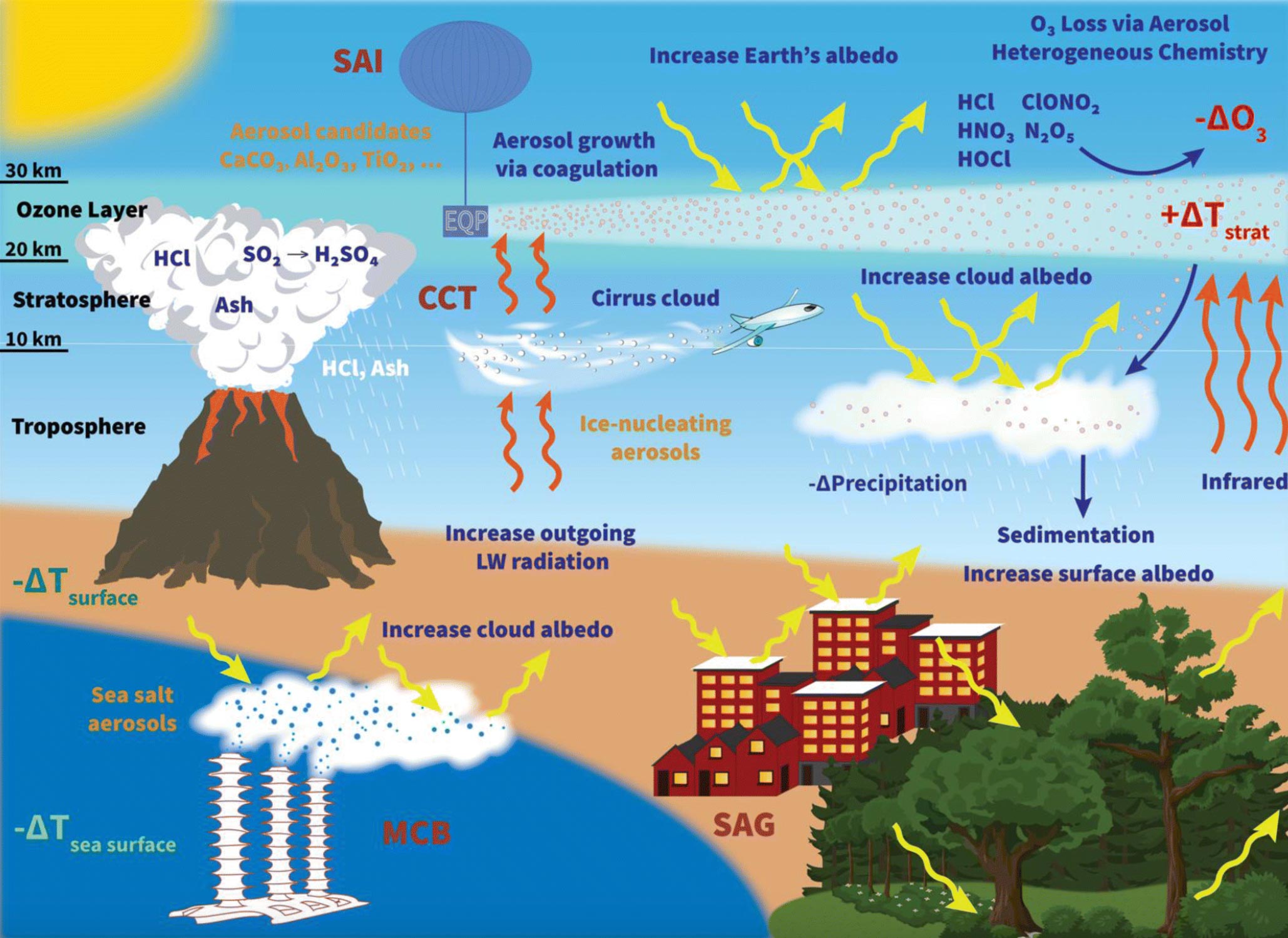
An idea once dismissed as far-fetched, cooling the planet by spreading sunlight-reflecting particles through the upper atmosphere, has now become a serious topic in climate science. This approach, known as stratospheric aerosol injection (SAI), aims to counter global warming by mimicking the natural cooling that follows volcanic eruptions. Hundreds of studies have modeled how such a system could work in theory. But researchers at Columbia University warn that supporters of the concept overlook just how uncertain, technically challenging, and risky it could be in practice.
“Even when simulations of SAI in climate models are sophisticated, they’re necessarily going to be idealized. Researchers model the perfect particles that are the perfect size. And in the simulation, they put exactly how much of them they want, where they want them. But when you start to consider where we actually are, compared to that idealized situation, it reveals a lot of the uncertainty in those predictions,” says V. Faye McNeill, an atmospheric chemist and aerosol scientist at Columbia’s Climate School and Columbia Engineering.
“There are a range of things that might happen if you try to do this—and we’re arguing that the range of possible outcomes is a lot wider than anybody has appreciated until now.”
Reckoning With Real-World Limits
In a study published in Scientific Reports, McNeill and her coauthors explored the physical, political, and economic barriers that could complicate efforts to deploy SAI. They compiled findings from previous research to better understand how different design choices — such as timing, altitude, and injection location — could influence the planet’s climate response. Even small differences in how and where aerosols are released could drastically change the results.
Among the many variables, latitude stands out as one of the most important. For instance, injecting particles over the poles could disrupt tropical monsoon systems, while focusing efforts near the equator might interfere with the jet stream and alter the circulation of heat between hemispheres.
“It isn’t just a matter of getting five teragrams of sulfur into the atmosphere. It matters where and when you do it,” says McNeill. These variabilities suggest that, if SAI takes place, it should be done in a centralized, coordinated fashion. Given geopolitical realities, however, the researchers say that is unlikely.
Lessons From Volcanic Cooling
Model studies to date have focused almost entirely on SAI approaches that would use sulfate-rich gases analogous to those formed when volcanic plumes oxidize and condense in the stratosphere. Volcanic eruptions have cooled Earth in the past: When Mount Pinatubo erupted in 1991, for example, planetary temperatures dropped by nearly one degree Celsius for several years afterwards. That event is often cited as a proof-of-principle for how SAI could work.
Beside cooling at ground level, SAI also poses undesirable consequences, both expected and unexpected. For example, Pinatubo’s eruption also disrupted the Indian monsoon system, leading to decreased rainfall across South Asia, and caused warming in the stratosphere and depletion of the ozone layer. The use of sulfates for SAI could pose similar risks, or additional environmental concerns, including acid rain and soil pollution. These concerns have led to a search for other aerosol ingredients for SAI.
Searching for Safer Sunlight Shields
Proposed mineral alternatives include calcium carbonate, alpha alumina, rutile and anatase titania, cubic zirconia and diamond. Consideration of alternatives has focused on their optical qualities, but other factors have been neglected.
“Scientists have discussed the use of aerosol candidates with little consideration of how practical limitations might limit your ability to actually inject massive amounts of them yearly,” says Miranda Hack, an aerosol scientist at Columbia University and the new paper’s lead author. “A lot of the materials that have been proposed are not particularly abundant.”
The Harsh Economics of Aerosol Alternatives
Diamond is optically well-suited to the task, but there simply isn’t enough of it. As for cubic zirconia and rutile titania, supply might conceivably meet demand, but the Columbia team’s economic modeling suggests that increased demand would strain supply chains and make them much more expensive. Sufficient supplies of alpha alumina and calcium carbonate exist to absorb demand without driving prices to prohibitive levels—but, along with the other candidates, there are serious technical challenges involved with dispersing them.
At the minuscule, sub-micron particle size necessary for SAI, the mineral alternatives all tend to clump into larger aggregates. According to the researchers’ calculations, these aggregates are less effective at reducing sunlight than are particles, and their climate impacts are even less understood. “Instead of having these perfect optical properties, you have something much worse. In comparison to sulfate, I don’t think we would necessarily see the types of climate benefits that have been discussed,” says Hack.
Uncertain Futures and Risky Trade-Offs
According to the Columbia University researchers, every real-world challenge — from how SAI would be carried out to the types of particles used — adds new layers of uncertainty to an already unpredictable idea. They argue that these complications must be recognized before any serious consideration of deploying stratospheric aerosol injection takes place.
“It’s all about risk trade-offs when you look at solar geoengineering,” says Gernot Wagner, a climate economist at the Columbia Business School and a close collaborator with the Climate School. Given the messy realities of SAI, he says, “it isn’t going to happen the way that 99 percent of these papers model.”
Reference: “Engineering and logistical concerns add practical limitations to stratospheric aerosol injection strategies” by Miranda Hack, V. Faye McNeill, Dan Steingart and Gernot Wagner, 21 October 2025, Scientific Reports.
DOI: 10.1038/s41598-025-20447-2
The study was coauthored by Daniel Steingart, co-director of the Columbia Electrochemical Energy Center.
Never miss a breakthrough: Join the SciTechDaily newsletter.
Follow us on Google and Google News.
8 Comments
A far better solution will be a barrier in space, that will decrease the sun light by 10-15%
This is actually doable & within this century
Why 10-15% when the radiative imbalance is MUCH smaller than that? Have you made even a rough estimate of the amount of materials that would have to be mined and fabricated to make the shield and lofted into space (at ~$20,000,000/ton) and the size of the space fleet (including replacements) necessary to loft the shield into place? Have you given ANY thought to the cost (and energy requirements) of mining and manufacturing of the shield materials, space fleet, probably a satellite to support the construction workers to reduce cost and air pollution, the manufacturing and transportation of fuel for the launch rockets, and the production of CO2 from creating this Great Wall of Space before assuring readers that it is “doable?”
Have you given any thought to how to tune the size of the shield in case that the first estimate is off and the Earth starts to cool too much?
Thankfully its not doable.
But neither is setting cucumbers like youself and Bill Gates straight.
How about bury yourself six feet under. That will dim all the sun you want, and spare the rest of us of stupid ideas like that.
“Even small differences in how and where aerosols are released could drastically change the results.”
Probably one of the highest risks would fall under the category of a ‘Black Swan’ event. That is, because we don’t (and can’t) know what we don’t know, and therefore wouldn’t be prepared for significant unintended consequences; there is a finite risk of inadvertently inducing some kind of so-called Tipping Point. While the only true Tipping Point from which Earth has never ‘recovered’ is the Great Oxygenation Event a couple billion years ago, we simply don’t know what will happen if we start purposely altering our environment on a scale never before possible. The general public is led down the ‘Garden Path’ by the ‘news’ media, suggesting that we scientists understand the dynamics of our climate system better than what we do.
Even climatologists commonly make the mistake of citing the Clausius-Clapeyron relationship as describing how the humidity of air varies with increasing temperature, suggesting that it increases predictably with increasing temperature, when it is actually an upper-bound dependent on evapo-transpiration to supply the water vapor; however, the humidity is usually supply limited, especially in the interiors of continents and on the leeward side of mountain ranges transverse to the prevailing winds. Also, climatologists, particularly modelers, regularly ignore specular reflection from the oceans near the terminator (limbs). This is important because specular reflection increases rapidly as the angle of incidence approaches (>60 deg) a glancing angle at the terminator, whereas, the cloud albedo is relatively constant with angle of incidence, albeit very heterogeneous with respect to cloud altitude, shape, and size.
Similarly, glaciologists commonly talk about floating ice shelves, capable of being moved around by wind, as acting as effective buttresses to the advance of the classic ‘irresistible force’ — glaciers.
All the general circulation computer models routinely overestimate the decadal increase in surface temperatures, save one. Therefore, the ensemble approach to estimating the average global temperature is obviously not symmetrical — it is biased! This is likely, in my judgement, related to the fact that no computer is able to handle the energy exchanges in clouds as a solution of differential equations and the modelers have resorted to what is called “parameterization.” That is, ‘experts’ have taken their best guesses of how the clouds behave, and simplified the models by using what are essentially look-up tables to speed up the calculation. That is, the weakest link in models is that they are NOT just physics calculations, as is usually claimed. They are subjective estimates of a key element of the feedback dynamics of the atmosphere and its clouds.
Yet, what is being proposed under the rubric of “geoengineering,” is messing around with the clouds, which are the least understood component of the system!
“At the minuscule, sub-micron particle size necessary for SAI, the mineral alternatives all tend to clump into larger aggregates.”
Currently, there is concern about micro- and nano-particles of plastics getting into, and interfering with the health of biological organisms. How long before mineral particles injected into the stratosphere drift down to the surface and start interacting with the biosphere? It seems to me that just as we blundered into the problem with plastic, we risk doing the same thing with particles for SAI. This is a potential Black Swan that I referred to above. Is anyone giving thought to the risk before it is too late?
Damn silly idea. It would be more effective to simply reduce energy consumption in the western world, Japan, India and PR China much of which is wasted on producing what becomes rubbish. I suppose we could also stop bombing people and fighting wars and up-bloating military organisations.
Dream on…………..
And that’s why idiots like Bill Gates, whom I first heard floating that idea, should be stripped of all their wealth.
I see the skies in my area NW Ohio sprayed nearly nonstop creating a white haze over a perfectly blue sky. Thousands of trees have died, the bee population is almost nonexistent as well as other insects and birds. Crops were 30%less this year from the farmers in my area. On and on it goes. People who are aware of these chemtrails are sick of it but don’t know who is funding it nor whose brilliant idea it was but from what I’m seeing we may be beyond the point of no return with little sunlight and all the aluminum particles and other chemicals being sprayed on the environment. Please stop it asap if you can!