
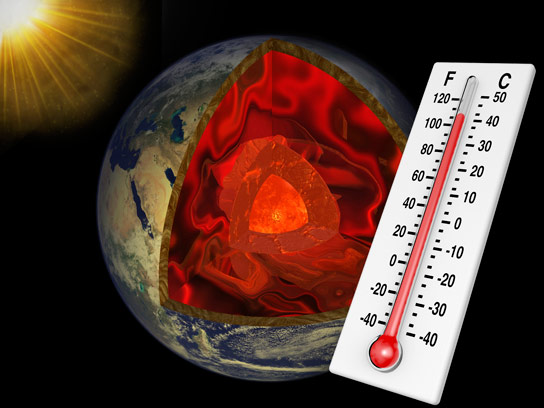
Geoscientists from Rice University are building a whole-Earth model to study long-term climate evolution, focusing on how carbon moves between Earth’s external and internal systems.
A Rice University-based team of geoscientists is going to great lengths — from Earth’s core to its atmosphere — to get to the bottom of a long-standing mystery about the planet’s climate.
“We want to know what controls long-term climate change on Earth, the oscillations between greenhouse and icehouse cycles that can last as long as tens of million years,” said Cin-Ty Lee, professor of Earth science at Rice and the principal investigator (PI) on a new $4.3 million, five-year federal grant from the National Science Foundation’s Frontiers in Earth-System Dynamics (FESD) Program.
“There are long periods where Earth is relatively cool, like today, where you have ice caps on the North and South poles, and there are also long periods where there are no ice caps,” Lee said. “Earth’s climate has oscillated between these two patterns for at least half a billion years. We want to understand what controls these oscillations, and we have people at universities across the country who are going to attack this problem from many angles.”
For starters, Lee distinguished between the type of climate change that he and his co-investigators are studying and the anthropogenic climate change that often makes headlines.
“We’re working on much longer timescales than what’s involved in anthropogenic climate change,” Lee said. “We’re interested in explaining processes that cycle over tens of millions of years.”
Lee described the research team as “a patchwork of free spirits” that includes bikers, birdwatchers, and skateboarders who are drawn together by a common interest in studying the whole Earth dynamics of carbon exchange. The group has specialists in oceanography, petrology, geodynamics, biogeochemistry, and other fields, and it includes more than a dozen faculty and students from the U.S., Europe, and Asia. Rice co-PIs include Rajdeep Dasgupta, Gerald Dickens, and Adrian Lenardic.
The team will focus on how carbon moves between Earth’s external and internal systems. On the external side, carbon is known to cycle between oceans, atmosphere, biosphere, and soils on timescales ranging from a few days to a few hundred thousand years. On million-year to billion-year timescales, carbon in these external reservoirs interacts with reservoirs inside Earth, ranging from crustal carbon stored in ancient sediments preserved on the continents to carbon deep in Earth’s mantle.
“Because of these differences in timescales, carbon cycling at Earth’s surface is typically modeled independently from deep-Earth cycling,” Lee said. “We need to bring the two together if we are to understand long-term greenhouse-icehouse cycling.”
From the fossil record, scientists know that atmospheric carbon dioxide plays a vital role in determining Earth’s surface temperatures. Many studies have focused on how carbon moves between the atmosphere, oceans, and biosphere. Lee said the FESD team will examine how carbon is removed from the surface and cycled back into the deep Earth, and it will also examine how volcanic eruptions bring carbon from the deep Earth to the surface. In addition, the team will examine the role that volcanic activity and plate tectonics may play in periodically releasing enormous volumes of carbon dioxide into the atmosphere. One of several hypotheses that will be tested is whether Earth’s subduction zones may at times be dominated by continental arcs, and if so, whether the passage of magmas through ancient carbonates stored in the continental upper plate can amplify the volcanic flux of carbon.
“Long-term climate variability is intimately linked to whole-Earth carbon cycling,” Lee said. “Our task is to build up a clearer picture of how the inputs and outputs change through time.”
In addition to the Rice team, the project’s primary investigators include Jaime Barnes of the University of Texas at Austin, Jade Star Lackey of Pomona College, Michael Tice of Texas A&M University, and Richard Zeebe of the University of Hawaii. Research affiliates include Steve Bergman of Shell, Mark Jellinek of the University of British Columbia, Tapio Schneider of the Swiss Federal Institute of Technology, and Yusuke Yokoyama of the University of Tokyo.
Never miss a breakthrough: Join the SciTechDaily newsletter.
Follow us on Google and Google News.