
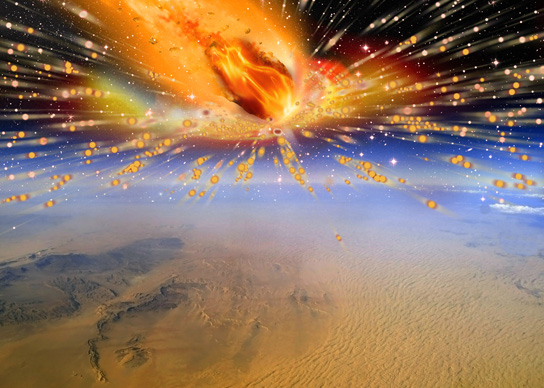
A team of scientists has discovered the first definitive proof of a comet striking Earth millions of years ago.
The first ever evidence of a comet entering Earth’s atmosphere and exploding, raining down a shock wave of fire which obliterated every life form in its path, has been discovered by a team of South African scientists and international collaborators, and will be presented at a public lecture on Thursday.
The discovery has not only provided the first definitive proof of a comet striking Earth, millions of years ago, but it could also help us to unlock, in the future, the secrets of the formation of our solar system.
“Comets always visit our skies – they’re these dirty snowballs of ice mixed with dust – but never before in history has material from a comet ever been found on Earth,” says Professor David Block of Wits University.
The comet entered Earth’s atmosphere above Egypt about 28 million years ago. As it entered the atmosphere, it exploded, heating up the sand beneath it to a temperature of about 2,000 degrees Celsius (3,600 degrees Fahrenheit), and resulting in the formation of a huge amount of yellow silica glass which lies scattered over a 6,000 square kilometers (2,300 square miles) area in the Sahara. A magnificent specimen of the glass, polished by ancient jewelers, is found in Tutankhamun’s brooch with its striking yellow-brown scarab.
The research, which will be published in Earth and Planetary Science Letters, was conducted by a collaboration of geoscientists, physicists and astronomers including Block, lead author Professor Jan Kramers of the University of Johannesburg, Dr Marco Andreoli of the South African Nuclear Energy Corporation, and Chris Harris of the University of Cape Town.
At the center of the attention of this team was a mysterious black pebble found years earlier by an Egyptian geologist in the area of the silica glass. After conducting highly sophisticated chemical analyses on this pebble, the authors came to the inescapable conclusion that it represented the very first known hand specimen of a comet nucleus, rather than simply an unusual type of meteorite.
Kramers describes this as a moment of career-defining elation. “It’s a typical scientific euphoria when you eliminate all other options and come to the realization of what it must be,” he said.
The impact of the explosion also produced microscopic diamonds. “Diamonds are produced from carbon-bearing material. Normally they form deep in the earth, where the pressure is high, but you can also generate very high pressure with shock. Part of the comet impacted and the shock of the impact produced the diamonds,” says Kramers.
The team have named the diamond-bearing pebble “Hypatia” in honor of the first well known female mathematician, astronomer, and philosopher, Hypatia of Alexandria.
Comet material is very elusive. Comet fragments have not been found on Earth before except as microscopic sized dust particles in the upper atmosphere and some carbon-rich dust in the Antarctic ice. Space agencies have spent billions to secure the smallest amounts of pristine comet matter.
“NASA and ESA (European Space Agency) spend billions of dollars collecting a few micrograms of comet material and bringing it back to Earth, and now we’ve got a radical new approach of studying this material, without spending billions of dollars collecting it,” says Kramers.
The study of Hypatia has grown into an international collaborative research program, coordinated by Andreoli, which involves a growing number of scientists drawn from a variety of disciplines. Dr Mario di Martino of Turin’s Astrophysical Observatory has led several expeditions to the desert glass area.
“Comets contain the very secrets to unlocking the formation of our solar system and this discovery gives us an unprecedented opportunity to study comet material firsthand,” says Block.
Reference: “Unique chemistry of a diamond-bearing pebble from the Libyan Desert Glass strewnfield, SW Egypt: Evidence for a shocked comet fragment” by Jan D. Kramers, Marco A.G. Andreoli, Maria Atanasova, Georgy A. Belyanin, David L. Block, Chris Franklyn, Chris Harris, Mpho Lekgoathi, Charles S. Montross, Tshepo Ntsoane, Vittoria Pischedda, Patience Segonyane, K.S. (Fanus) Viljoen and Johan E. Westraadt, 25 September 2013, Earth and Planetary Science Letters.
DOI: 10.1016/j.epsl.2013.09.003
Never miss a breakthrough: Join the SciTechDaily newsletter.
Follow us on Google and Google News.
6 Comments
There does not seem to be any explaination here about the “the first definitive proof” or how they know this happenen about 28 million years ago.
this article fails to mention many key new discoveries regarding comets, and mis labels them as “dirty snowballs”, a common misconception that has been repeatedly refuted by NADA missions of recent years. Also see: The electric universe theory, and the thunderbolts project.
Read article again, perhaps several times and then wait until research paper is published next month in Nov. The article is not about new discoveries regarding comets, or whatever ” dirty snowballs” is the right term for comets, neither is about the ” electric universe theory and the thunderbolt project”. You have dragged other subjects into the discussion which are not relevant to the scientist’s findings. The course of science is slow with mistakes, detours, going over familiar grounds again and again, and if lucky you may find something worth writing about, after strict testing, analyzing and the collaboration of others concernint the findings.
As noted article very incomplete. What is relation to Tunguska event as well as Shoemaker levy impact on Jupiter? What seems to be occuring here is some unexplainible hydrogen fusion reaction,unexplainable considering our presentday understanding of the conditions necessary for this event. Would suggest the following 1.analysis of any gamma rays emitted by shoemakerlevy. 2. fusion reactions should emit large amounts on neutrons which create the formation of many isotopes inthe area.
Extremely interesting piece
I seldom discuss these posts, but I thought this on deserved a well done you