

Close Menu
    Facebook X (Twitter) Instagram
    SciTechDaily
    • Biology
    • Chemistry
    • Earth
    • Health
    • Physics
    • Science
    • Space
    • Technology
    Facebook X (Twitter) Pinterest YouTube RSS
    SciTechDaily
    Home»Biology»Why Do Some People “Hear Voices”? A Look Inside the Schizophrenic Brain
    Biology

    Why Do Some People “Hear Voices”? A Look Inside the Schizophrenic Brain

    By PLOSOctober 3, 20241 Comment3 Mins Read
    Facebook Twitter Pinterest Telegram LinkedIn WhatsApp Email Reddit
    Share
    Facebook Twitter LinkedIn Pinterest Telegram Email Reddit
    Schizophrenia Faces Concept
    A study finds that auditory hallucinations in schizophrenia may be due to defects in brain processes that manage self-generated sounds, pointing to new therapeutic targets.

    Researchers have identified two potential brain process failures contributing to auditory hallucinations in schizophrenia: malfunctioning corollary discharge and overly active efference copy.

    Their study, involving EEGs of patients, shows these flaws may prevent the brain from properly identifying self-generated sounds, offering a new direction for treatment.

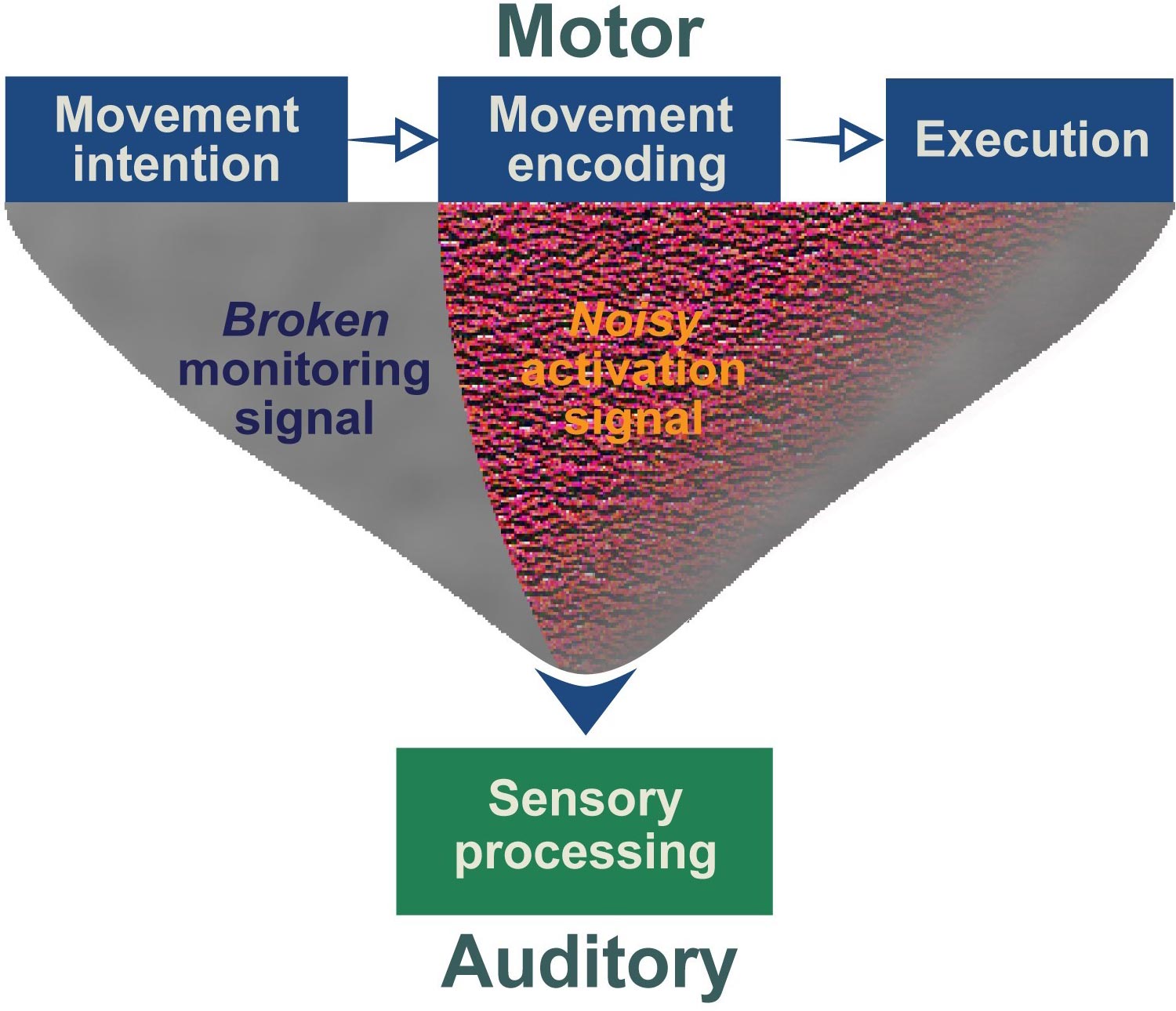
    Auditory hallucinations are likely the result of abnormalities in two brain processes: a “broken” corollary discharge that fails to suppress self-generated sounds, and a “noisy” efference copy that makes the brain hear these sounds more intensely than it should. That is the conclusion of a new study published today (October 3rd) in the open-access journal PLOS Biology by Xing Tian, of New York University Shanghai, China, and colleagues.

    Insights From EEG Experiments

    Patients with certain mental disorders, including schizophrenia, often hear voices in the absence of sound. Patients may fail to distinguish between their own thoughts and external voices, resulting in a reduced ability to recognize thoughts as self-generated. In the new study, researchers carried out electroencephalogram (EEG) experiments measuring the brain waves of twenty patients diagnosed with schizophrenia with auditory hallucinations and twenty patients diagnosed with schizophrenia who had never experienced such hallucinations.
    Cognitive Neural Mechanism of Auditory Hallucinations
    The cognitive neural mechanism of auditory hallucinations. Dissociative impairment of functional distinct signals in motor-to-sensory transformation process – a ‘broken’ monitoring signal plus a ‘noisy’ activation signal in the – causes erroneous monitoring of the imprecise generation of internal auditory representation and yields auditory hallucinations. (adapted from the manuscript.) Credit: Fuyin Yang and Xing Tian (CC-BY 4.0)

    Mechanisms Behind Hearing Voices

    In general, when people are preparing to speak, their brains send a signal known as “corollary discharge” that suppresses the sound of their own voice. However, the new study showed that when patients with auditory hallucinations were preparing to speak a syllable, their brains not only failed to suppress these internal sounds, but had an enhanced “efference copy” response to internal sounds other than the planned syllable.

    Future Directions for Treatment

    The authors conclude that impairments in these two processes likely contribute to auditory hallucinations and that targeting them in the future could lead to new treatments for such hallucinations.

    The authors add, “People who suffer from auditory hallucinations can ‘hear’ sounds without external stimuli. A new study suggests that impaired functional connections between motor and auditory systems in the brain mediate the loss of ability to distinguish fancy from reality.”

    Reference: “Impaired motor-to-sensory transformation mediates auditory hallucinations” by Fuyin Yang, Hao Zhu, Xinyi Cao, Hui Li, Xinyu Fang, Lingfang Yu, Siqi Li, Zenan Wu, Chunbo Li, Chen Zhang and Xing Tian, 3 October 2024, PLOS Biology.
    DOI: 10.1371/journal.pbio.3002836

    Funding: This study was supported by the National Natural Science Foundation of China 32071099 and 32271101, Natural Science Foundation of Shanghai 20ZR1472100, Program of Introducing Talents of Discipline to Universities, Base B16018 to X.T., East China Normal University (ECNU) Academic Innovation Promotion Program for Excellent Doctoral Students YBNLTS2019-026 and China Postdoctoral Foundation under Grant Number 2024M752047 to F.Y. The funders had no role in study design, data collection and analysis, decision to publish, or preparation of the manuscript.

    Never miss a breakthrough: Join the SciTechDaily newsletter.
    Follow us on Google and Google News.

    Brain Neuroscience PLOS Schizophrenia
    Share. Facebook Twitter Pinterest LinkedIn Email Reddit

    Related Articles

    Scientists Discover That Ketamine Increases Brain Noise

    Abnormal 12-Hour Cyclic Gene Activity Found in Schizophrenic Brains

    Scientists Reveal New Potential Therapeutic Targets for Mental and Neurological Disorders

    How Left Brain Asymmetry Is Related to Reading Ability – Two “Opposing” Theories Are Both Correct

    Magnetic Brain Stimulation Can Improve Memory

    Protein Made in the Liver May Cause Alzheimer’s Disease in the Brain

    Neuroscience Experiment Shows How Dopamine Drives Hallucination-Like Perception in Mice

    Neurotransmitter Levels in the Brain Predict Math Ability

    Evidence of Sleep-Dependent Brain Activity in Clearing Toxic Proteins and Preventing Alzheimer’s Disease

    1 Comment

    1. Candace Bell on October 26, 2024 4:17 pm

      Will TMS therapy help?

      Reply
    Leave A Reply Cancel Reply

    • Facebook
    • Twitter
    • Pinterest
    • YouTube

    Don't Miss a Discovery

    Subscribe for the Latest in Science & Tech!

    Trending News

    One of the Universe’s Largest Stars May Be Getting Ready To Explode

    Scientists Discover Enzyme That Could Supercharge Ozempic-Like Weight Loss Drugs

    Popular Sweetener Linked to DNA Damage – “It’s Something You Should Not Be Eating”

    Ancient “Rock” Microbes May Reveal How Complex Life Began

    Researchers Capture Quantum Interference in One of Nature’s Rarest Atoms

    “A Plague Is Upon Us”: The Mass Death That Changed an Ancient City Forever

    Scientists Discover Game-Changing New Way To Treat High Cholesterol

    This Small Change to Your Exercise Routine Could Be the Secret to Living Longer

    Follow SciTechDaily
    • Facebook
    • Twitter
    • YouTube
    • Pinterest
    • Newsletter
    • RSS
    SciTech News
    • Biology News
    • Chemistry News
    • Earth News
    • Health News
    • Physics News
    • Science News
    • Space News
    • Technology News
    Recent Posts
    • New Research Uncovers Hidden Side Effects of Popular Weight-Loss Drugs
    • Scientists Rethink Extreme Warming After Surprising Ocean Discovery
    • The Surprising Role of Asteroids in the Origin of Life
    • Scientists Raise Concerns Over Newly Recognized Pollutant Found Everywhere in the Air
    • New Study Challenges 40-Year Puzzle About Childhood Body Fat
    Copyright © 1998 - 2026 SciTechDaily. All Rights Reserved.
    • Science News
    • About
    • Contact
    • Editorial Board
    • Privacy Policy
    • Terms of Use

    Type above and press Enter to search. Press Esc to cancel.