

A Study on Fruit Flies Revealed a Brain Circuit That Promotes Midday Napping on Hot Days
You might find yourself falling asleep in the middle of the day on the hottest summer days. It’s customary to arrange “siestas” and close shops at the hottest times of the day in some parts of the world. In fact, biology—not just culture—might be the cause of this.
Human behavior is impacted by temperature across the board, including eating and activity levels as well as sleep-wake cycles. In the summer, we may have trouble falling asleep, and in the winter, we might take longer to get out of bed. However, the relationship between sensory neurons and the neurons that control this cycle is not well known.
Neurobiologists at Northwestern University have uncovered a few hints as to what is going on. According to a new study that was just published in Current Biology, fruit flies are biologically programmed to nap in the middle of the day. The new paper, which is a follow-up to their 2020 Biology publication that discovered a brain thermometer that is exclusively active in cold conditions, investigates a similar “thermometer” circuit for hot temperatures.
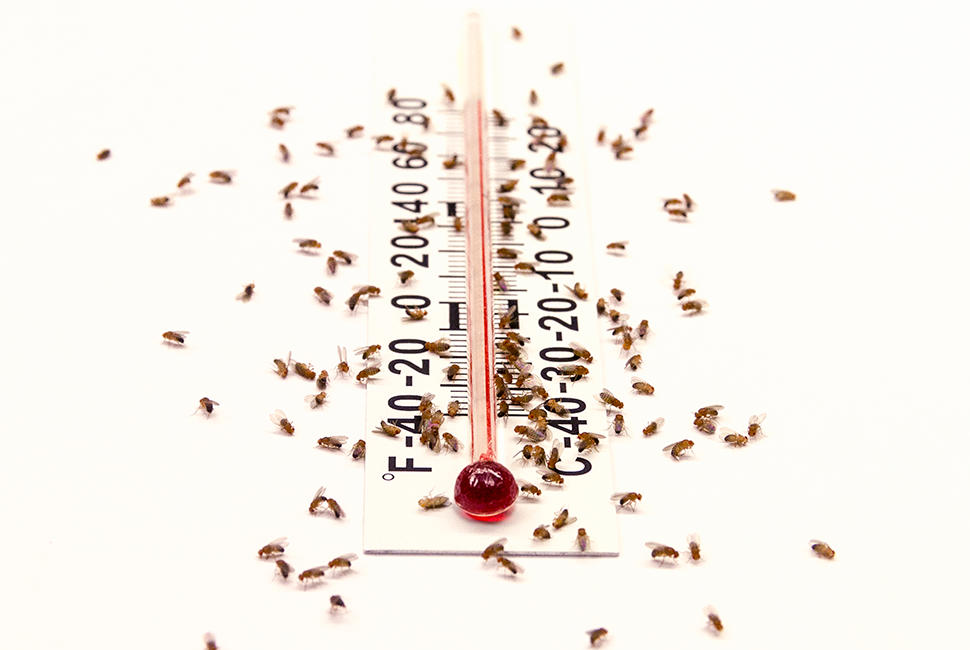
“Changes in temperature have a strong effect on behavior in both humans and animals, and offer animals a cue that is time to adapt to the changing seasons,” said Marco Gallio, associate professor of neurobiology at the Weinberg College of Arts and Sciences. “The effect of temperature on sleep can be quite extreme, with some animals deciding to sleep off an entire season — think of a hibernating bear — but the specific brain circuits that mediate the interaction between temperature and sleep centers remain largely unmapped.”
The study’s lead author, Gallio, noted that fruit flies are a particularly useful model for investigating important questions like “why do we sleep” and “what does sleep do for the brain” because they don’t try to disrupt instinct in the same way that people do, for instance when they stay up all night studying. They also make it possible for researchers to investigate how biological pathways are influenced by external cues like light and temperature.
Cells That Stay on Longer
The paper is the first to identify “absolute heat” receptors in fly heads, which respond to temperatures above about 77 degrees Fahrenheit — the fly’s favorite temperature. As it turns out, the common laboratory fruit fly (Drosophila) has colonized nearly the entire planet by forming a close association with humans. Not surprisingly, its favorite temperature also matches that of many humans.
Just as they expected based on the results of their previous paper on cold temperature, researchers found that brain neurons receiving information about heat are part of the broader system that regulates sleep. When the hot circuit, which runs parallel to the cold circuit, is active, the target cells that promote midday sleep stay on longer. This results in an increase in midday sleep that keeps flies away from the hottest part of the day.
The study was enabled by a 10-year initiative that produced the first completed map of neural connections in an animal (a fly), called the connectome. With the connectome, researchers have access to a computer system that tells them all possible brain connections for each of the fly’s ~100,000 brain cells. However, even with this extremely detailed road map, researchers still need to figure out how information in the brain goes from point A to B. This paper helps fill that gap.
The different circuits for hot versus cold temperatures make sense to Gallio because “hot and cold temperatures can have quite different effects on physiology and behavior,” he said. This separation may also reflect evolutionary processes based on the heat and cold cycles of the Earth. For example, the possibility that brain centers for sleep may be directly targeted in humans by a specific sensory circuit is now open to be investigated based on this work.
Next Steps
Next, Gallio’s team hopes to figure out the common targets of the cold and hot circuit, to discover how each can influence sleep.
“We identified one neuron that could be a site of integration for the effects of hot and cold temperatures on sleep and activity in Drosophila,” said Michael Alpert, the paper’s first author and a post-doctoral researcher in the Gallio lab. “This would be the start of interesting follow-up studies.”
Gallio added that the team is interested in looking at the long-term effects of temperature on behavior and physiology to understand the impact of global warming, looking at how adaptable species are to change.
“People may choose to take an afternoon nap on a hot day, and in some parts of the world this is a cultural norm, but what do you choose and what is programmed into you?” Gallio said. “Of course, it’s not culture in flies, so there actually might be a very strong underlying biological mechanism that is overlooked in humans.”
Reference: “A thermometer circuit for hot temperature adjusts Drosophila behavior to persistent heat” by Michael H. Alpert, Hamin Gil, Alessia Para and Marco Gallio, 17 August 2022, Current Biology.
DOI: 10.1016/j.cub.2022.07.060
The study was funded by the National Institutes of Health.
Never miss a breakthrough: Join the SciTechDaily newsletter.
Follow us on Google and Google News.
2 Comments
Study must be flawed.
I cannot sleep in heat at all.
I only sleep good when its cold which is why I turn down the thermostat every night.
… the 2 C° will do it!!! on large population of individuals … it will make us more … well… tucked in for a big nap…