
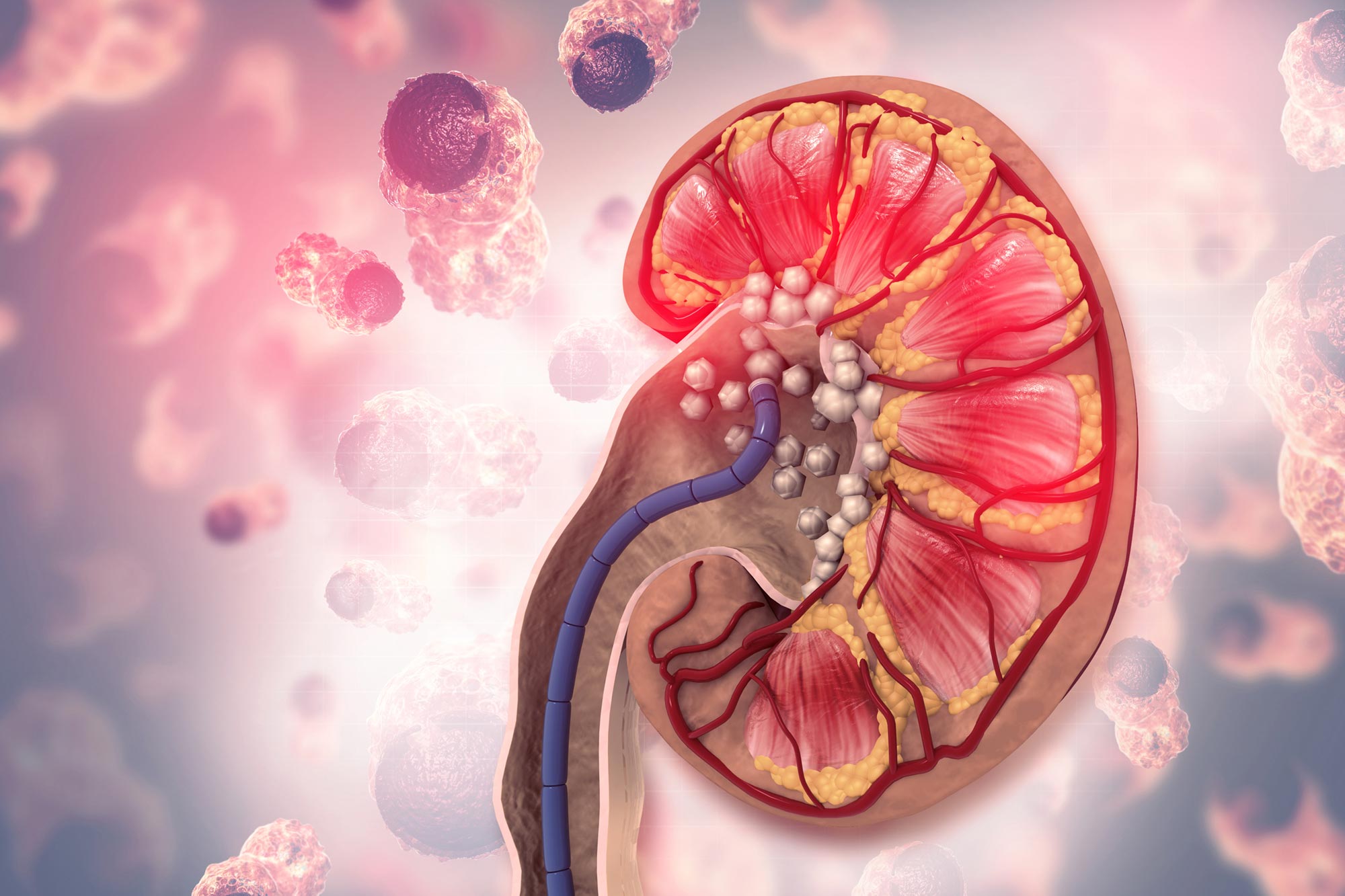
A major study finds that simply encouraging people to drink more water may not be enough to stop kidney stones from coming back.
Kidney stones are small, hard mineral deposits, but the pain they cause can be overwhelming. They often strike suddenly, interrupt daily life, and send people to the emergency room. In the United States, about 1 in 11 people will develop a kidney stone, and nearly half will have another one later.
Because stones often return, prevention matters as much as treatment. A major new study from the Urinary Stone Disease Research Network, coordinated by the Duke Clinical Research Institute, tested whether a behavioral program could help people drink enough fluid to lower that risk.
Published in The Lancet, the research sheds light on why preventing kidney stones remains difficult, even among individuals who are motivated and receive ongoing support.
“The trial results show that despite the importance of high fluid intake to prevent stone recurrence, achieving and maintaining very high fluid intake is more challenging than we often assume for people with urinary stone disease,” said Charles Scales, M.D., corresponding and co-senior author of the paper and associate professor in the departments of Urology and Population Health Sciences at Duke University School of Medicine.
“The challenge of adherence likely contributes to the relatively high rate of stone recurrence in people with this chronic condition,” Scales said.
Inside the Behavioral Hydration Program
Participants were randomly assigned to either standard care or a behavioral hydration program. This program included Bluetooth-enabled smart water bottles to track fluid intake, personalized hydration goals (“fluid prescriptions”), financial incentives, reminder text messages, and health coaching to encourage increased fluid consumption.
Each “fluid prescription” was based on how much urine a participant typically produced and how much additional fluid was needed to reach a daily urine output target of at least 2.5 liters (about 85 ounces).
Those in the program did increase their fluid intake and urine output. However, the improvement was not enough to reduce the overall rate of symptomatic kidney stone recurrence.
The study enrolled 1,658 adolescents and adults across six U.S. clinical centers (UT Southwestern Medical Center, Washington University in St. Louis, University of Pennsylvania/Children’s Hospital of Philadelphia, University of Washington, Mayo Clinic and Cleveland Clinic). Participants were followed for two years after enrollment, making this the largest behavioral study focused on kidney stone prevention.
Researchers emphasized that this was the first trial designed to track actual stone recurrence rather than relying only on fluid intake or urine output. Surveys and imaging were used throughout the study to monitor whether new stones developed or existing ones grew.
The findings highlight how difficult it is for many people to consistently drink large amounts of fluid, even with structured support. They also suggest that a single hydration target may not work for everyone, since fluid needs vary based on factors such as age, body size, lifestyle, and overall health.
Toward More Personalized Prevention
“Across adolescents and adults, the study moves the field toward more precise prevention,” said Gregory E. Tasian, M.D., co-senior author and attending pediatric urologist in the Division of Urology and principal investigator of the trial at the Children’s Hospital of Philadelphia.
“Rather than asking every patient to meet the same fluid goal, we should determine who benefits from which targets, understand why adherence breaks down, and build interventions — behavioral and medical — that reliably reduce stone recurrence,” Tasian said.
The researchers say these results point to the need for new prevention approaches. These could include individualized hydration goals, strategies to address real-world barriers such as work and daily habits, and therapies that help keep minerals dissolved in urine.
“Kidney stone disease is a chronic condition, punctuated by unpredictable, sometimes excruciatingly painful episodes that can disrupt work, sleep, productivity and life in general,” said Alana Desai, M.D., first author of the study and principal investigator at the Washington University in St. Louis study site.
“Most people would appreciate a simple means to reduce their chances of experiencing another event,” said Desai.
Reference: “Prevention of urinary stones with hydration: a randomised clinical trial of an adherence intervention” by Alana C Desai, Naim M Maalouf, Jonathan D Harper, Sri Sivalingam, John C Lieske, H Henry Lai, Peter P Reese, Hunter Wessells, Hongqiu Yang, Hussein R Al-Khalidi, Ziya Kirkali, Gregory E Tasian and Charles D Scales, 21 March 2026, The Lancet.
DOI: 10.1016/S0140-6736(25)02637-6
This study, and other research conducted by the Urinary Stone Disease Research Network, is funded by the National Institute of Diabetes and Digestive and Kidney Diseases.
Never miss a breakthrough: Join the SciTechDaily newsletter.
Follow us on Google and Google News.
11 Comments
Testing and correcting a person’s ph balance may help
How about a correlation between kidney stones and hard water? If you live in an area with hard water as I do, and don’t filter it, then drinking more water will make the problem even worse. And kidney stones are not a ‘disease’ as the university Ph.D. stated. Unless she can prove they are caused by bacteria or viruses….
I don’t agree with all of this. Nov 23 l had kidney stones big time. Hospital trip ,one was still in my left Kidney. Everything fine until Jan 2024 . They didn’t find anything. But l knew. Hospital 2 days later for UTI. 6 months straight a uti every month. And 2 more Kidney stones.which l was able to remove myself. Hasn’t been a year yet because no Dr. is doing anything to prevent it. I drink 90 Oz of water everyday. But they don’t do anything to prevent it. Nor answers.
How did you remove it on your own?
I used to have kidney stone problems. Suffering through a kidney stone that needs to pass but won’t move is probably the most pain I have ever felt.
Drinking more water helped but I don’t drink 2.5 liters a day! I think eliminating calcium supplements is what did the trick for me.
Avoid oxalate Rich foods – greens, beetroot nuts, if you want to take,add curd, lemon juice a little as you prefer
I think that calcium supplements are definitely a factor for many people who have suffered from kidney stones. These supplements can also cause or at least exacerbate other conditions, such as aortic stenosis (family experience).
My doctor told me too much salt and coca cola or any pop like Pepsi or doctor pepper isn’t good for kidney stones ive stopped drinking it and I feel much better
I have one functioning right kidney, the left one is gone due to 5 cm stone in it. I had some stones in healthy one as well but it is removed by laser procedure on 20/2/2026. The reason I lost my kidney was not malfunctioning of water, it was the usage of red meat regularly that contains high amounts of calcium and protein. As CKD pointed for me it is very difficult to drink 2 liters of water, because every 20 minutes I have to visit restroom. If anyone has the same issue and have positive ideas to share , I would appreciate it.
I am sure the full article would talk about different types of stone and the relevance of diet and genetics involved; however, if it doesn’t, then these are the points that need to be addressed when dealing with kidney stones. Of course, a nidus for stone formation could be bacteria. The solubility product for the formation of each type of stone can also determine how much urine needs to be produced, rather than how much fluid needs to be consumed during the day.
People with Kidney stones should be evaluated for Hyperparathyroidism. Your Parathyrids regulate your calcium level in your body. Kidney stones is one of the symptoms it can cause when they are overactive.