
Upwelling of deep water rich in phosphorus supports an N-fixing symbiont that lives on Sargassum algae, giving the algae a competitive advantage.
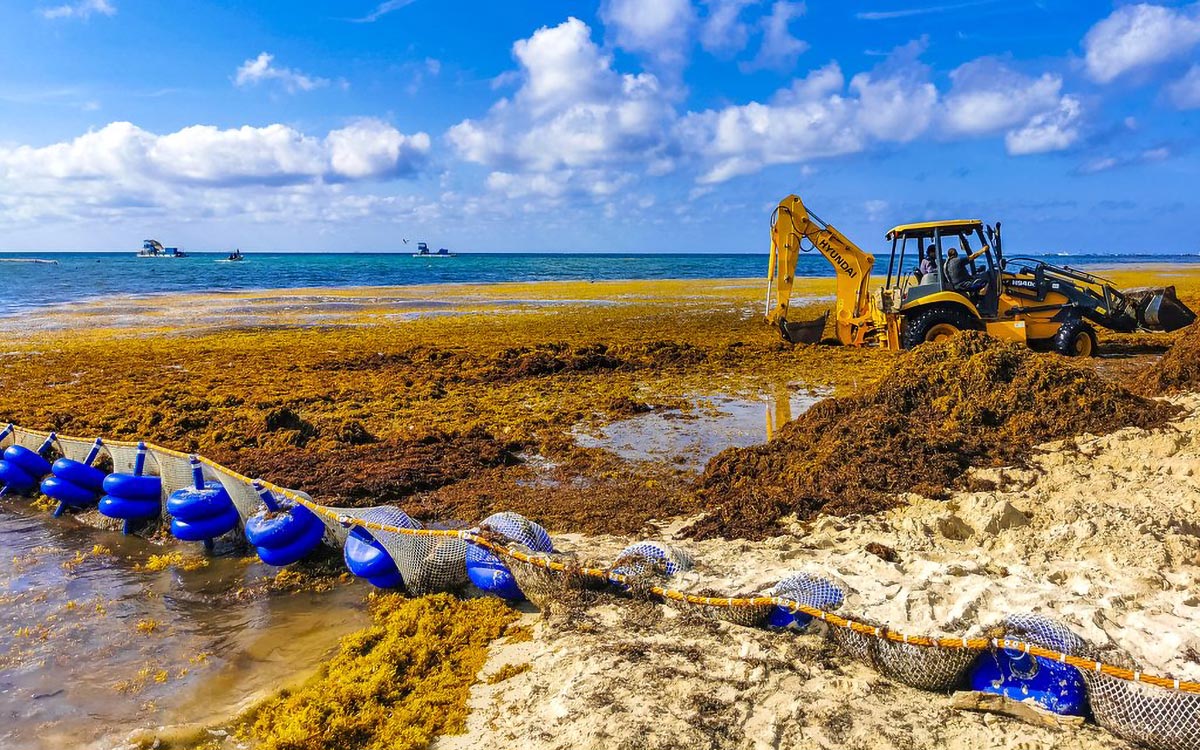
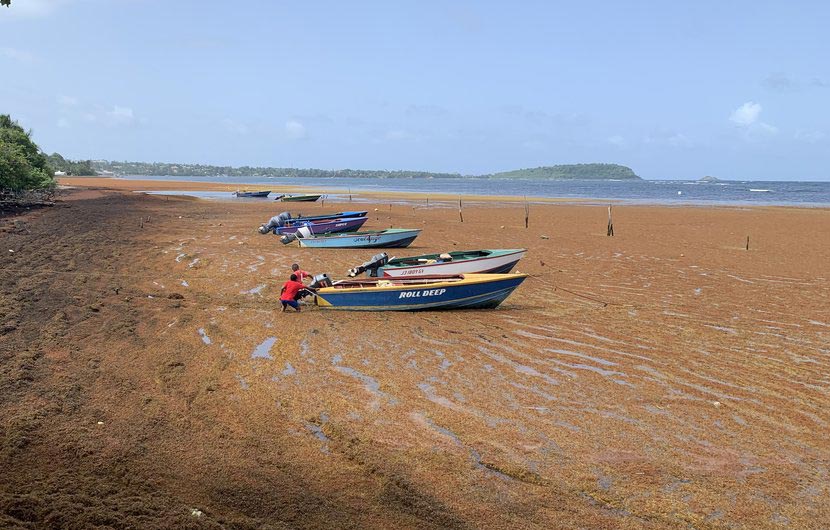
By early June of this year, roughly 38 million tons of Sargassum had drifted toward the coasts of the Caribbean islands, the Gulf of Mexico, and northern South America, setting a new record. During the summer months, these brown algae often pile up along shorelines, where they decompose and release a strong odor.
This accumulation not only discourages tourism but also threatens coastal ecosystems. In open waters, however, floating Sargassum serves as an important food source and habitat for many marine species.
The algae originally come from the Sargasso Sea, located east of Florida. Since 2011, scientists have repeatedly documented the formation of the Great Atlantic Sargassum Belt, a massive stretch of seaweed that drifts from the equator toward the Caribbean under prevailing easterly winds.
Until recently, the sources of phosphorus (P) and nitrogen (N) that fuel the algae’s rapid growth were not well understood. Many researchers suspected that nutrient runoff from agriculture or rainforest deforestation was responsible, but these factors alone cannot explain the sharp rise in Sargassum biomass seen in recent years.
A new study led by the Max Planck Institute for Chemistry has identified the main mechanism behind these extensive blooms, along with the climatic conditions that favor them. This discovery has allowed scientists to design a predictive system to forecast future Sargassum stranding events.
Extra nitrogen provided by cyanobacteria growing on the algae
In the latest issue of Nature Geoscience, researchers from Mainz describe how strong wind-driven upwelling near the equator brings phosphorus-rich deep water to the surface, transporting it northward toward the Caribbean. The resulting increase in phosphorus availability promotes the growth of cyanobacteria that live on the surface of Sargassum.
These microorganisms are capable of capturing atmospheric nitrogen gas (N₂) and converting it into a form the algae can use—a process known as nitrogen fixation. The cyanobacteria form a symbiotic relationship with the algae, providing an additional nitrogen source that enhances their growth. According to the study, this partnership gives Sargassum a competitive advantage over other algae in the Equatorial Atlantic and helps explain the recent rise in its biomass.
Nitrogen isotopes bound in coral cores have unveiled nitrogen fixation rates over the past 120 years
The researchers have identified the connection between algal blooms, increased nitrogen fixation, and the upwelling of cool, nutrient-rich deep water by analyzing coral cores from diverse Caribbean locations. Corals are vital archives to reconstruct past changes in the ocean because during their growth they incorporate chemical signatures from the water in their calcareous skeletons. By analyzing coral annual growth layers, which are akin to tree rings, researchers can reveal changes in the chemical composition of the ocean over the past centuries.
In this study, the Max Planck researchers have analyzed the nitrogen isotopic composition of corals to reconstruct the amount of nitrogen fixed in the ocean by microorganisms over the last 120 years. During nitrogen fixation bacteria lower the ratio of stable nitrogen isotopes 15N to 14N in the ocean. Thus, periods of low 15N to 14N analyzed in the coral layers indicate times of high nitrogen fixation rates. Seawater samples collected by the research vessel Eugen Seibold were used to calibrate the nitrogen isotopic composition of modern corals, demonstrating that they record nitrogen fixation.
Since 2011, algae growth and nitrogen fixation have remained coupled
Jonathan Jung, a PhD student at the Max Planck Institute for Chemistry and first author of the study, explains, “In the first set of measurements, we noticed two significant increases in nitrogen fixation in 2015 and 2018, two years of record Sargassum blooms. So we compared our coral reconstruction with annual Sargassum biomass data, and the two records aligned perfectly! At that time, however, it was not at all clear whether there was a causal link.”
The researchers identified a connection after examining both sets of measurements. It turned out that not only the maximum values but the entire data series for algae growth and nitrogen fixation, including minimum values, have been coupled since 2011. This timing is important because, in 2010, strong winds displaced brown algae for the first time from the Sargasso Sea to the tropical Atlantic.
The research team concluded that the excess of phosphorus is the key factor in Sargassum blooms by eliminating other possibilities. One previous theory suggested that iron-rich Saharan dust, which frequently blows from Africa to the Atlantic, promotes the growth of the algae. However, the dust input did not correlate with biomass. Similarly, nutrient inputs from the Amazon or Orinoco rivers did not correlate with observations of Sargassum blooms.
The new mechanism can be used to improve predictions of future Sargassum blooms
In their publication, the researchers therefore describe a mechanism in which phosphorus from upwelling deep water and nitrogen from nitrogen fixation drive algal blooms observed during the past decades. Geochemist Jung adds: “Our mechanism explains the variability of Sargassum growth better than any previous approaches. However, there is still uncertainty as to whether and to what extent other factors also play a role.”
The supply of phosphorus occurs due to cooler sea surface temperatures in the tropical North Atlantic and warmer temperatures in the southern Atlantic. These temperature variations cause changes in air pressure, leading to wind anomalies that displace surface water and allow phosphorus-rich water from the deep sea to flow in.
According to Mainz researchers, observing winds, sea temperatures, and the resulting upwelling changes in the equatorial Atlantic can improve predictions of Sargassum growth. Alfredo Martínez-García, group leader at the Max Planck Institute for Chemistry and senior author of the study, explains: “Ultimately, the future of Sargassum in the tropical Atlantic will depend upon how global warming affects the processes that drive the supply of excess phosphorous to the equatorial Atlantic.”
His team plans to provide a more detailed view of these processes by measuring new coral records from different locations across the Caribbean. The researchers expect that these new findings can guide efforts to mitigate the impacts of the blooms on Caribbean reef ecosystems and coastal communities.
Reference: “Equatorial upwelling of phosphorus drives Atlantic N2 fixation and Sargassum blooms” by Jonathan Jung, Nicolas N. Duprey, Alan D. Foreman, Juan Pablo D’Olivo, Carolin Pellio, Yeongjun Ryu, Erin L. Murphy, Baseerat Romshoo, Diego K. Kersting, Gabriel O. Cardoso, Tanja Wald, François Fripiat, Carlos Jimenez, Eberhard Gischler, Paolo Montagna, Carlos Alonso-Hernández, Miguel Gomez-Batista, Christina Treinen-Crespo, José Carriquiry, Maria Rosabelle Ong, Nathalie F. Goodkin, Reia Guppy, Hedy Aardema, Hans Slagter, Lena Heins, Isabella Hrabe de Angelis, Aaron L. Bieler, Maayan Yehudai, Trevor P. Noël, Kendon James, Denis Scholz, Chuanmin Hu, Brian B. Barnes, Andrea Pozzer, Christopher Pöhlker, Jos Lelieveld, Ulrich Pöschl, Hubert Vonhof, Gerald H. Haug, Ralf Schiebel, Daniel M. Sigman and Alfredo Martínez-García, 5 November 2025, Nature Geoscience.
DOI: 10.1038/s41561-025-01812-2
Never miss a breakthrough: Join the SciTechDaily newsletter.
Follow us on Google and Google News.
6 Comments
In New Zealand and the Channel Islands Sargassom is collected from the beaches for spreading on the fields and people hang it in fruit trees to discourage leaf curl ! I believe it is also used instead of gelatine for puddings, and for wrapping food.
I was just thinking, couldn’t it collected and used as organic fertilizer.
It’s the elevated CO2 level.
When you raise the CO2 levels, plant growth accelerates, assuming that the nutrient and light levels are also high.
We ran greenhouses with CO2 generators… same idea… The growth rate is measurably greater.
So there should be similar elevated algae/seaweed blooms happening elsewhere in the world …🤔
I mean this is kind of obvious, all the fertilizers we use leach into rivers and then into the oceans, it was so bad here they couldn’t use the local river as a water source for a while because the nitrate levels were so high.
Let’s see, seaweed is a plant. Plants power themselves through photosynthesis turning CO2 into oxygen. More CO2 in the environment means more energy for plants so they grow more abundantly. Might that not be a factor too?
Oops sorry, I forgot. CO2 is always bad….
This is the solution to the artifical fertiliser replacement for food production and towards neutrialising excess emission production, seaweed has always been a rich nutrient that has no artifical properties. I hope the local people can harvest it and make a living.