
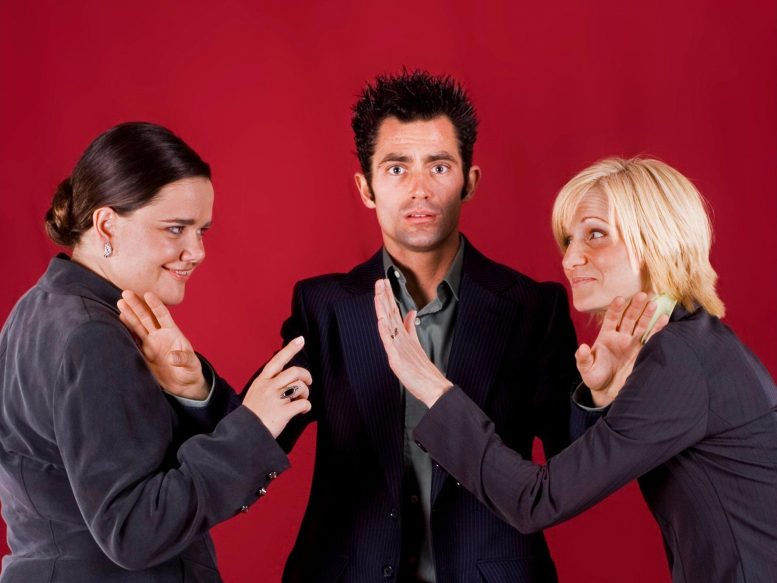
Are we really living in a polarized world? A mathematical model reveals surprises — particularly about people in the middle.
When people talk about the political spectrum, it’s often in reference to “opposite sides.” Whether the sides are “conservatives versus liberals,” “Republicans versus Democrats,” or “left versus right,” the center is rarely included — and can be actively excluded, according to Santa Fe Institute research published this week in the journal PLOS One.
In the paper, mathematician Vicky Chuqiao Yang, sociologist Tamara van der Does, and cognitive scientist Henrik Olsson mathematically model how people categorize each other along a spectrum. The foundational hypothesis of their work comes from cognitive psychology and assumes that when people form categories it’s to tell each other apart as accurately as possible.
But remembering where everyone is on a continuum is challenging, so people use a shortcut of dividing everyone into two camps: “us” or “them.” And those within the same group want to agree about boundaries that separate “us” from “them.”

“The categorization makes it easier for people to think about things. We only have so much mental capacity,” explains Yang.
“We are trying to understand why we tend to create categories for things in our everyday life like political views, gender, sexuality, and race, even if in reality these things are on a continuous spectrum,” says van der Does. “Specifically, we want to look at the benefits of categorizations to understand when they emerge.”
Modeling Social Boundaries with Applied Math
In the paper, the researchers explore these questions via a dynamical-system model, which is an applied math method frequently used to study natural or engineered systems. By combining cognitive and social components together into the model’s equations, Yang says they can “solve” for where the social boundaries appear.
The researchers applied their model to a large dataset from U.S. political surveys from the 1980s, with the goal of understanding how self-identified Democrats and Republicans at the ends of the spectrum perceived political independents in the center. Would the extremes welcome the “in-betweeners” as close allies? Would they lump them in with the other side? Or would they perceive them as something truly in-between?
The model predicted that when two groups form, both want to exclude those in the middle – a dynamic born out by the survey data.
“By being ‘inbetweeners,’ independents are viewed as unfavorably as the other party by both sides, and left out,” Yang says. “So Independents get the worst of both worlds, and there are downstream consequences.”
The main takeaway of this work is that the middle falls through the cracks of the categorization process — and not just in politics. The researchers’ model could also be applied to understand how social categories form around other attributes, like skin color.
The Disappearing Middle and Identity Polarization
“One possible consequence of falling through the cracks is that people in the middle may be motivated to appear as if they belong to one of the two camps — despite misalignment on policy positions,” says Yang. “This creates a feedback loop, and eventually the middle might disappear, and then you’re left with two camps that are quite strong in their identity and hostility toward each other.”
“Not many scientific studies have studied this dynamic. For example, the national survey we analyzed stopped asking about attitudes towards political Independents after the 1980s. But it’s very unfortunate and we should pay more attention to it,” says Yang. Studying people in the middle “is really important, especially how they’re treated by other members of a diverse society.”
Reference: “Falling through the cracks: Modeling the formation of social category boundaries” by Vicky Chuqiao Yang, Tamara van der Does and Henrik Olsson, 31 March 2021, PLOS ONE.
DOI: 10.1371/journal.pone.0247562
Vicky Chuqiao Yang is an Omidyar Fellow and Peters Hurst Scholar at the Santa Fe Institute; Tamara van der Does is a Program Postdoctoral Fellow at the Santa Fe Institute; Henrik Olsson is an External Professor at the Santa Fe Institute.
Never miss a breakthrough: Join the SciTechDaily newsletter.
Follow us on Google and Google News.
1 Comment
The research agrees with my long-held view that a moderate is someone who is reviled by both ends of the political spectrum.