
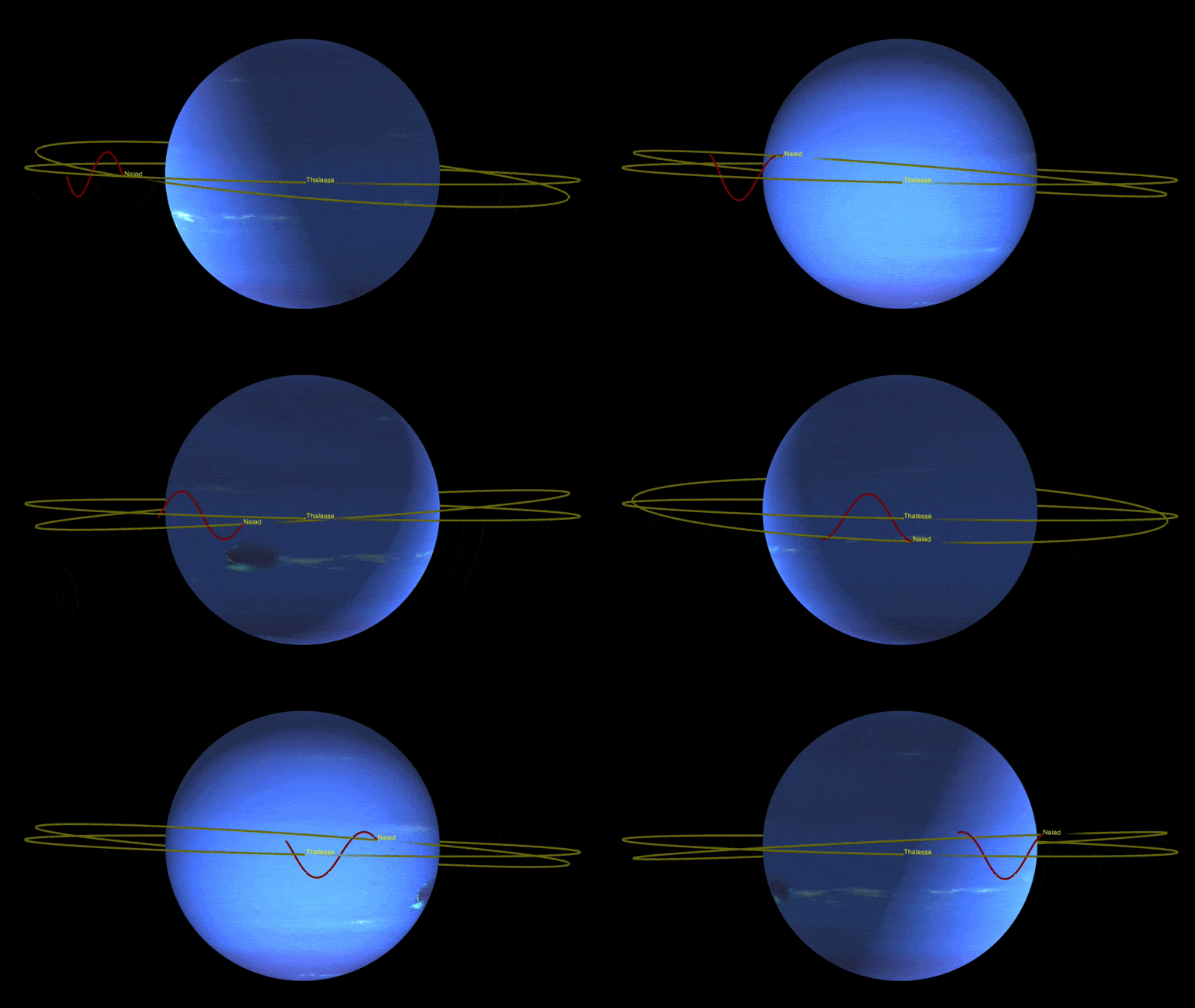
Even by the wild standards of the outer solar system, the strange orbits that carry Neptune’s two innermost moons are unprecedented, according to newly published research.
Orbital dynamics experts are calling it a “dance of avoidance” performed by the tiny moons Naiad and Thalassa. The two are true partners, orbiting only about 1,150 miles (1,850 kilometers) apart. But they never get that close to each other; Naiad’s orbit is tilted and perfectly timed. Every time it passes the slower-moving Thalassa, the two are about 2,200 miles (3,540 kilometers) apart.
An observer sitting on Thalassa would see Naiad in an orbit that varies wildly in a zigzag pattern, passing by twice from above and then twice from below. Credit: NASA/JPL-Caltech
In this perpetual choreography, Naiad swirls around the ice giant every seven hours, while Thalassa, on the outside track, takes seven and a half hours. An observer sitting on Thalassa would see Naiad in an orbit that varies wildly in a zigzag pattern, passing by twice from above and then twice from below. This up, up, down, down pattern repeats every time Naiad gains four laps on Thalassa.
Although the dance may appear odd, it keeps the orbits stable, researchers said.
“We refer to this repeating pattern as a resonance,” said Marina Brozovic, an expert in solar system dynamics at NASA’s Jet Propulsion Laboratory in Pasadena, California, and the lead author of the new paper, which was published November 13 in the journal Icarus. “There are many different types of ‘dances’ that planets, moons, and asteroids can follow, but this one has never been seen before.”
Far from the pull of the Sun, the giant planets of the outer solar system are the dominant sources of gravity, and collectively, they boast dozens upon dozens of moons. Some of those moons formed alongside their planets and never went anywhere; others were captured later, then locked into orbits dictated by their planets. Some orbit in the opposite direction their planets rotate; others swap orbits with each other as if to avoid collision.
Neptune has 14 confirmed moons. Neso, the farthest-flung of them, orbits in a wildly elliptical loop that carries it nearly 46 million miles (74 million kilometers) away from the planet and takes 27 years to complete.
Naiad and Thalassa are small and shaped like Tic Tacs, spanning only about 60 miles (100 kilometers) in length. They are two of Neptune’s seven inner moons, part of a closely packed system that is interwoven with faint rings.
“We refer to this repeating pattern as a resonance. There are many different types of ‘dances’ that planets, moons, and asteroids can follow, but this one has never been seen before.” — Marina Brozovic, NASA’s Jet Propulsion Laboratory
So how did they end up together — but apart? It’s thought that the original satellite system was disrupted when Neptune captured its giant moon, Triton, and that these inner moons and rings formed from the leftover debris.
“We suspect that Naiad was kicked into its tilted orbit by an earlier interaction with one of Neptune’s other inner moons,” Brozovic said. “Only later, after its orbital tilt was established, could Naiad settle into this unusual resonance with Thalassa.”
Brozovic and her colleagues discovered the unusual orbital pattern using analysis of observations by NASA’s Hubble Space Telescope. The work also provides the first hint about the internal composition of Neptune’s inner moons. Researchers used the observations to compute their mass and, thus, their densities — which were close to that of water ice.
“We are always excited to find these co-dependencies between moons,” said Mark Showalter, a planetary astronomer at the SETI Institute in Mountain View, California, and a co-author of the new paper. “Naiad and Thalassa have probably been locked together in this configuration for a very long time, because it makes their orbits more stable. They maintain the peace by never getting too close.”
Reference: “Orbits and resonances of the regular moons of Neptune” by Marina Brozović, Mark R. Showalter, Robert A. Jacobson, Robert S. French, Jack J. Lissauer and Imke de Pater, 22 October 2019, Icarus.
DOI: 10.1016/j.icarus.2019.113462
arXiv: 1910.13612
Never miss a breakthrough: Join the SciTechDaily newsletter.
Follow us on Google and Google News.
6 Comments
Lots of mundane motions look strange when viewed in a rotating reference frame.
Shameful. This solar system needs fewer suggestive dance moves and more Jesus.
Orbital resonance is actually pretty interesting. Stability through motion is somewhat counter intuitive until you understand the effects of angular momentum. Which I don’t, but I have played Kerbal Space Program. Which is a bit like spending the night at a Holiday Inn.
I think the suggestions that they are avoiding each other is misleading. It’s only by chance that they have different orbits that they haven’t destroy each other.
thanks Don
There are other orbital resonances in our solar system. Jupiter/Saturn for instance. It seems clear to me that more than just gravity is at play. The most obvious mechanism is electromagnetic. This would explain why orbits in general are stable and planetary bodies aren’t hitting each other like billiard balls. Does it really make sense that only gravity is at play? The stability of orbital families cannot be possible with just gravity.