
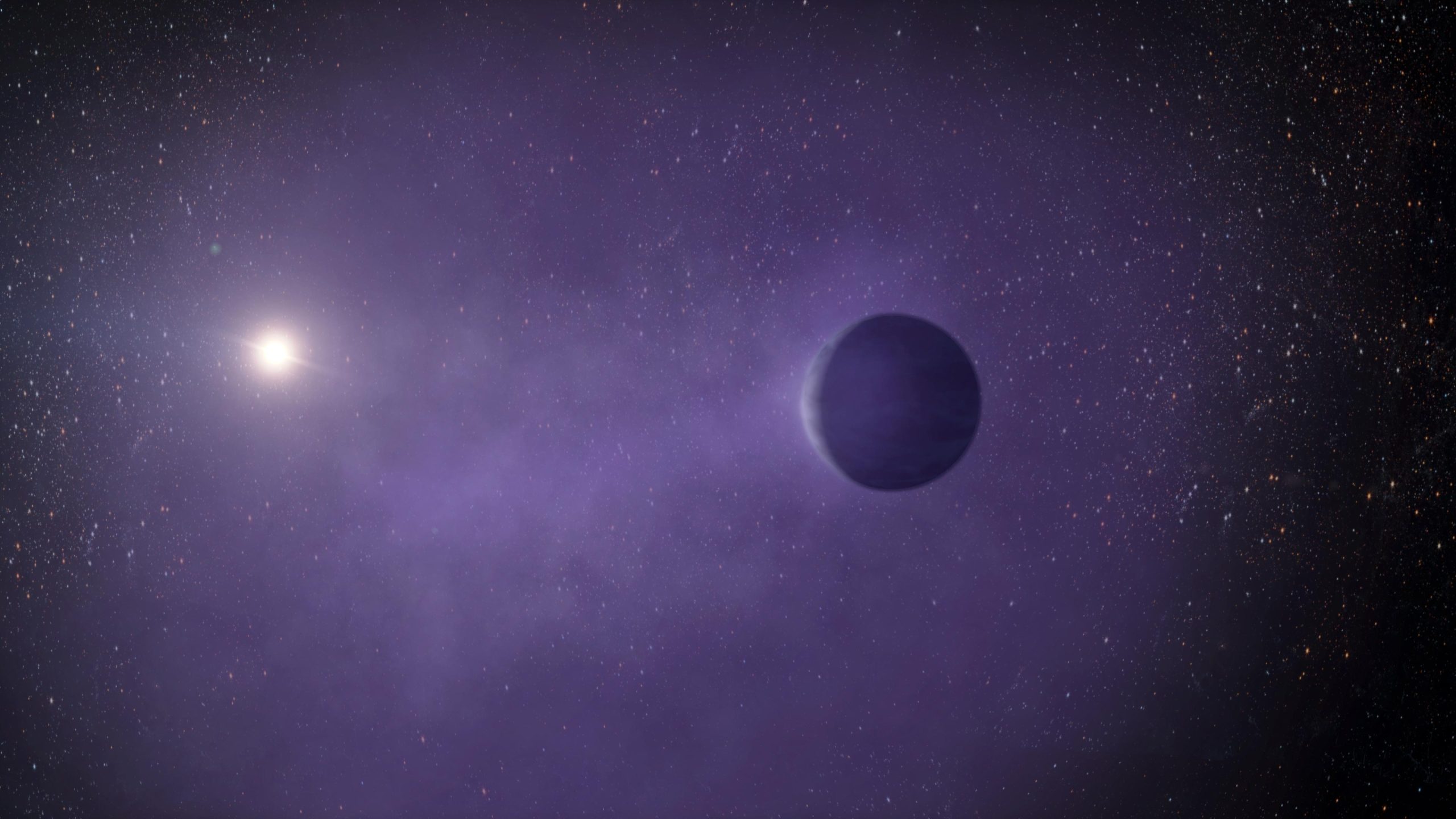
Worlds Around Other Stars Can Change Their Classification
If our solar system were a hobbyist kit, it would come boxed up with four rocky terrestrial planets, like Earth; and four gas giant planets like Jupiter.
What astronomers have discovered around some other stars is a rare type of planet not found in our solar system. It is not too big or too small but fits between the radius of Earth and the radius of Neptune. Toward the bottom of this range are dense “super-Earths” (no, not the home of the comic book hero, Superman) that are slightly bigger than Earth. Toward the top of the range are the puffier so-called “mini-Neptunes,” which have a fraction of the radius of the planet Neptune.
Astronomers are assembling a complex picture of how these sorts of “missing link” planets come to be. Apparently, the mini-Neptunes start out as smaller, denser versions of the planet Neptune. But radiation from a planet’s host star heats their hydrogen/helium atmosphere which then escapes into space like a hot air balloon. The planet goes onto sort of a crash-diet, losing a lot of mass until all that’s left is a dense, rocky core that is still bigger than Earth and may retain a thin skin of an atmosphere.
Astronomers using the Hubble Space Telescope and the Keck Observatory have identified two different cases of “mini-Neptune” planets that are losing their puffy atmospheres and possibly transforming into super-Earths. This is further evidence for the diversity – if not unpredictability – of how planets form and evolve around other stars.
Exoplanets come in shapes and sizes that are not found in our solar system. These include small gaseous planets called mini-Neptunes and rocky planets several times Earth’s mass called super-Earths.
Now, astronomers have identified two different cases of “mini-Neptune” planets that are losing their puffy atmospheres and likely transforming into super-Earths. Radiation from the planets’ stars is stripping away their atmospheres, driving the hot gas to escape like steam from a pot of boiling water. The new findings help paint a picture of how exotic worlds like these form and evolve, and help explain a curious gap in the size distribution of planets found around other stars.
Mini-Neptunes are smaller, denser versions of the planet Neptune in our solar system, and are thought to consist of large rocky cores surrounded by thick blankets of gas. In the new studies, a team of astronomers used NASA’s Hubble Space Telescope to look at two mini-Neptunes orbiting HD 63433, a star located 73 light-years away. And they used the W. M. Keck Observatory in Hawaii to study one of two mini-Neptune planets in the star system called TOI 560, located 103 light-years away.
Their results show that atmospheric gas is escaping from the innermost mini-Neptune in TOI 560, called TOI 560.01 (also known as HD 73583b), and from the outermost mini-Neptune in HD 63433, called HD 63433c. This suggests that they could be turning into super-Earths.
“Most astronomers suspected that young, mini-Neptunes must have evaporating atmospheres,” said Michael Zhang, lead author of both studies and a graduate student at Caltech. “But nobody had ever caught one in the process of doing so until now.”
The study also found, surprisingly, that the gas around TOI 560.01 was escaping predominantly toward the star.
“This was unexpected, as most models predict that the gas should flow away from the star,” said professor of planetary science Heather Knutson of Caltech, Zhang’s advisor and a co-author of the study. “We still have a lot to learn about how these outflows work in practice.”
New Clues to Missing Link in Planetary Types
Since the first exoplanets orbiting sun-like stars were discovered in the mid-1990s, thousands of other exoplanets have been found. Many of these orbit close to their stars, and the smaller, rocky ones generally fall into two groups: the mini-Neptunes and super-Earths. The super-Earths are as large as 1.6 times the size of Earth (and occasionally as large as 1.75 times the size of Earth), while the mini-Neptunes are between 2 and 4 times the size of Earth. Planets of these types are not found in our solar system. In fact, few planets with sizes between these two ranges have been detected around other stars.
One possible explanation for this size-gap is that the mini-Neptunes are transforming into the super-Earths. The mini-Neptunes are theorized to be cocooned by primordial atmospheres made of hydrogen and helium. The hydrogen and helium are left over from the formation of the central star, which is born out of clouds of gas. If a mini-Neptune is small enough and close enough to its star, stellar X-rays and ultraviolet radiation can strip away its primordial atmosphere over a period of hundreds of millions of years, scientists theorize. This would then leave behind a rocky super-Earth with a substantially smaller diameter (which could, in theory, still retain a relatively thin atmosphere similar to that surrounding our planet Earth).
“A planet in the size-gap would have enough atmosphere to puff up its radius, making it intercept more stellar radiation and thereby enabling fast mass loss,” said Zhang. “But the atmosphere is thin enough that it gets lost quickly. This is why a planet wouldn’t stay in the gap for long.”
Other scenarios could explain the size-gap, according to the astronomers. For instance, the smaller rocky planets might have never gathered gas envelopes in the first place, and mini-Neptunes could be water worlds and not enveloped in hydrogen gas. This latest discovery of two mini-Neptunes with escaping atmospheres represents the first direct evidence to support the theory that mini-Neptunes are indeed turning into super-Earths.
Signatures in the Sunlight
The astronomers were able to detect the escaping atmospheres by watching the mini-Neptunes cross in front of, or transit, their host stars. The planets cannot be seen directly but when they pass in front of their stars as seen from our point of view on Earth, telescopes can look for absorption of starlight by atoms in the planets’ atmospheres. In the case of the mini-Neptune TOI 560.01, the researchers found signatures of helium. For the star system HD 63433, the team found signatures of hydrogen in the outermost planet they studied, called HD 63433c, but not the inner planet, HD 63433b.
“The inner planet may have already lost its atmosphere,” explained Zhang.
“The speed of the gases provides the evidence that the atmospheres are escaping. The observed helium around TOI 560.01 is moving as fast as 20 kilometers per second, while the hydrogen around HD 63433c is moving as fast as 50 kilometers per second. The gravity of these mini-Neptunes is not strong enough to hold on to such fast-moving gas. The extent of the outflows around the planets also indicates escaping atmospheres; the cocoon of gas around TOI 560.01 is at least 3.5 times as large as the radius of the planet, and the cocoon around HD 63433c is at least 12 times the radius of the planet.”
The observations also revealed that the gas lost from TOI 560.01 was flowing toward the star. Future observations of other mini-Neptunes should reveal if TOI 560.01 is an anomaly or whether an inward-moving atmospheric outflow is more common.
“As exoplanet scientists, we’ve learned to expect the unexpected,” Knutson said. “These exotic worlds are constantly surprising us with new physics that goes beyond what we observe in our solar system.”
The findings are being published in two separate papers in The Astronomical Journal.
References:
“Escaping Helium from TOI 560.01, a Young Mini-Neptune” by Michael Zhang, Heather A. Knutson, Lile Wang, Fei Dai and Oscar Barragán, 17 January 2022, The Astronomical Journal.
DOI: 10.3847/1538-3881/ac3fa7
“Detection of Ongoing Mass Loss from HD 63433c, a Young Mini-Neptune” by Michael Zhang, Heather A. Knutson, Lile Wang, Fei Dai, Leonardo A. dos Santos, Luca Fossati, Gregory W. Henry, David Ehrenreich5, Yann Alibert, Sergio Hoyer, Thomas G. Wilson and Andrea Bonfanti, 17 January 2022, The Astronomical Journal.
DOI: 10.3847/1538-3881/ac3f3b
Never miss a breakthrough: Join the SciTechDaily newsletter.
Follow us on Google and Google News.
5 Comments
Very Interesting
Need a Complete and Comprehensive theory on the formation of Planets (Multiple Scenarios) and the likely evolution of life forms based on the earth like Carbon, Nitrogen , Oxygen Model.
Great Opportunity for Predictive Modeling using Data.
Could be one of the Focus Areas going forward now that we have the WEBB telescope at Lagrange Point L2 and will start getting a huge flow of data come summertime. I understand we can also analyse the exoplanet atmospheres. This data will help in understanding the evolution of Planets! Rocky or Otherwise. Go Balboa!!
Other elements on the vertical branch of the periodic table could also result in New ife , which may be quite unlike us!
Views expressed are personal and not binding on anyone.
Please unsubscribe me from your newsletter
Has anyone thought of the possibility that the sun in each galaxy gives birth to the planets. I was taught that in our galaxy Neptune was the first planet birthed from the Sun. Then came Saturn, Jupiter, Mars and then Earth. The ancients also say that Jupiter became bigger because of chaos that existed at the time of its birth. Has anyone researched how chaos in the galaxy affects the mass/size of the planets?
Life cycle of planets? Perhaps our own earth is going thru an atmosphere shedding process as well? Offset by periodic volcanic eruptions? Impact of global warming? Once earth cools, no replenishment. Earth eventually becomes barren.
good morning, idealistic blog on fatlike loss. such a person helped.