
Close Menu
    Facebook X (Twitter) Instagram
    SciTechDaily
    • Biology
    • Chemistry
    • Earth
    • Health
    • Physics
    • Science
    • Space
    • Technology
    Facebook X (Twitter) Pinterest YouTube RSS
    SciTechDaily
    Home»Space»Will Asteroid 2024 YR4 Strike Earth? NASA Revises Impact Probability
    Space

    Will Asteroid 2024 YR4 Strike Earth? NASA Revises Impact Probability

    By NASAFebruary 20, 20255 Comments3 Mins Read
    Facebook Twitter Pinterest Telegram LinkedIn WhatsApp Email Reddit
    Share
    Facebook Twitter LinkedIn Pinterest Telegram Email Reddit
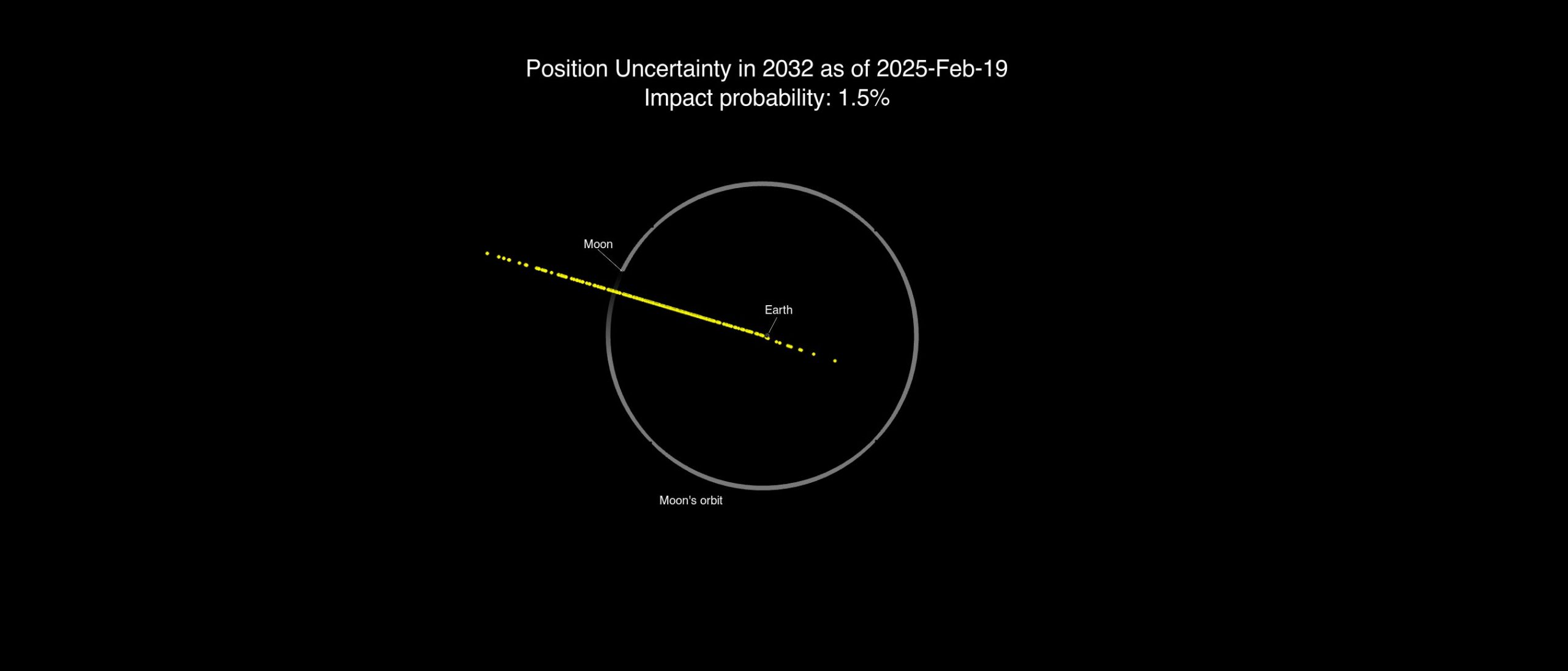
    Possible 2032 Locations of Asteroid 2024 YR4 As of February 19, 2025
    Graphic of the possible locations of 2024 YR4 on December 22, 2032, as of February 19, 2025. Earth is close to the center of the white circle, which represents the Moon’s orbital path. The range of possibilities has decreased from the previous image because of the additional data gathered. Credit: NASA JPL/CNEOS

    Astronomers are closely monitoring asteroid 2024 YR4, which once had the highest recorded impact probability for its size. Current estimates place its chance of hitting Earth at 1.5% in 2032, with a smaller risk for the Moon.

    With the full moon now past, the skies have darkened, allowing astronomers to resume observations of asteroid 2024 YR4. Ground-based telescopes need minimal light pollution to detect asteroids, which are often faint and difficult to spot. During a full moon, the sky is too bright, making observations nearly impossible.

    NASA’s Center for Near-Earth Object Studies (CNEOS) at the Jet Propulsion Laboratory in Southern California has analyzed new data reported to the Minor Planet Center. On February 18, updated calculations placed the asteroid’s impact probability for December 22, 2032, at 3.1% — the highest ever recorded for an object of this size or larger. However, by February 19, new overnight observations refined the estimate, lowering the impact probability to 1.5%.
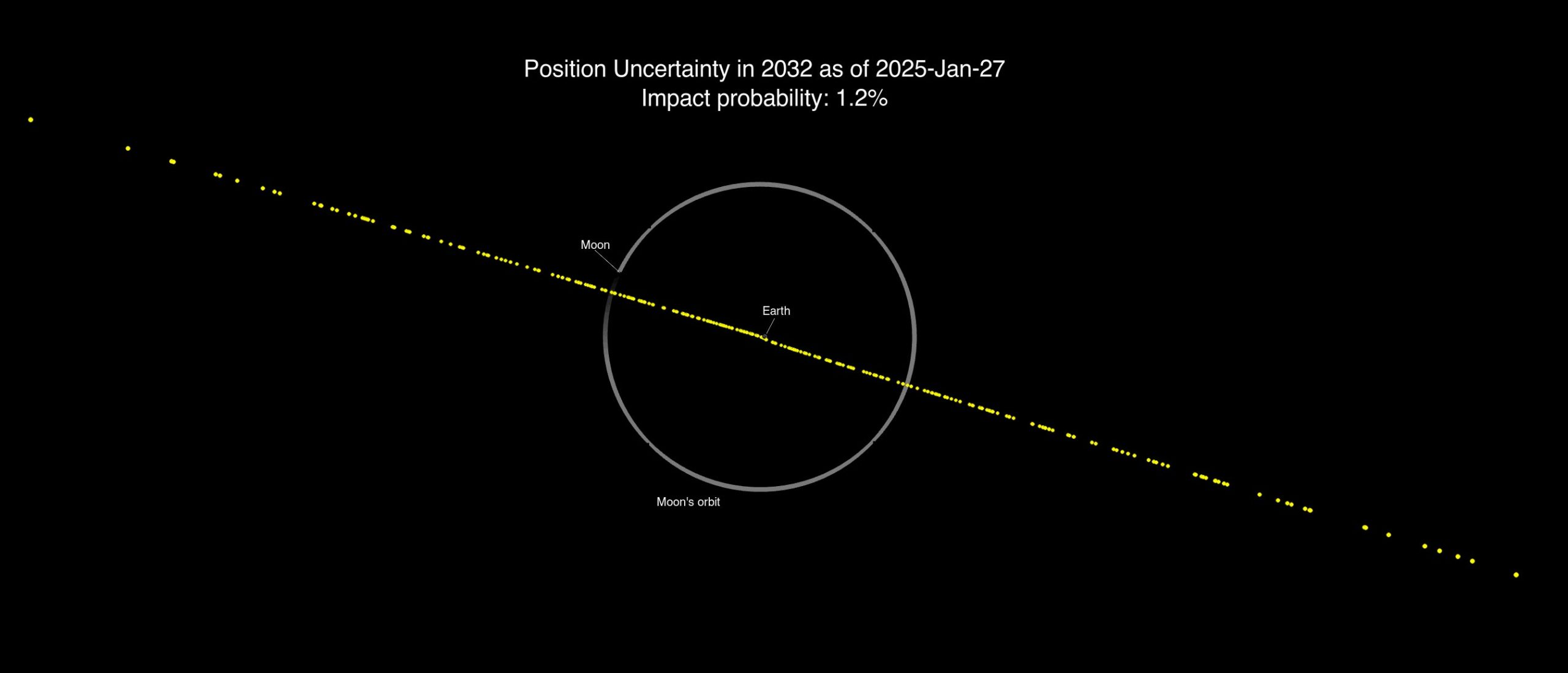
    Possible 2032 Locations of Asteroid 2024 YR4 As of January 27, 2025
    Graphic of the possible locations of 2024 YR4 on December 22, 2032 as of January 27, 2025. Earth is close to the center of the white circle, which represents the Moon’s orbital path. Credit: NASA JPL/CNEOS

    Refining the Asteroid’s Path

    Each additional night of observations helps scientists narrow down the asteroid’s possible trajectory and better assess any potential risk to Earth. NASA expects these probability estimates to continue changing as more data is collected in the coming days and weeks.

    These recent observations have further constrained the uncertainty around the asteroid’s trajectory, and the yellow dots in the above graphics represent possible locations of the asteroid on December 22, 2032. As we continue to observe the asteroid’s motion over time, the region of possible locations will shrink even further. For the impact probability to drop to zero, the Earth would need to fall outside of the range of potential locations of asteroid 2024 YR4 on December 22, 2032.

    Potential Impact on the Moon

    Additionally, there is also a – much lower — chance this asteroid could impact the Moon. Current calculations estimate this impact probability to be 0.8%.

    NASA’s Near-Earth Object Surveyor mission, set to launch no earlier than September 2027, will accelerate NASA’s ability to discover unknown asteroids by hunting for them in the infrared. While dark in visible light, asteroids and comets glow in the infrared as they’re heated by sunlight. In addition, NEO Surveyor will add an in-space vantage point that complements ground-based observatories.

    Never miss a breakthrough: Join the SciTechDaily newsletter.
    Follow us on Google and Google News.

    Asteroid NASA Planetary Defense
    Share. Facebook Twitter Pinterest LinkedIn Email Reddit

    Related Articles

    Webb Telescope Raises Moon Impact Odds for “City-Killer” Asteroid 2024 YR4

    Webb Zooms In on Building-Sized Asteroid Once Feared to Hit Earth – And It’s Stranger Than Expected

    NASA’s Heat-Seeking Space Telescope Is Almost Ready to Spot Killer Asteroids

    Asteroid Alert: NASA Drops Impact Risk to Near Zero, But There’s One Small Catch

    NASA’s New Asteroid Data Changes Everything – And the Moon Might Pay the Price

    NASA Just Doubled the Odds of an Asteroid Impact – Should We Worry?

    NASA Tracks Skyscraper-Sized Asteroid With a 1% Chance of Earth Impact in 2032

    Asteroid Deflection Planetary Defense Mission Target: “Dimorphos”

    NASA Double Asteroid Redirection Test: First Planetary Defense Mission Target Gets a New Name

    5 Comments

    1. Tree on February 20, 2025 6:01 am

      There is no more reliable data till 2028, this current data is worthless, numbers quoted are wrong, and then it’s gonna be to late, then we get to deal with apophsis.
      this and global warming started by the sumatra tsunami in 2004, and increased by the tonga 2022 tsunami

      the climate scientist are flipping out as to why their models are all failures now since Tonga 2022, and not one understands that it all started with the 12.26.2004 Bande Ache Sumatra Tsunami.
      since that happened I have been preaching “Watch for the coming Earth Changes, there’s nothing we can do to stop what’s coming”

      Reply
    2. wtf on February 20, 2025 7:22 am

      one can only hope that it hits… 😉

      Reply
      • Not Kadence on February 20, 2025 9:00 am

        …..the right place.

        Reply
        • wtf on February 20, 2025 10:08 am

          there is no right place, entire server been aching for a reset these last couple years.
          2032, will be the 7th (or 11th) anniversary of the reign our new holy emperor, or one of it’s successor.
          brave new world

          Reply
    3. Robert on February 20, 2025 8:32 am

      Apophis is a Greek name for Apaypi the Egyptian God of Destruction – the Destroyer. Big snake in the Egyptian Netherworld who fights and must be subdued by the newly reborn Ra every night – the struggle makes him strong and better capable of dealing with the vicissitudes of the Day.
      Apaypi’s Abode is the Great Sea of Middle Cavern.
      Of course, if somehow, he were to escape and bridge the Horn of the Eastern, or of the Western Horizon, and made it into the seas of our world… – then, bad news.

      Reply
    Leave A Reply Cancel Reply

    • Facebook
    • Twitter
    • Pinterest
    • YouTube

    Don't Miss a Discovery

    Subscribe for the Latest in Science & Tech!

    Trending News

    Largest-Ever Study Finds Medicinal Cannabis Ineffective for Anxiety, Depression, PTSD

    250-Million-Year-Old Egg Solves One of Evolution’s Biggest Mysteries

    Living With Roommates Might Be Changing Your Gut Microbiome Without You Knowing

    Century-Old Cleaning Chemical Linked to 500% Increased Risk of Parkinson’s Disease

    What if Your Memories Never Happened? Physicists Take a New Look at the Boltzmann Brain Paradox

    One of the Universe’s Largest Stars May Be Getting Ready To Explode

    Scientists Discover Enzyme That Could Supercharge Ozempic-Like Weight Loss Drugs

    Popular Sweetener Linked to DNA Damage – “It’s Something You Should Not Be Eating”

    Follow SciTechDaily
    • Facebook
    • Twitter
    • YouTube
    • Pinterest
    • Newsletter
    • RSS
    SciTech News
    • Biology News
    • Chemistry News
    • Earth News
    • Health News
    • Physics News
    • Science News
    • Space News
    • Technology News
    Recent Posts
    • A Simpler Path to Super-Resolution: Scientists Reinvent Microscopy
    • Scientists Uncover Hidden Genetic Cause of Diabetes in Babies
    • Amazonian Chocolate Could Become the Next Superfood, Scientists Say
    • Challenging the Narrative: New Study Shows U.S. Life Expectancy Is Rising Across All States
    • Mystery Illness Kills 5 in Burundi As Doctors Scramble for Answers
    Copyright © 1998 - 2026 SciTechDaily. All Rights Reserved.
    • Science News
    • About
    • Contact
    • Editorial Board
    • Privacy Policy
    • Terms of Use

    Type above and press Enter to search. Press Esc to cancel.