
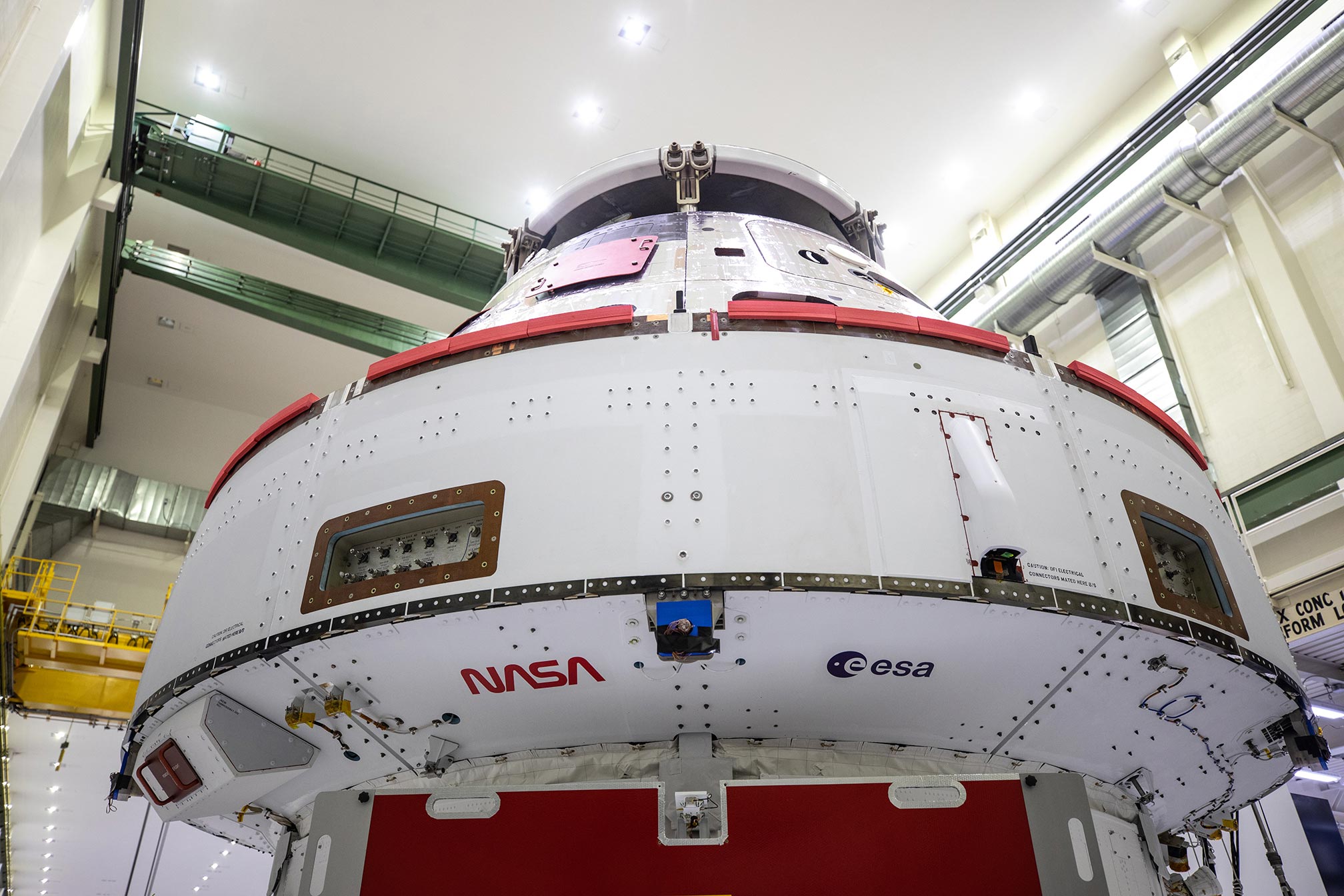
NASA is headed back to the Moon as part of the Artemis program – and the agency’s “worm” logo will be along for the ride on the first integrated mission of the powerful Space Launch System (SLS) rocket and Orion spacecraft. Teams at NASA’s Kennedy Space Center in Florida have applied the historic logo in bright red on visible parts of the Artemis I rocket and spacecraft.

“After almost three decades, our famous logotype is back in action, and it is thrilling for all of us that worked on the original design to have it return in such an impressive way,” said Richard Danne, of the design team at Danne & Blackburn who originally created the logo. “It is particularly exciting to be involved with the Artemis program, so full of potential beginning with this promising first mission.”
The bold, sleek design of the “worm” logo was officially introduced in 1975 and was incorporated into many of the agency’s next-generation programs. It was retired in 1992, but made a comeback in 2020 as the agency ushers in a new, modern era of human spaceflight.
The worm began making an appearance on the SLS twin solid rocket boosters in late August when workers with NASA’s Exploration Ground Systems and their contractor Jacobs started painting the iconic design across two of the booster segments. The team used a laser projector to mask off the logo with tape, then painted the first coat of the logo inside the center’s Rotation, Processing, and Surge Facility. The job was completed by adding a second coat of paint, followed by multiple clear coats on the booster.
“The most technically challenging task was identifying the correct sizing and location of where the logo was to go,” said William Richards, an engineer with Jacobs, the lead contractor supporting booster stacking operations. “New laser technology helped us lay it out in the correct position to mask off for the painting and correctly shape the letters, especially the curve of the ‘S’.”
In this time-lapse video, technicians paint the NASA logotype, or “worm,” on a segment of a booster that will carry astronauts into space on the Artemis I mission.
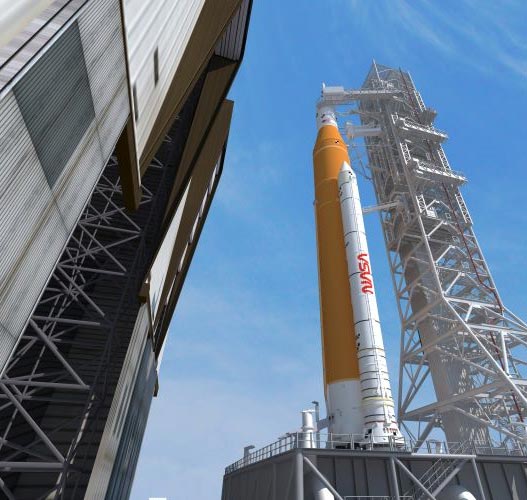
After the boosters are transferred to the Vehicle Assembly Building for stacking, technicians will secure an access panel across the middle section of the boosters and paint it to complete the insignia. The worm will be visible as the boosters are stacked on top of the mobile launcher, while the rocket is on the launch pad, and as it soars through Earth’s atmosphere during launch.
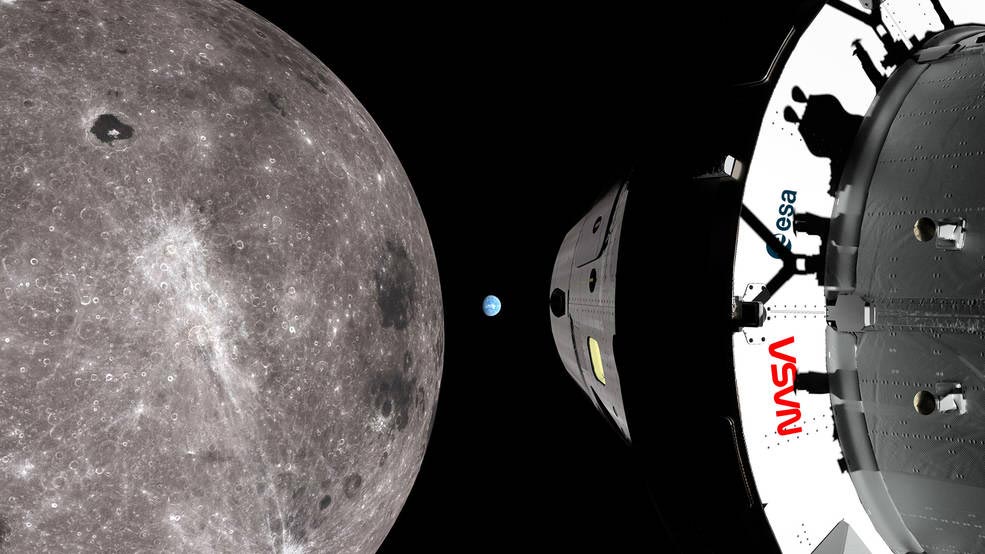
The worm and ESA (European Space Agency) logo were recently applied to the Orion spacecraft as well. Technicians cut the emblems into flight-proof decals and adhered them to the underside of Orion’s crew module adapter (CMA). ESA is providing Orion’s service module, which is the powerhouse that fuels and propels the spacecraft. These bold images will be seen from cameras at the end of Orion’s solar arrays as the spacecraft travels toward the Moon and back.
The decals were affixed to the spacecraft by Frank Pelkey, a technician who previously painted the U.S. flag on the spacecraft that flew on NASA’s Exploration Flight Test-1. “I felt a great sense of pride when painting the U.S. flag on Orion’s first flight,” said Pelkey. “It was that same feeling of gratitude to be selected to apply the NASA and ESA logos to the vehicle for the first Artemis mission.”
Later this year, teams will apply an American flag and the primary NASA logo with the blue sphere, known as the “meatball,” to the crew module, in addition to a decal of the worm on the outer band of the CMA. These logos will also be seen during the mission while Orion is in space, and the worm on the CMA band will be visible while on the launch pad as well.
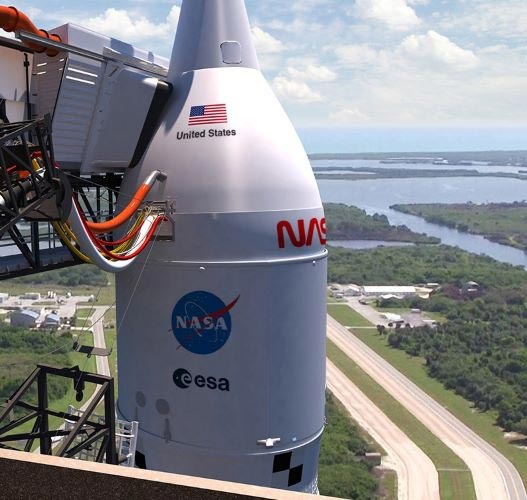
Also to be applied early next year and visible from the launch pad, the meatball, and an ESA logo will be shown on the fairings that cover the service module, and the American flag will appear on the Interim Cryogenic Propulsion Stage, as well as the launch abort system along with the words “United States.”
In June, Northrop Grumman, the prime contractor for the boosters, delivered the Artemis I rocket motors to Kennedy where assembly of the entire five-segment booster has started. The twin boosters will help propel the SLS rocket on its first flight in 2021. Shortly after launch from Pad 39B, the boosters will separate from the rocket as the core stage continues to send Orion to space.
After the core stage’s job is complete, the rocket’s upper stage sends Orion toward the Moon, and then Orion continues the rest of its journey around the Moon and back powered by the European-provided service module. Artemis II in 2023 will be the first flight test with crew. In 2024, NASA will send the first woman and next man to the surface of the Moon on the Artemis III mission, and establish sustainable exploration by the end of the decade.
Never miss a breakthrough: Join the SciTechDaily newsletter.
Follow us on Google and Google News.