
Close Menu
    Facebook X (Twitter) Instagram
    SciTechDaily
    • Biology
    • Chemistry
    • Earth
    • Health
    • Physics
    • Science
    • Space
    • Technology
    Facebook X (Twitter) Pinterest YouTube RSS
    SciTechDaily
    Home»Biology»Yale Biologists Describe DNA’s Security System
    Biology

    Yale Biologists Describe DNA’s Security System

    By Bill Hathaway, Yale UniversityOctober 13, 2014No Comments3 Mins Read
    Facebook Twitter Pinterest Telegram LinkedIn WhatsApp Email Reddit
    Share
    Facebook Twitter LinkedIn Pinterest Telegram Email Reddit
    Surveillance of Nuclear Pore Complex Assembly
    DNA is protected by a complex security system involving a double membrane with protein channels. This system prevents unwanted materials from entering while allowing essential messengers to pass through. Credit: Brant M. Webster, et al., doi:10.1016/j.cell.2014.09.012

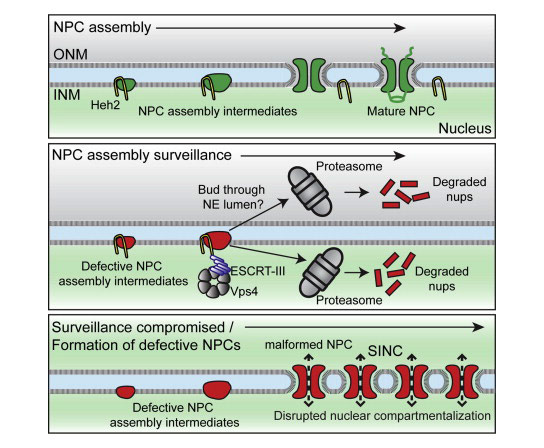
    In a newly published study, Yale biologists and colleagues describe a key quality control mechanism that protects new cells from inheriting defective nuclear pore complexes.

    As befitting life’s blueprint, DNA is surrounded by an elaborate security system that assures crucial information is imparted without error.

    The security is provided by a double membrane perforated by protein channels that block unwanted material from entering the nucleus and promote entry of key messengers. The breakdown of these channels, called nuclear pore complexes (NPCs), is associated with some forms of cancer and with aging.


    Defective nuclear pore complexes (red) are restricted from being inherited by daughter cells demonstrating a quality control pathway during nuclear pore complex biogenesis.

    In a new study appearing in the October 9 issue of the journal Cell, Yale researchers Brant Webster, Patrick Lusk, and colleagues describe a key quality control mechanism that protects new cells from inheriting defective NPCs. In the accompanying movie, defective NPCs are sequestered into a specialized compartment (colored red) that is retained in the mother cell, while each daughter inherits functional NPCs. “It is important to understand how these gatekeepers, which are fundamental to cellular function, are built and maintained,” Lusk said.

    Abstract:

    The maintenance of nuclear compartmentalization by the nuclear envelope and nuclear pore complexes (NPCs) is essential for cell function; loss of compartmentalization is associated with cancers, laminopathies, and aging. We uncovered a pathway that surveils NPC assembly intermediates to promote the formation of functional NPCs. Surveillance is mediated by Heh2, a member of the LEM (Lap2-emerin-MAN1) family of integral inner nuclear membrane proteins, which binds to an early NPC assembly intermediate, but not to mature NPCs. Heh2 recruits the endosomal sorting complex required for transport (ESCRT)—III subunit Snf7 and the AAA-ATPase Vps4 to destabilize and clear defective NPC assembly intermediates. When surveillance or clearance is compromised, malformed NPCs accumulate in a storage of improperly assembled nuclear pore complexes compartment, or SINC. The SINC is retained in old mothers to prevent loss of daughter lifespan, highlighting a continuum of mechanisms to ensure nuclear compartmentalization.

    Reference: “Surveillance of Nuclear Pore Complex Assembly by ESCRT-III/Vps4” by Brant M. Webster, Paolo Colombi, Jens Jäger and C. Patrick Lusk, 9 October 2014, Cell.
    DOI: 10.1016/j.cell.2014.09.012


    Never miss a breakthrough: Join the SciTechDaily newsletter.
    Follow us on Google and Google News.

    Cell Biology DNA Yale University
    Share. Facebook Twitter Pinterest LinkedIn Email Reddit

    Related Articles

    “DNA-Origami” Allows Scientists to Study Minute Protein Interactions

    Yale Researchers Track How Cells Repair Rips in DNA

    Scientists Create a More Precise Technique to Edit Genomes of Living Organisms

    Understanding How Cells Package Fat

    Key Differences in Seemingly Synonymous Parts of the Genetic Code

    The Most Comprehensive Catalog of Human Genome Variations

    Optogenetics Regulates Metabolic Activity in the Membranes of Cells

    DNA Jumps Directly From the Cell’s Chloroplasts Into Its Nucleus

    Researchers Study Regulatory Gene’s Role in Sperm Quality Control

    Leave A Reply Cancel Reply

    • Facebook
    • Twitter
    • Pinterest
    • YouTube

    Don't Miss a Discovery

    Subscribe for the Latest in Science & Tech!

    Trending News

    Millions Take These IBS Drugs, But a New Study Finds Serious Risks

    Scientists Unlock Hidden Secrets of 2,300-Year-Old Mummies Using Cutting-Edge CT Scanner

    Bread Might Be Making You Gain Weight Even Without Eating More Calories

    Scientists Discover Massive Magma Reservoir Beneath Tuscany

    Europe’s Most Active Volcano Just Got Stranger – Here’s Why Scientists Are Rethinking It

    Alzheimer’s Symptoms May Start Outside the Brain, Study Finds

    Millions Take This Popular Supplement – Scientists Discover a Concerning Link to Heart Failure

    The Universe Is Expanding Too Fast and Scientists Can’t Explain Why

    Follow SciTechDaily
    • Facebook
    • Twitter
    • YouTube
    • Pinterest
    • Newsletter
    • RSS
    SciTech News
    • Biology News
    • Chemistry News
    • Earth News
    • Health News
    • Physics News
    • Science News
    • Space News
    • Technology News
    Recent Posts
    • Doctors Surprised by the Power of a Simple Drug Against Colon Cancer
    • Why Popular Diabetes Drugs Like Ozempic Don’t Work for Everyone: The “Genetic Glitch”
    • Scientists Create Improved Insulin Cells That Reverse Diabetes in Mice
    • Scientists Stunned After Finding Plant Thought Extinct for 60 Years
    • A Common Diabetes Drug May Hold the Key to Stopping HIV From Coming Back
    Copyright © 1998 - 2026 SciTechDaily. All Rights Reserved.
    • Science News
    • About
    • Contact
    • Editorial Board
    • Privacy Policy
    • Terms of Use

    Type above and press Enter to search. Press Esc to cancel.