
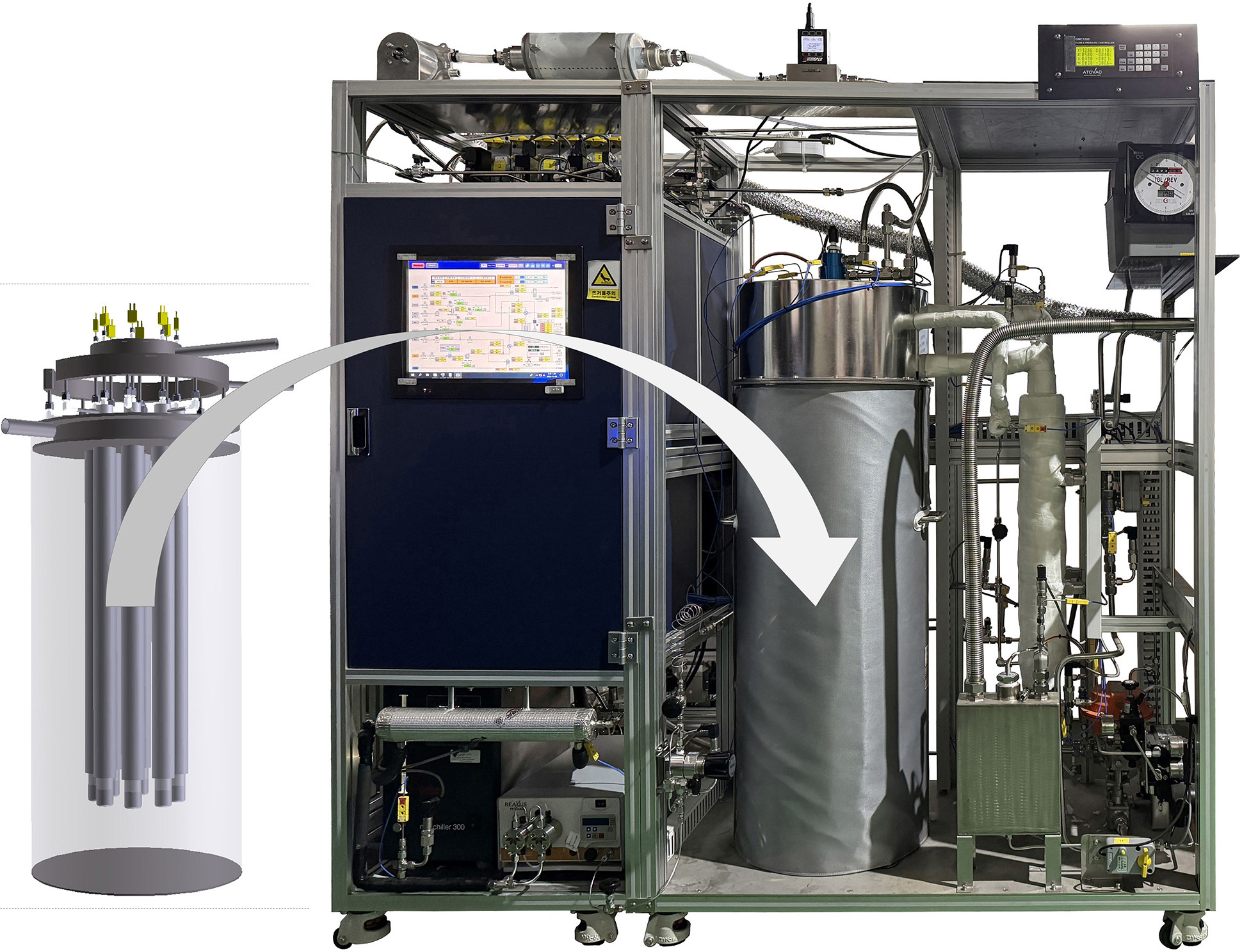
The KIER has achieved a historic milestone in Korea by successfully producing hydrogen of exceptional purity from ammonia, completely eliminating carbon dioxide emissions in the process.
Dr. Jung Unho’s research team at the Hydrogen Research Department of the Korea Institute of Energy Research (KIER) has developed Korea’s first clean hydrogen production technology. This innovative approach is based on ammonia decomposition and does not use fossil fuels. The team’s breakthrough could pave the way for a more sustainable and eco-friendly energy source. This allows for the production of high-purity hydrogen that meets international standards for hydrogen-powered vehicles, without the carbon dioxide emissions produced by using fossil fuels.
Ammonia, a compound of hydrogen and nitrogen, has a hydrogen storage density 1.7 times higher than that of liquefied hydrogen, and it is gaining attention as the most cost-effective method for transporting hydrogen. In particular, as it has been used in various fields such as fertilizer for over 100 years, it is equipped with infrastructure, handling, and safety standards. It is considered the most practical solution to address hydrogen storage and transportation challenges.
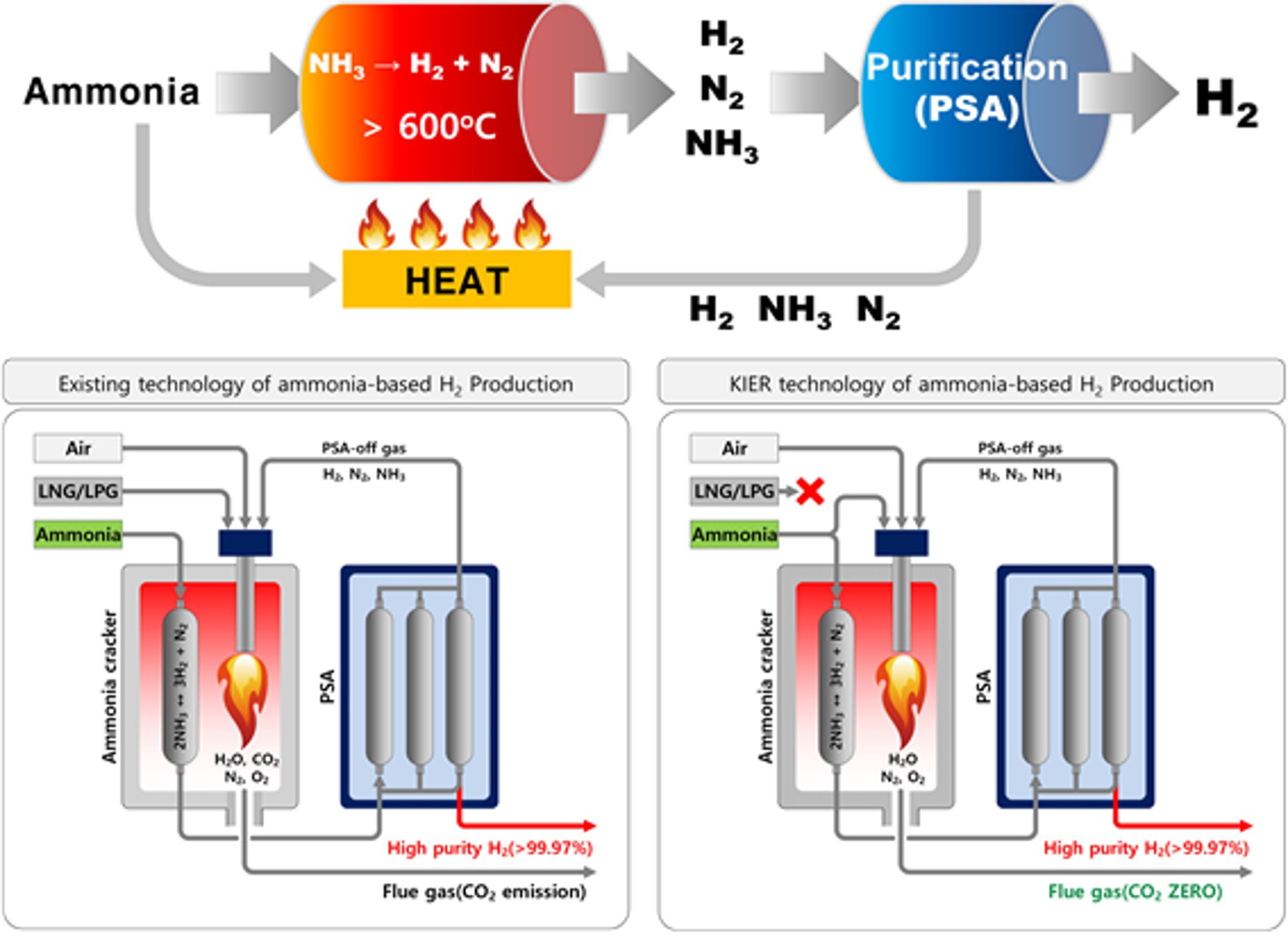
The Process of Clean Hydrogen Production
Ammonia consists only of hydrogen and nitrogen, so no carbon is emitted when the hydrogen is separated. The decomposition process requires a supply of heat energy of over 600℃, and currently, fossil fuels are used, resulting in the emission of carbon dioxide. Therefore, to produce clean hydrogen, a carbon-free energy source must be used, even in the process of decomposing ammonia.
By utilizing the small quantities of hydrogen and ammonia left over from the decomposition reaction, the researchers were able to produce hydrogen without the use of fossil fuels.

To generate pure hydrogen from ammonia, the decomposition of ammonia is carried out at a temperature above 600℃ using a ruthenium (Ru) catalyst, followed by the purification of hydrogen through pressure swing adsorption (PSA) technology. While carrying out this method, a residual gas mixture of nitrogen and hydrogen is formed and repurposed as a heating element for the ammonia decomposition reactor. Despite this, the residual gas alone does not offer sufficient heat of reaction, therefore extra heat must be added.
Overcoming Challenges with Innovative Solutions
In the case of existing technology, insufficient heat of reaction are supplemented with fossil fuels such as natural gas (LNG) or liquefied petroleum gas (LPG), so carbon dioxide is emitted during combustion. However, using the system developed this time, by supplying ammonia instead of fossil fuels, the heat of reaction can be supplied and carbon dioxide emissions can be blocked at the source.
Using the developed system, high-purity hydrogen of more than 99.97%, which can be supplied to fuel cells for hydrogen electric vehicles, is produced at 5Nm3 (approximately 0.45kg) per hour. In addition, the hydrogen produced has an impurity concentration of less than 300ppm for nitrogen and less than 0.1ppm for ammonia. It met ISO 14687, the international standard for hydrogen-fueled electric vehicles.
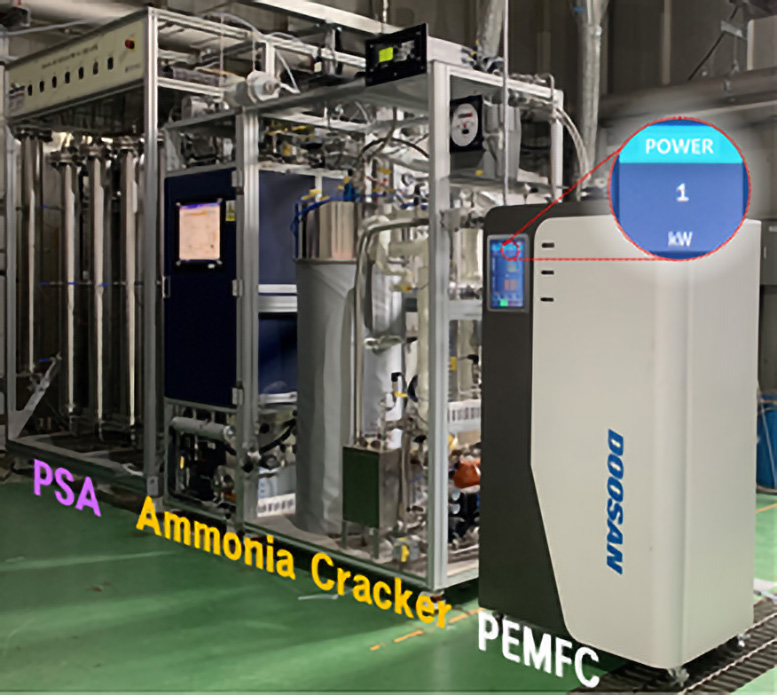
The research team has reached a significant milestone by demonstrating a 1kW fuel cell system for buildings that generates electricity without emitting carbon dioxide, using hydrogen extracted from ammonia. This demonstration, conducted in collaboration with Doosan Fuel Cell Power BU (Business Unit), is of great importance as it overcomes the issue of carbon dioxide emissions, which has been considered a disadvantage of natural gas (LNG) based fuel cell systems. It shows the potential to generate power using clean hydrogen fuel cells.
According to lead researcher Dr. Jung Unho, the newly developed technology holds great significance as it allows for carbon-free hydrogen production using ammonia, filling a previous gap in this area. There is an expectation that it will find practicality in diverse areas that use clean hydrogen. In his remarks, he went on to say, “The combining of ammonia and fuel cells presents a viable option for powering eco-ships. And as we scale up, we can also make a significant impact in the clean hydrogen power sector.”
Meanwhile, this research was conducted with the support of Korea Southern Power Co., Ltd. (KOSPO).
Never miss a breakthrough: Join the SciTechDaily newsletter.
Follow us on Google and Google News.