
Close Menu
    Facebook X (Twitter) Instagram
    SciTechDaily
    • Biology
    • Chemistry
    • Earth
    • Health
    • Physics
    • Science
    • Space
    • Technology
    Facebook X (Twitter) Pinterest YouTube RSS
    SciTechDaily
    Home»Biology»Zoologist Solves the Bizarre 100-Year-Old Mystery of the Floating Phantom Midge
    Biology

    Zoologist Solves the Bizarre 100-Year-Old Mystery of the Floating Phantom Midge

    By University of British ColumbiaJanuary 26, 2022No Comments4 Mins Read
    Facebook Twitter Pinterest Telegram LinkedIn WhatsApp Email Reddit
    Share
    Facebook Twitter LinkedIn Pinterest Telegram Email Reddit
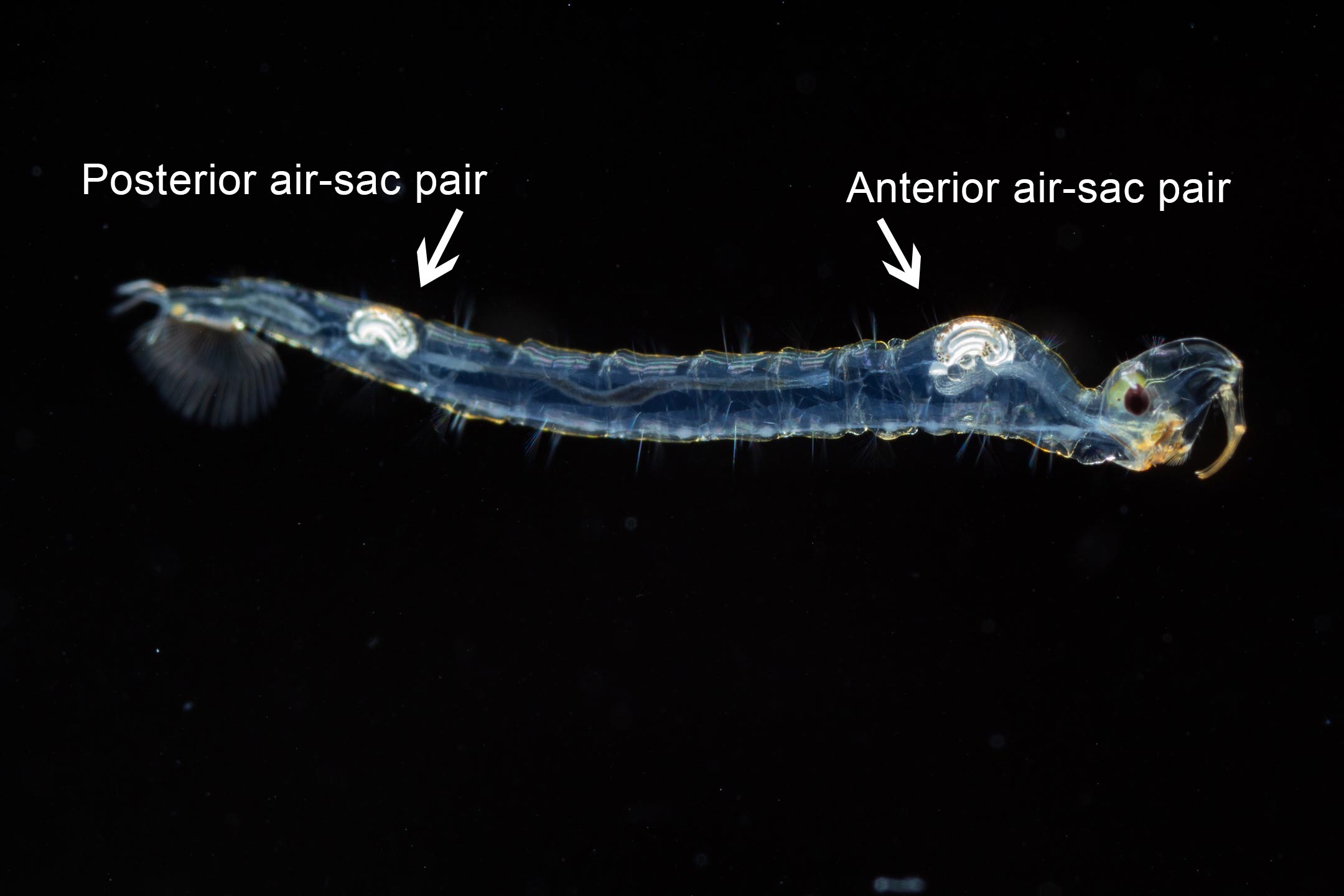
    Aquatic Chaoborus Midge Larvae
    Aquatic Chaoborus midge larvae are the only insect that can control their buoyancy. Their tracheal air-sacs act as a pH-powered mechanochemical engine. Credit: Philip Matthews

    Chaoborus midge larvae use air sacs with the protein resilin, which adjusts volume through pH changes, to maintain buoyancy. This unique mechanism allows the larvae to float neutrally in water.

    In spring 2018, Dr. Philip Matthews spent a typical afternoon capturing dragonflies in the University of British Columbia’s (UBC) experimental ponds. Little did the zoologist know he was about to embark on a journey to solve a century-old entomological mystery involving a much smaller, but equally intriguing, insect. As he worked in the ponds, larvae floating in rainwater in a nearby cattle tank caught his eye.

    The insects were the freshwater aquatic larvae of the Chaoborus midge, also called the ‘phantom midge’ due to its near transparency. The transparency makes the larvae resemble tiny ghosts as they move through lakes, ponds, and puddles.

    “These bizarre insects were floating neutrally buoyant in the water, which is something you just don’t see insects doing,” said Dr. Matthews. “Some insects can become neutrally buoyant for a short time during a dive, but Chaoborus larvae are the only insects close to being neutrally buoyant.”

    Glowing Air Sacs
    When researchers mounted the air-sacs of the larvae on a microscope that just happened to have ultraviolet light illuminating the microscope’s stage, the air-sacs started glowing blue. Credit: Evan McKenzie

    Solving a 100-year-old mystery with a Nobel connection

    Some fish regulate their buoyancy by inflating a swim bladder with oxygen unloaded from the hemoglobin in their blood. In 1911, Nobel laureate August Krogh discovered Chaoborus larvae use a completely different mechanism, regulating their buoyancy using two pairs of internal air-filled sacs. But he never figured out how the insects adjusted the volume of their sacs without having blood or hemoglobin as vertebrates do.
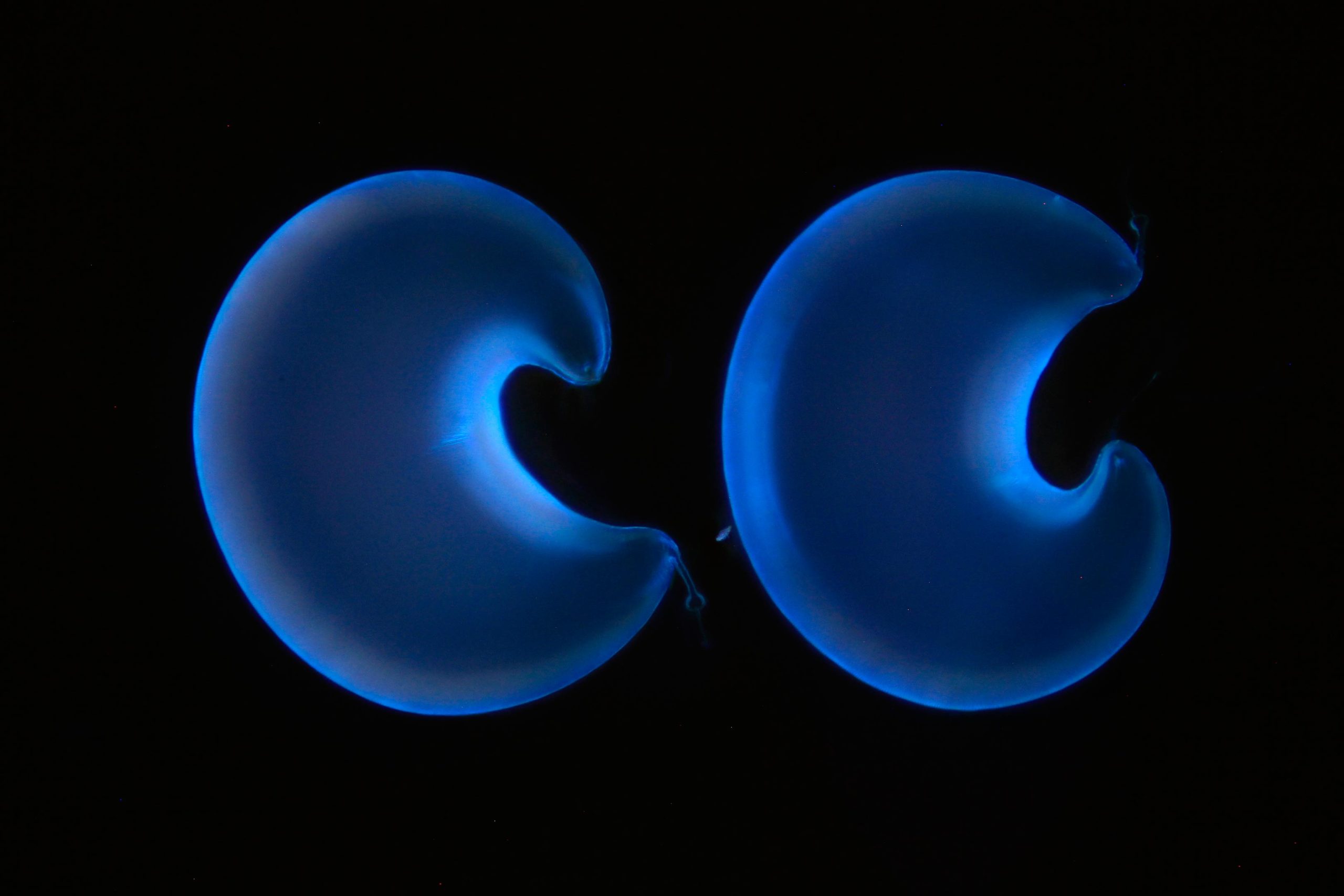
    Blue Fluorescence Air Sac
    The blue fluorescence of the air-sac was due to resilin—an almost a perfect rubber found in parts of insects where elasticity is key, as in the elastic energy that powers a flea’s incredible jump. Credit: Philip Matthews

    A serendipitous discovery

    Back in the lab after his coffee, Dr. Matthews mounted the air-sacs of the larvae from the cattle tank on a microscope that just happened to have ultraviolet light illuminating the microscope’s stage. The air-sacs started glowing blue.

    The blue fluorescence was due to resilin—an almost perfect rubber found in parts of insects where elasticity is key, as in the elastic energy that powers a flea’s incredible jump.
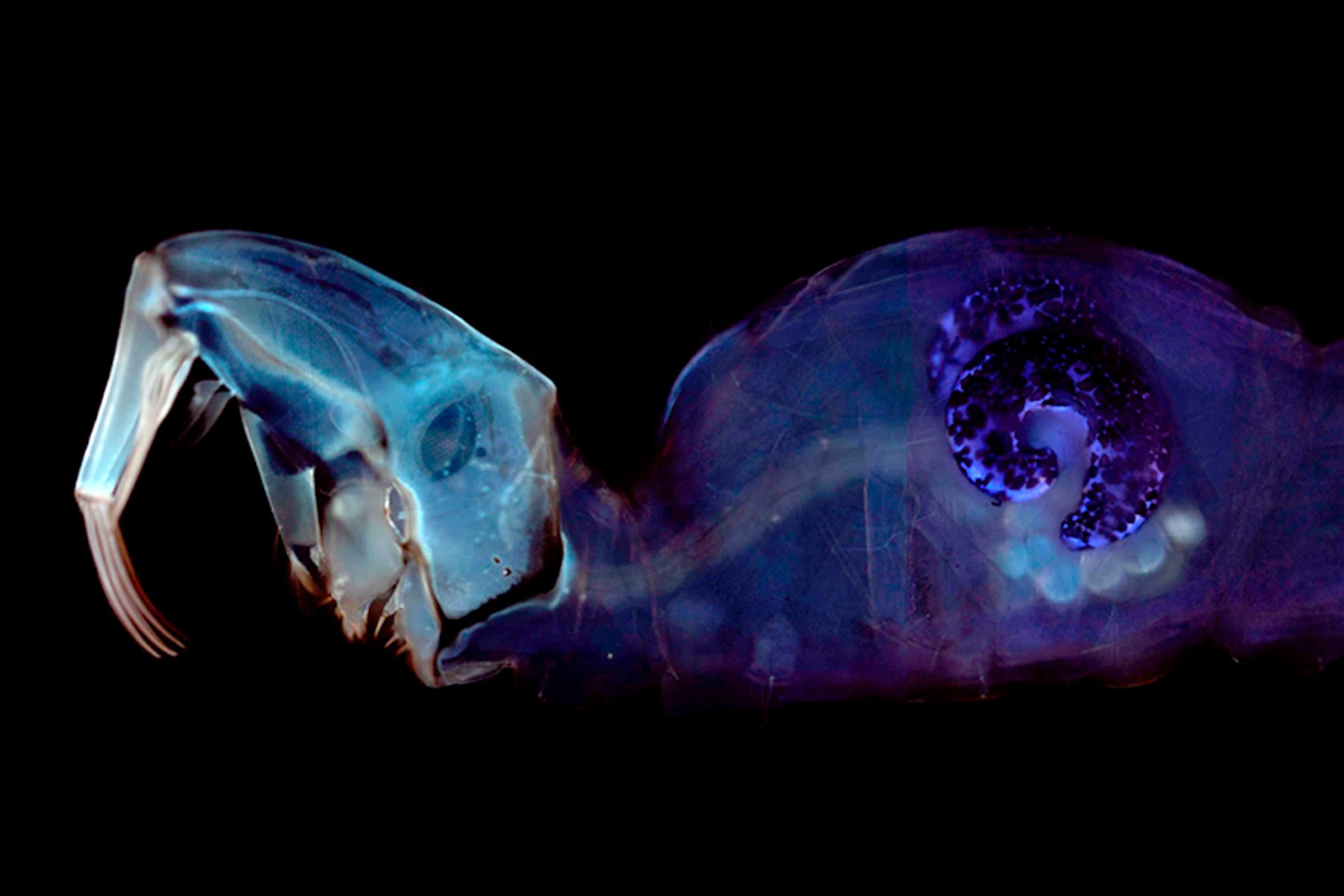
    Chaoborus Head and Anterior Air-Sac Pair
    Researchers discovered that the insect doesn’t secrete gas into their air-sacs to make them expand. Instead, they change the pH level of the air-sac wall, the bands of resilin within the air-sac wall swell or contract in response, and the volume of the sac adjusts. Credit: Evan McKenzie

    “The weird thing about resilin is that not only is it really elastic. It will swell if you make it alkaline and contract if you make it acidic.”

    With PhD student Evan McKenzie driving experimental investigations, the researchers discovered that the insect doesn’t secrete gas into their air-sacs to make them expand. Instead, they change the pH level of the air-sac wall, the bands of resilin within the air-sac wall swell or contract in response, and the volume of the sac adjusts.

    The Chaoborus air-sacs function as mechanochemical engines, converting changes in chemical potential energy into mechanical work.

    “This is a really bizarre adaptation that we didn’t go looking for,” says Dr. Matthews. “We were just trying to figure out how they can float in water without sinking!”

    The findings were published this week in Current Biology.

    Reference: “A pH-powered mechanochemical engine regulates the buoyancy of Chaoborus midge larvae” by Evan K.G. McKenzie, Garfield T. Kwan, Martin Tresguerres and Philip G.D. Matthews, 25 January 2022, Current Biology.
    DOI: 10.1016/j.cub.2022.01.018

    Never miss a breakthrough: Join the SciTechDaily newsletter.
    Follow us on Google and Google News.

    Entomology Insect Popular University of British Columbia
    Share. Facebook Twitter Pinterest LinkedIn Email Reddit

    Related Articles

    Researchers Discover Unknown Beetle Species Just Steps From Their Lab

    Bed Bugs Are Terrified of This Simple Thing, Study Finds

    Mystery Solved: Why Termite Kings and Queens Are Monogamous

    A Record-Breaking 2600 Miles – First Recorded Atlantic Crossing by Butterflies

    250-Year-Old Mystery Solved: Scientists Unveil Surprising Man-Made Origins of the German Cockroach

    Scientists Solve the 250-Year-Old Origin Mystery of the Most Common Indoor Urban Pest Insect on the Planet

    Neuroterus Valhalla: Biologists Discover Weird New Wasp Species

    Aphid-Like Insects Stole DNA From Plants – Gene Shields Them From Leaf Toxins

    Haemaphysalis Flava Hardy Enough to Survive Vacuum and Electron Beam

    Leave A Reply Cancel Reply

    • Facebook
    • Twitter
    • Pinterest
    • YouTube

    Don't Miss a Discovery

    Subscribe for the Latest in Science & Tech!

    Trending News

    Your Blood Pressure Reading Could Be Wrong Because of One Simple Mistake

    Astronomers Stunned by Ancient Galaxy With No Spin

    Physicists May Be on the Verge of Discovering “New Physics” at CERN

    Scientists Solve 320-Million-Year Mystery of Reptile Skin Armor

    Scientists Say This Daily Walking Habit May Be the Secret to Keeping Weight Off After Dieting

    New Therapy Rewires the Brain To Restore Joy in Depression Patients

    Giant Squid Detected off Western Australia in Stunning Deep-Sea Discovery

    Popular Sugar-Free Sweetener Linked to Liver Disease, Study Warns

    Follow SciTechDaily
    • Facebook
    • Twitter
    • YouTube
    • Pinterest
    • Newsletter
    • RSS
    SciTech News
    • Biology News
    • Chemistry News
    • Earth News
    • Health News
    • Physics News
    • Science News
    • Space News
    • Technology News
    Recent Posts
    • Dante’s Inferno May Secretly Be About a Planet-Destroying Asteroid Strike
    • Mixing Edible Cannabis and Alcohol May Impair Driving More Than Scientists Expected
    • Scientists Reverse Stroke Damage Using Stem Cells in Breakthrough Study
    • Eating One Egg a Day Could Cut Alzheimer’s Risk by 27%
    • Hidden Warm Water Beneath Antarctica Could Rapidly Raise Global Sea Levels
    Copyright © 1998 - 2026 SciTechDaily. All Rights Reserved.
    • Science News
    • About
    • Contact
    • Editorial Board
    • Privacy Policy
    • Terms of Use

    Type above and press Enter to search. Press Esc to cancel.