
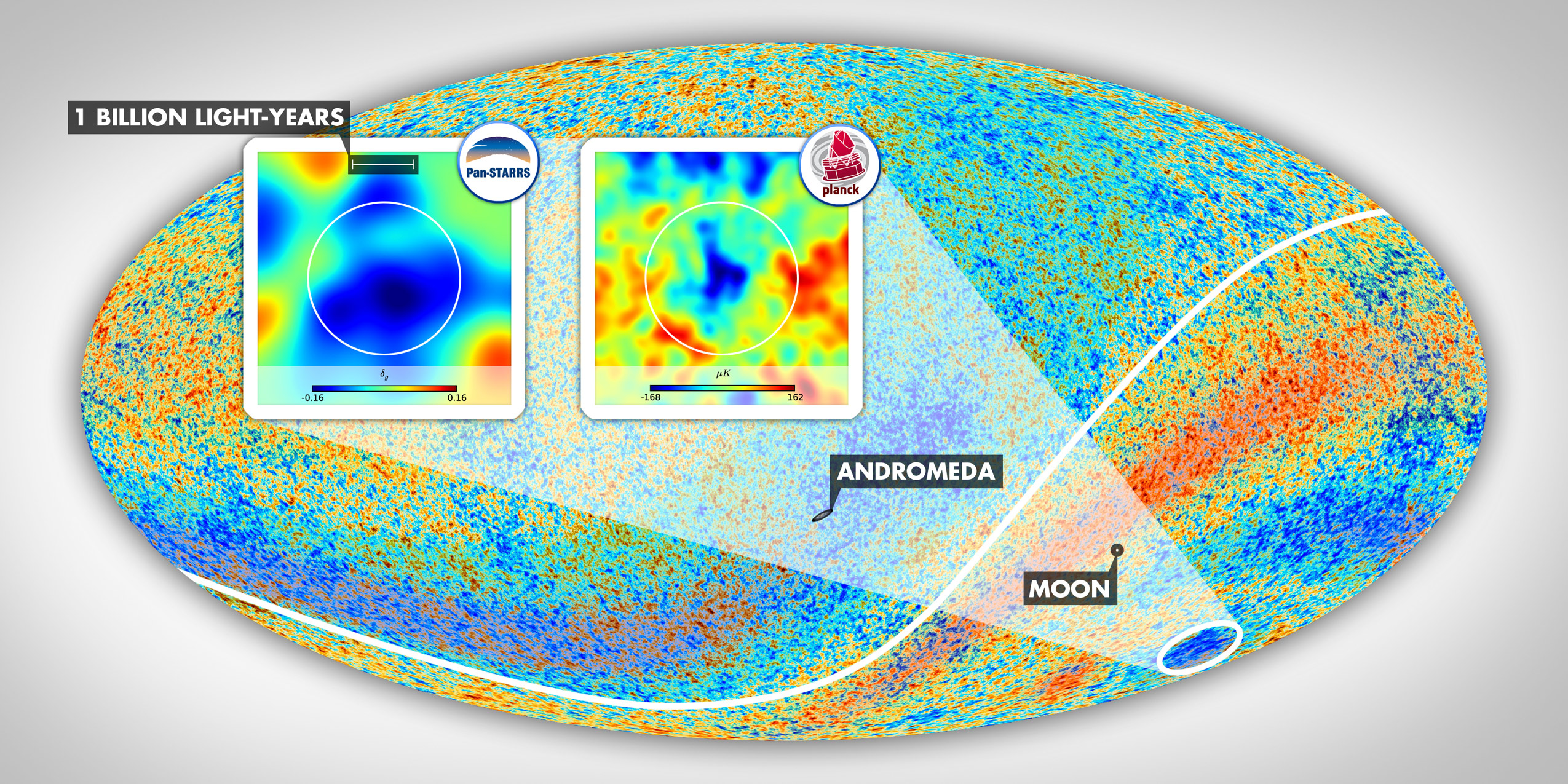
Using the WISE-2MASS infrared galaxy catalog matched with Pan-STARRS1 (PS1) galaxies, astronomers reveal a supervoid aligned with the cold spot of the cosmic microwave background.
Astronomers may have found “the largest individual structure ever identified by humanity,” according to Dr. István Szapudi of the University of Hawaii at Manoa. Dr. Szapudi and his team report their findings in the journal Monthly Notices of the Royal Astronomical Society.
In 2004, astronomers examining a map of the radiation left over from the Big Bang (the cosmic microwave background, or CMB) discovered the Cold Spot, a larger-than-expected unusually cold area of the sky. The physics surrounding the Big Bang theory predicts warmer and cooler spots of various sizes in the infant universe, but a spot this large and this cold was unexpected. Now astronomers may have found an explanation for the existence of the Cold Spot.
If the Cold Spot originated from the Big Bang itself, it could be a rare sign of exotic physics that the standard cosmology (basically, the Big Bang theory and related physics) does not explain. If, however, it is caused by a foreground structure between us and the CMB, it would be a sign that there is an extremely rare large-scale structure in the mass distribution of the universe.
Using data from Hawaii’s Pan-STARRS1 (PS1) telescope located on Haleakala, Maui, and NASA’s Wide Field Survey Explorer (WISE) satellite, Szapudi’s team discovered a large supervoid, a vast region 1.8 billion light-years across, in which the density of galaxies is much lower than usual in the known universe. This void was found by combining observations taken by PS1 at optical wavelengths with observations taken by WISE at infrared wavelengths to estimate the distance to and position of each galaxy in that part of the sky.
Earlier studies, also done in Hawaii, observed a much smaller area in the direction of the Cold Spot, but they could establish only that no very distant structure is in that part of the sky. Paradoxically, identifying nearby large structures is harder than finding distant ones, since we must map larger portions of the sky to see the closer structures. The large three-dimensional sky maps created from PS1 and WISE by Dr András Kovács (Eötvös Loránd University, Budapest, Hungary) were thus essential for this study. The supervoid is only about 3 billion light-years away from us, a relatively short distance in the cosmic scheme of things.
Imagine there is a huge void with very little matter between you (the observer) and the CMB. Now think of the void as a hill. As the light enters the void, it must climb this hill. If the universe were not undergoing accelerating expansion, then the void would not evolve significantly, and light would descend the hill and regain the energy it lost as it exits the void. But with the accelerating expansion, the hill is measurably stretched as the light is traveling over it. By the time the light descends the hill, the hill has gotten flatter than when the light entered, so the light cannot pick up all the speed it lost upon entering the void. The light exits the void with less energy, and therefore at a longer wavelength, which corresponds to a colder temperature.
Getting through a supervoid takes hundreds of millions of years, even at the speed of light, so this measurable effect (known as the Integrated Sachs-Wolfe (ISW) effect) might provide an explanation for the Cold Spot. The spot is one of the most significant anomalies found to date in the CMB, first by a NASA satellite called the Wilkinson Microwave Anisotropy Probe (WMAP), and more recently by Planck, a satellite launched by the European Space Agency.
While the existence of the supervoid and its expected effect on the CMB do not fully explain all the properties of the Cold Spot, it is very unlikely that the supervoid and the Cold Spot at the same location are a coincidence. The team will continue its work using improved data from PS1, and from the Dark Energy Survey being conducted with a telescope in Chile to study the Cold Spot and supervoid, as well as another large void located near the constellation Draco.
Reference: “Detection of a supervoid aligned with the cold spot of the cosmic microwave background” by István Szapudi, András Kovács, Benjamin R. Granett, Zsolt Frei, Joseph Silk, Will Burgett, Shaun Cole, Peter W. Draper, Daniel J. Farrow, Nicholas Kaiser, Eugene A. Magnier, Nigel Metcalfe, Jeffrey S. Morgan, Paul Price, John Tonry and Richard Wainscoat, 11 June 2015, MNRAS.
DOI: 10.1093/mnras/stv488
arXiv: 1405.1566
Never miss a breakthrough: Join the SciTechDaily newsletter.
Follow us on Google and Google News.