
Close Menu
    Facebook X (Twitter) Instagram
    SciTechDaily
    • Biology
    • Chemistry
    • Earth
    • Health
    • Physics
    • Science
    • Space
    • Technology
    Facebook X (Twitter) Pinterest YouTube RSS
    SciTechDaily
    Home»Space»Astronomers Discover Fascinating Discs Around Young Stars
    Space

    Astronomers Discover Fascinating Discs Around Young Stars

    By Richard Hook, European Southern ObservatoryApril 11, 2018No Comments5 Mins Read
    Facebook Twitter Pinterest Telegram LinkedIn WhatsApp Email Reddit
    Share
    Facebook Twitter LinkedIn Pinterest Telegram Email Reddit
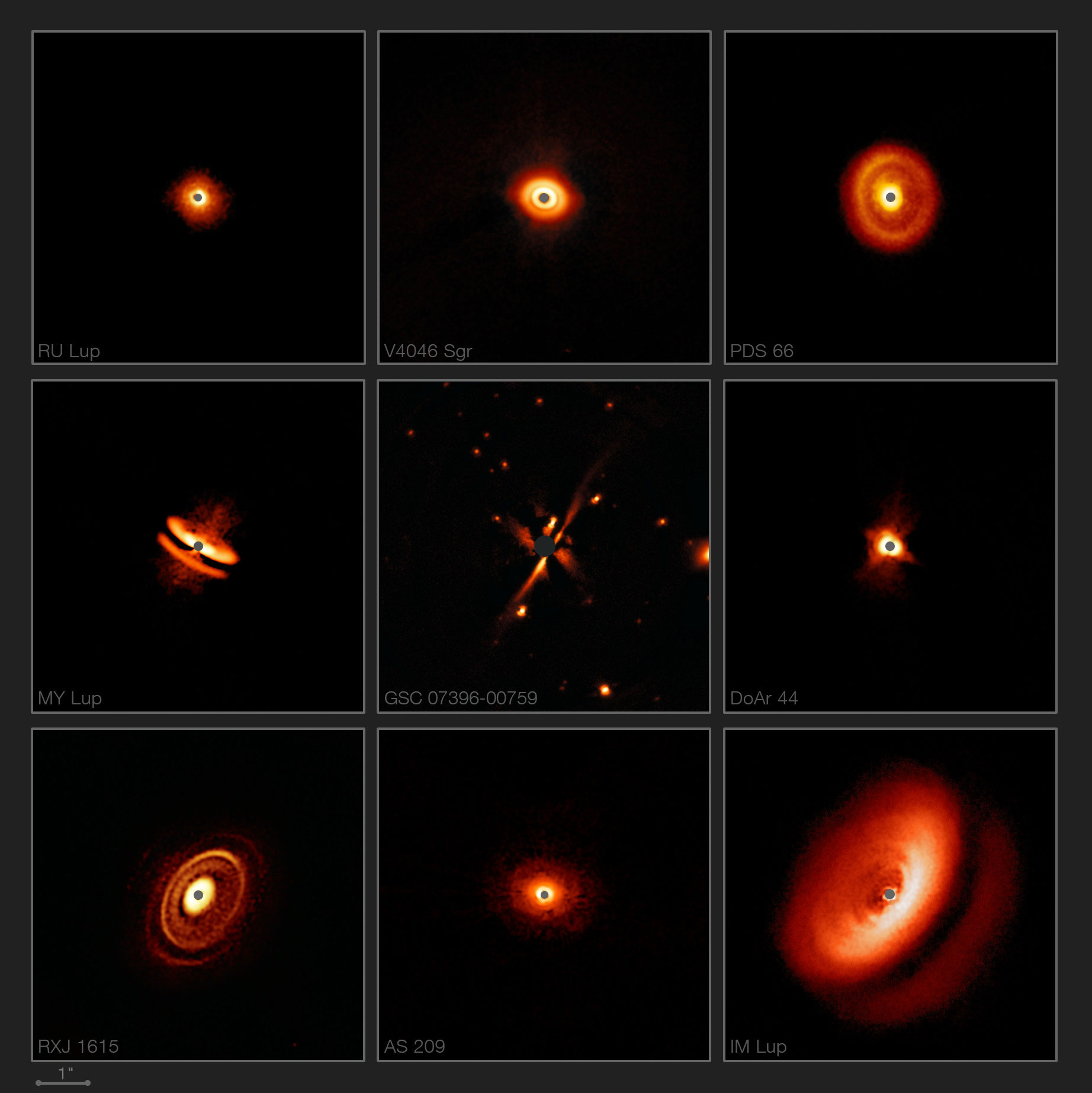
    ESO Reveals Fascinating Zoo of Discs Around Young Stars
    New images from the SPHERE instrument on ESO’s Very Large Telescope are revealing the dusty discs surrounding nearby young stars in greater detail than previously achieved. They show a bizarre variety of shapes, sizes and structures, including the likely effects of planets still in the process of forming. Credit: ESO/H. Avenhaus et al./E. Sissa et al./DARTT-S and SHINE collaborations

    The SPHERE instrument on ESO’s Very Large Telescope (VLT) in Chile allows astronomers to suppress the brilliant light of nearby stars in order to obtain a better view of the regions surrounding them. This collection of new SPHERE images is just a sample of the wide variety of dusty discs being found around young stars.

    These discs are wildly different in size and shape — some contain bright rings, some dark rings, and some even resemble hamburgers. They also differ dramatically in appearance depending on their orientation in the sky — from circular face-on discs to narrow discs seen almost edge-on.
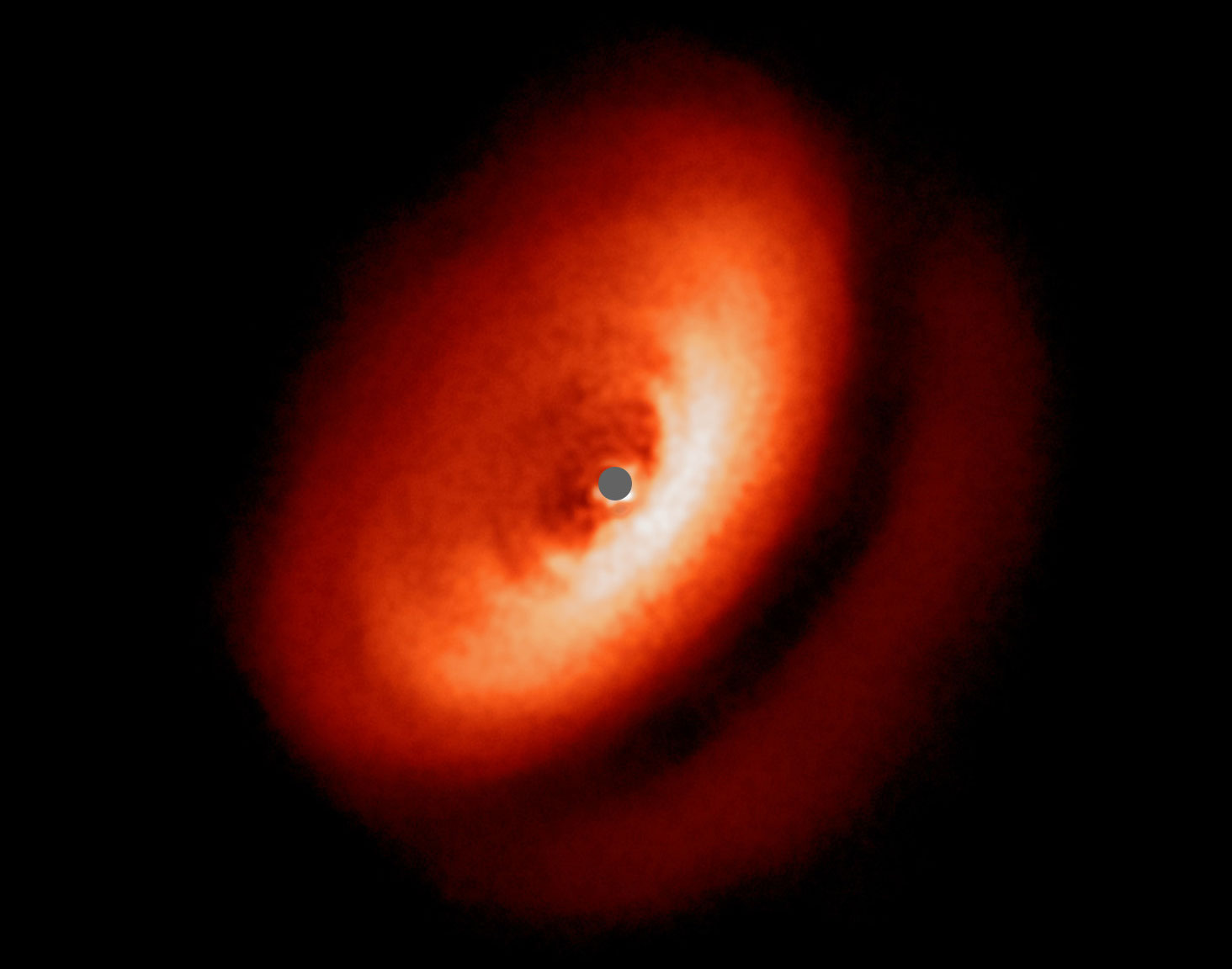
    SPHERE Reveals Fascinating Zoo of Discs Around Young Stars
    This spectacular image from the SPHERE instrument on ESO’s Very Large Telescope shows the dusty disc around the young star IM Lupi in finer detail than ever before. Credit: ESO/H. Avenhaus et al./DARTT-S collaboration

    SPHERE’s primary task is to discover and study giant exoplanets orbiting nearby stars using direct imaging. But the instrument is also one of the best tools in existence to obtain images of the discs around young stars — regions where planets may be forming. Studying such discs is critical to investigating the link between disc properties and the formation and presence of planets.

    Many of the young stars shown here come from a new study of T Tauri stars, a class of stars that are very young (less than 10 million years old) and vary in brightness. The discs around these stars contain gas, dust, and planetesimals — the building blocks of planets and the progenitors of planetary systems.

    These images also show what our own Solar System may have looked like in the early stages of its formation, more than four billion years ago.
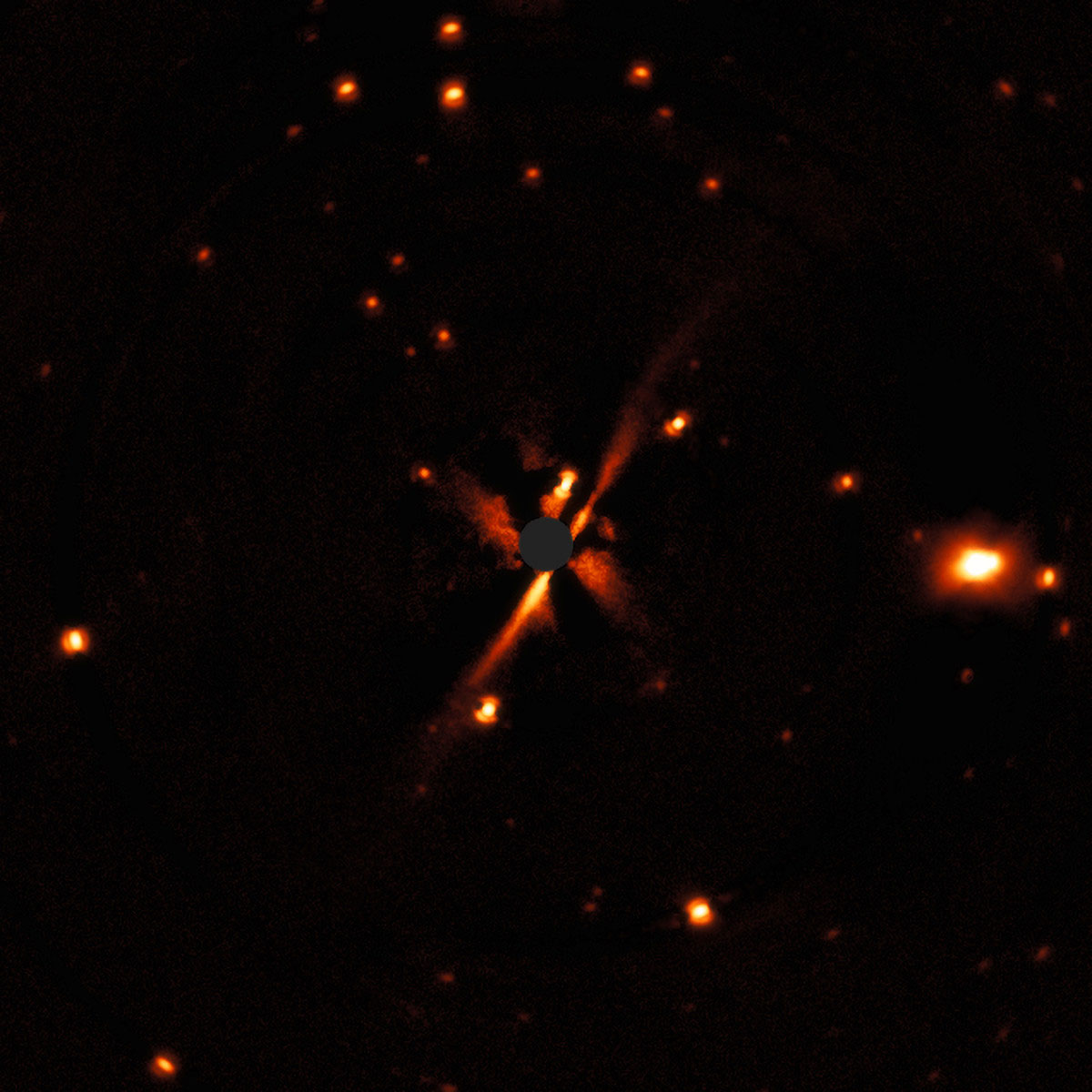
    Fascinating Zoo of Discs Around Young Stars
    This SPHERE observation is the discovery of an edge-on disc around the star GSC 07396-00759, which is a member of a multiple star system included in the DARTTS-S sample. Oddly, this new disc appears to be more evolved than the gas-rich disc around the T Tauri star in the same system, although they are the same age. The disc extends from the lower-left to the upper-right and the central grey region shows where the star was masked out. Credit: ESO/E. Sissa et al.

    Most of the images presented were obtained as part of the DARTTS-S (Discs ARound T Tauri Stars with SPHERE) survey. The distances of the targets ranged from 230 to 550 light-years away from Earth. For comparison, the Milky Way is roughly 100,000 light-years across, so these stars are, relatively speaking, very close to Earth. But even at this distance, it is very challenging to obtain good images of the faint reflected light from discs, since they are outshone by the dazzling light of their parent stars.

    Another new SPHERE observation is the discovery of an edge-on disc around the star GSC 07396-00759, found by the SHINE (SpHere INfrared survey for Exoplanets) survey. This red star is a member of a multiple star system also included in the DARTTS-S sample but, oddly, this new disc appears to be more evolved than the gas-rich disc around the T Tauri star in the same system, although they are the same age. This puzzling difference in the evolutionary timescales of discs around two stars of the same age is another reason why astronomers are keen to find out more about discs and their characteristics.


    New images from the SPHERE instrument on ESO’s Very Large Telescope are revealing the dusty discs surrounding nearby young stars in greater detail than previously achieved. They show a bizarre variety of shapes, sizes and structures, including the likely effects of planets still in the process of forming. The video is available in 4K UHD. Credit: ESO

    Astronomers have used SPHERE to obtain many other impressive images, as well as for other studies including the interaction of a planet with a disc, the orbital motions within a system, and the time evolution of a disc.

    The new results from SPHERE, along with data from other telescopes such as ALMA, are revolutionizing astronomers’ understanding of the environments around young stars and the complex mechanisms of planetary formation.

    References:

    • “Disks Around T Tauri Stars With SPHERE (DARTTS-S) I: SPHERE / IRDIS Polarimetric Imaging of 8 Prominent T Tauri Disks” by Henning Avenhaus, Sascha P. Quanz, Antonio Garufi, Sebastian Perez, Simon Casassus, Christophe Pinte, Gesa H.-M. Bertrang, Claudio Caceres, Myriam Benisty, and Carsten Dominik, 8 August 2018, The Astrophysical Journal.
      DOI: 10.3847/1538-4357/aab846
    •  “A new disk discovered with VLT/SPHERE around the M star GSC 07396-00759” by E. Sissa, J. Olofsson, A. Vigan, J. C. Augereau, V. D’Orazi, S. Desidera, R. Gratton, M. Langlois, E. Rigliaco, A. Boccaletti, Q. Kral, C. Lazzoni, D. Mesa, S. Messina, E. Sezestre, P. Thébault, A. Zurlo, T. Bhowmik, M. Bonnefoy, G. Chauvin, M. Feldt, J. Hagelberg, A.-M. Lagrange, M. Janson, A.-L. Maire, F. Ménard, J. Schlieder, T. Schmidt, J. Szulágyi, E. Stadler, D. Maurel, A. Delboulbé, P. Feautrier, J. Ramos and F. Rigal, 25 May 2018, Astronomy & Astrophysics.
      DOI: 10.1051/0004-6361/201832740

    Never miss a breakthrough: Join the SciTechDaily newsletter.
    Follow us on Google and Google News.

    Astronomy Astrophysics Cosmology European Southern Observatory
    Share. Facebook Twitter Pinterest LinkedIn Email Reddit

    Related Articles

    Scientists Capture the Universe’s Hidden Web of Dark Matter

    ESO Image of the Week: SPHERE Reveals Spiral Disc Around Nearby Star

    Astronomers Discover VFTS 352 – The Hottest and Most Massive Touching Double Star System to Date

    ESO and Hubble Reveal Fast-Moving, Wave-Like Features in the Debris Disk Around AU Microscopii

    ESO Image of the Week: A Microlensing Mystery

    GAMA Survey Reveals the Slow Death of the Universe

    VLT Discovers the Brightest Distant Galaxy to Date and Signs of Population III Stars

    VLT/SPHERE Reveal a Star Giving Birth to a Butterfly-Like Planetary Nebula

    The Possible First Signs of Self-interacting Dark Matter

    Leave A Reply Cancel Reply

    • Facebook
    • Twitter
    • Pinterest
    • YouTube

    Don't Miss a Discovery

    Subscribe for the Latest in Science & Tech!

    Trending News

    Enormous Prehistoric Insects Puzzle Scientists

    Scientists Develop Bioengineered Chewing Gum That Could Help Fight Oral Cancer

    After 37 Years, the World’s Longest-Running Soil Warming Experiment Uncovers a Startling Climate Secret

    NASA Satellite Captures First-Ever High-Res View of Massive Pacific Tsunami

    ADHD Isn’t Just a Deficit: Study Reveals Powerful Hidden Strengths

    Scientists Discover Stem Cells That Could Regrow Teeth and Bone

    Early Cannabis Use May Stall Key Brain Skills in Teens

    Popular Vitamin D Supplement Has “Previously Unknown” Negative Effect, Study Finds

    Follow SciTechDaily
    • Facebook
    • Twitter
    • YouTube
    • Pinterest
    • Newsletter
    • RSS
    SciTech News
    • Biology News
    • Chemistry News
    • Earth News
    • Health News
    • Physics News
    • Science News
    • Space News
    • Technology News
    Recent Posts
    • Quantum Breakthrough: New Algorithm Solves “Impossible” Materials in Seconds
    • Could the Universe’s Hidden Shape Solve One of Physics’ Biggest Mysteries?
    • Rewriting Dinosaur Evolution: Scientists Unearth Remarkable 150-Million-Year-Old Stegosaur Skull
    • Scientists Identify Two Simple Treatments for Cancer-Related Cognitive Impairment
    • Omega-3 Supplements Linked to Cognitive Decline in Surprising New Study
    Copyright © 1998 - 2026 SciTechDaily. All Rights Reserved.
    • Science News
    • About
    • Contact
    • Editorial Board
    • Privacy Policy
    • Terms of Use

    Type above and press Enter to search. Press Esc to cancel.