
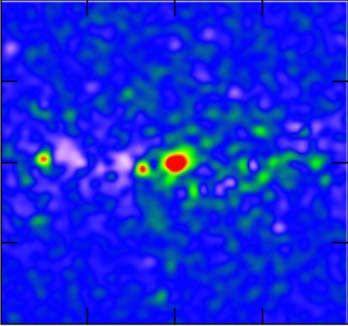
By studying the spatial distribution of gamma-ray emission in the Milky Way, astronomers believe they have identified a signature of dark matter annihilation.
We live in a dramatic epoch of astrophysics. Breakthrough discoveries like exoplanets, gravitational waves from merging black holes, or cosmic acceleration seem to arrive every decade, or even more often. But perhaps no discovery was more unexpected, mysterious, and challenging to our grasp of the “known universe” than the recognition that the vast majority of matter in the universe cannot be directly seen. This matter is dubbed “dark matter,” and its nature is unknown. According to the latest results from the Planck satellite, a mere 4.9% of the universe is made of ordinary matter (that is, matter composed of atoms or their constituents). The rest is dark matter, and it has been firmly detected via its gravitational influence on stars and other normal matter. Dark energy is a separate constituent.
Understanding this ubiquitous yet mysterious substance is a prime goal of modern astrophysics. Some astronomers have speculated that dark matter might have another property besides gravity in common with ordinary matter: It might come in two flavors, matter and anti-matter, that annihilate and emit high energy radiation when coming into contact. The leading class of particles in this category are called weakly interacting massive particles (WIMPS). If dark matter annihilation does occur, the range of options for the theoretical nature of dark matter would be considerably narrowed.
CfA astronomer Doug Finkbeiner and a team of colleagues claim to have identified just such a signature of dark matter annihilation. They studied the spatial distribution of gamma-ray emission in the Milky Way, in particular gamma-ray emission from the Galactic Center region. This region is both relatively nearby and has a high matter density (and nominally a high dark matter density as well). If dark matter annihilation occurred, the location would be expected to be bright in gamma-rays. Indeed, a large gamma-ray signature has been seen from the area that extends over hundreds of light-years (there is also fainter emission extending outward for thousands of light-years). There are other possible explanations, however, most notably that the gamma-rays result from a large population of rapidly spinning pulsars, the nuclear ashes of some supernovae.
The scientists revisited the set of previously published gamma-ray observations, applying careful new data reduction methods in order to constrain more precisely the location of the emission, and they did so for each of the several observed energy regimes of the gamma-ray emission. Pulsars have a distinctive spatial distribution: they are located where stars are found, predominantly in the plane of the galaxy. The team was able to show with high significance that the distribution of gamma-ray emission is in good agreement with the predictions of simple annihilating dark matter models, but less likely to be consistent with a pulsar explanation. Their result, if confirmed, would be an impressive breakthrough in the understanding of the nature of dark matter, the dominant constituent of the cosmos.
Reference: “The Characterization of the Gamma-Ray Signal from the Central Milky Way: A Compelling Case for Annihilating Dark Matter” by Tansu Daylan, Douglas P. Finkbeiner, Dan Hooper, Tim Linden, Stephen K. N. Portillo, Nicholas L. Rodd and Tracy R. Slatyer, 11 February 2016, Physics of the Dark Universe.
DOI: 10.1016/j.dark.2015.12.005
arXiv:1402.6703
Never miss a breakthrough: Join the SciTechDaily newsletter.
Follow us on Google and Google News.
8 Comments
Dark matter is not a clump of stuff that travels with the matter. Dark matter fills the space unoccupied by particles of matter and is displaced by the particles of matter which exist in it and move through it. Dark matter strongly interacts with matter. Dark matter is displaced by matter.
[0903.3802] The Milky Way’s dark matter halo appears to be lopsided
“the emerging picture of the dark matter halo of the Milky Way is dominantly lopsided in nature.”
The Milky Way’s halo is not a clump of dark matter traveling along with the Milky Way. The Milky Way’s halo is lopsided due to the matter in the Milky Way moving through and displacing the dark matter, analogous to a submarine moving through and displacing the water.
What physicists mistake for the density of the dark matter is actually the state of displacement of the dark matter. Physicists think they are determining the density of the dark matter by how much it and the matter curve spacetime. What they fail to realize is the state of displacement of the dark matter is curved spacetime.
“Dark matter fills the space unoccupied by particles of matter”… fills it with what? This doesn’t make sense. Almost all space, even inside an atom, is “unoccupied” by particles.
“Dark matter strongly interacts with matter.” No it doesn’t. That’s the whole point of why we call it dark. It doesn’t interact with ordinary matter in the ways that ordinary matter interacts with other ordinary matter. In particular, it neither absorbs nor emits electromagnetic radiation. Whatever it is, it doesn’t involve charged particles, and charge is one of the main ways ordinary matter interacts.
Dark matter has mass which physically occupies three dimensional space. Dark matter fills ’empty’ space.
The notion of a weakly interacting dark matter that travels with the matter is incorrect. Dark matter fills ’empty’ space and is displaced by matter.
Correct, dark matter does not emit nor absorb light. That has nothing to do with it physically occupying three dimensional space and being displaced by matter.
What is referred to geometrically as the curvature of spacetime physically exists in nature as the state of displacement of the dark matter.
The Standard Model of particle physics does not incorporate the physics of GR and it is not consistent with the Standard Model of cosmology with its dark energy and dark matter. The questions are arising. Do we really have a wrong Standard Model of the particles which can not explain 96% of our world? Or is the Standard Model of cosmology not correct since it requires all this non-existing dark matter and dark energy? Why does a mainstream science refuse to pose these clear questions?
What process is annihilating the dark matter?
The annihilation of dark matter and anti-dark matter. Changing matter into pure energy. Could this be the source of “dark energy?
No, because what you’re getting is ordinary energy, not dark energy.
Sorry, I remain unconvinced that so-called dark matter exists as some sort of exotic substance or substances. More than likely, the effects of gravity have been underestimated and that there are far more black holes, neutron stars, brown stars, and stellar debris than had been supposed.