
Close Menu
    Facebook X (Twitter) Instagram
    SciTechDaily
    • Biology
    • Chemistry
    • Earth
    • Health
    • Physics
    • Science
    • Space
    • Technology
    Facebook X (Twitter) Pinterest YouTube RSS
    SciTechDaily
    Home»Space»New Model Supports Connection Between Gamma Ray Bursts and Supernovae
    Space

    New Model Supports Connection Between Gamma Ray Bursts and Supernovae

    By Megan Watzke, Harvard-Smithsonian Center For AstrophysicsApril 13, 2018No Comments2 Mins Read
    Facebook Twitter Pinterest Telegram LinkedIn WhatsApp Email Reddit
    Share
    Facebook Twitter LinkedIn Pinterest Telegram Email Reddit
    The Gamma Ray Burst – Supernova Connection
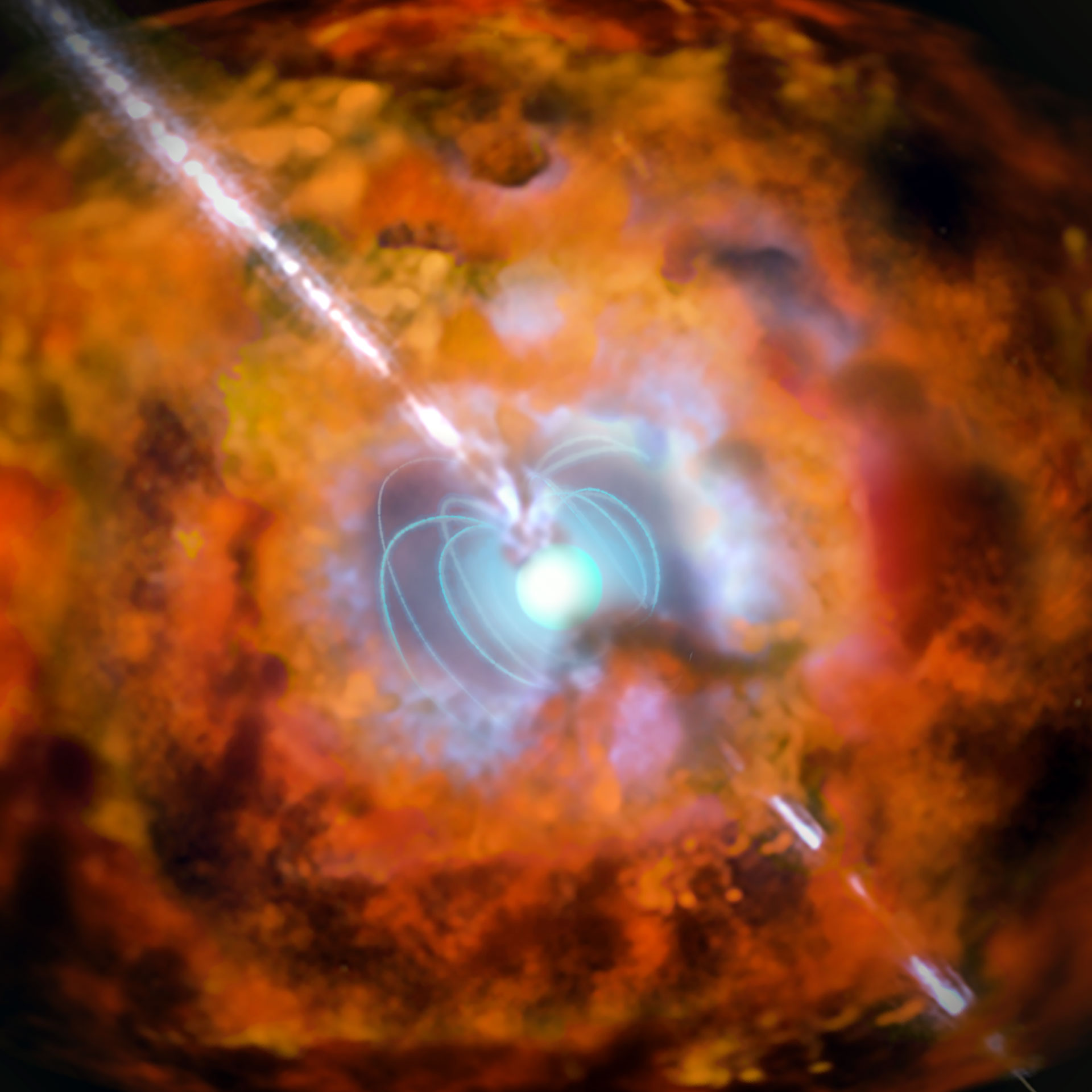
    An artist’s impression of a superluminous supernova and an associated gamma-ray burst being driven by a rapidly spinning neutron star. A new model proposes that a slight misalignment between the spin and magnetic axes of the neutron star can power both the superluminous supernova and the gamma-ray burst phenomena. ESO

    A “core-collapse” supernova occurs when the iron core of a massive star collapses under the force of gravity and then rebounds, generating pressure waves and shocks that propagate outward. A superluminous supernovae is a rare class of core collapse supernovae whose luminosity, equal to 10-1000 billion suns, is too high to be powered by the usual process that drives supernovae, the radioactive decay of nickel (there is not enough nickel present to do it). The source of the energetics has been hotly contested, with suggestions including shocks from the ejected material or pulsating instabilities interacting with surrounding material. The most favored model, however, is the sustained injection of energy from a source like a spinning compact remnant: a neutron star or an accreting black hole.

    Long-duration gamma-ray bursts are those that last for a few seconds up to several minutes, unlike the more common gamma-ray bursts that last for under a few seconds. The long-duration bursts are suspected of being sustained by the rotational energy of a spinning compact object left behind from a supernova. Superluminous supernovae seem to be associated with these kinds of long-duration bursts, lending support to the idea that they too are powered by a spinning remnant. CfA astronomer Matt Nicholl and four colleagues have proposed a unifying model for superluminous supernovae and long-duration gamma-ray bursts in which a spinning neutron star has a slight misalignment between its spin axis and its magnetic axis. The consequence is that substantial fractions of the spinning power are supplied both to the supernova and to a jet of particles moving at speeds close to the speed of light that enabled the long burst. Moreever, the scientists are able to predict the radio emission and thermal wind effects, and to address some of the transient effects that appear in these dramatic events.

    Reference: “The GRB–SLSN Connection: Misaligned Magnetars, Weak Jet Emergence, and Observational Signatures” by Ben Margalit, Brian D Metzger, Todd A Thompson, Matt Nicholl and Tuguldur Sukhbold, 9 January 2018, MNRAS.
    DOI: 10.1093/mnras/sty013

    Never miss a breakthrough: Join the SciTechDaily newsletter.
    Follow us on Google and Google News.

    Astronomy Astrophysics Cosmology Gamma Ray Harvard-Smithsonian Center for Astrophysics Supernova
    Share. Facebook Twitter Pinterest LinkedIn Email Reddit

    Related Articles

    Astronomers Study Enduring ‘Radio Rebound’ from Gamma-Ray Burst 161219B

    Astronomers Reveal Superluminous Supernova Gaia16apd is Powered by a Magnetar

    Astronomers Identify a Signature of Dark Matter Annihilation

    Astronomers Reveal “Missing-Link” in the Supernova-GRB Connection

    Astronomers Search for Trigger of Nearby Supernova

    Calculations Show the Ideal Time to Study the Cosmos

    Supernova Shock Wave Breaks Through a Cocoon of Gas

    Origins of Type Ia Supernovae

    Links Between Core Collapse Supernovae and Star Formation Established

    Leave A Reply Cancel Reply

    • Facebook
    • Twitter
    • Pinterest
    • YouTube

    Don't Miss a Discovery

    Subscribe for the Latest in Science & Tech!

    Trending News

    One of the Universe’s Largest Stars May Be Getting Ready To Explode

    Scientists Discover Enzyme That Could Supercharge Ozempic-Like Weight Loss Drugs

    Popular Sweetener Linked to DNA Damage – “It’s Something You Should Not Be Eating”

    Ancient “Rock” Microbes May Reveal How Complex Life Began

    Researchers Capture Quantum Interference in One of Nature’s Rarest Atoms

    “A Plague Is Upon Us”: The Mass Death That Changed an Ancient City Forever

    Scientists Discover Game-Changing New Way To Treat High Cholesterol

    This Small Change to Your Exercise Routine Could Be the Secret to Living Longer

    Follow SciTechDaily
    • Facebook
    • Twitter
    • YouTube
    • Pinterest
    • Newsletter
    • RSS
    SciTech News
    • Biology News
    • Chemistry News
    • Earth News
    • Health News
    • Physics News
    • Science News
    • Space News
    • Technology News
    Recent Posts
    • Scientists Rethink Extreme Warming After Surprising Ocean Discovery
    • The Surprising Role of Asteroids in the Origin of Life
    • Scientists Raise Concerns Over Newly Recognized Pollutant Found Everywhere in the Air
    • New Study Challenges 40-Year Puzzle About Childhood Body Fat
    • 20-Year Study Finds Daily Multivitamins Don’t Extend Lifespan
    Copyright © 1998 - 2026 SciTechDaily. All Rights Reserved.
    • Science News
    • About
    • Contact
    • Editorial Board
    • Privacy Policy
    • Terms of Use

    Type above and press Enter to search. Press Esc to cancel.