
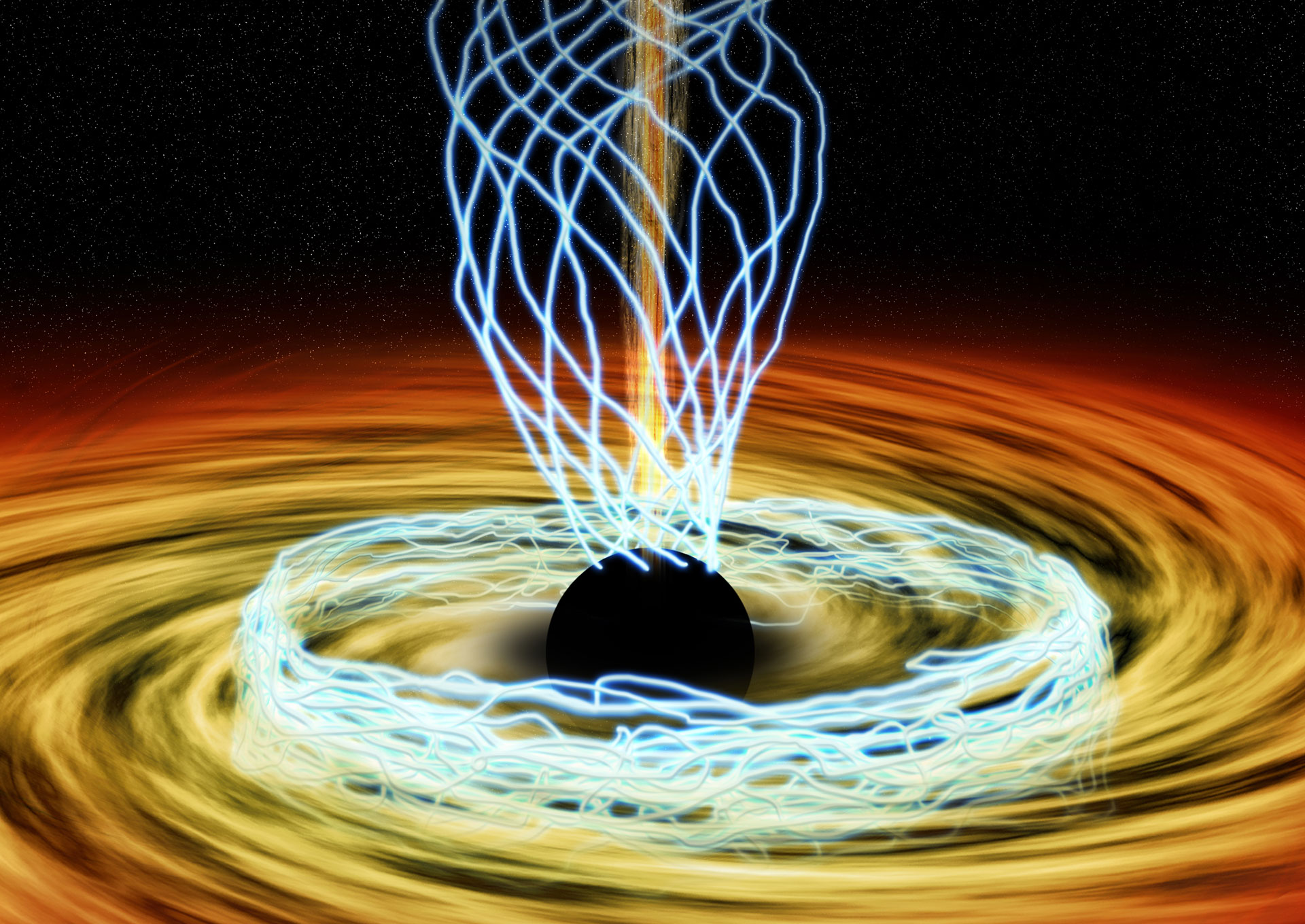
Using the Event Horizon Telescope, astronomers have measured the magnetic fields just outside the event horizon of Sagittarius A* for the first time.
Most people think of black holes as giant vacuum cleaners sucking in everything that gets too close. But the supermassive black holes at the centers of galaxies are more like cosmic engines, converting energy from infalling matter into intense radiation that can outshine the combined light from all surrounding stars. If the black hole is spinning, it can generate strong jets that blast across thousands of light-years and shape entire galaxies. These black hole engines are thought to be powered by magnetic fields. For the first time, astronomers have detected magnetic fields just outside the event horizon of the black hole at the center of our Milky Way galaxy.
“Understanding these magnetic fields is critical. Nobody has been able to resolve magnetic fields near the event horizon until now,” says lead author Michael Johnson of the Harvard-Smithsonian Center for Astrophysics (CfA). The results appear in the December 4th issue of the journal Science.
“These magnetic fields have been predicted to exist, but no one has seen them before. Our data puts decades of theoretical work on solid observational ground,” adds principal investigator Shep Doeleman (CfA/MIT), who is assistant director of MIT’s Haystack Observatory.
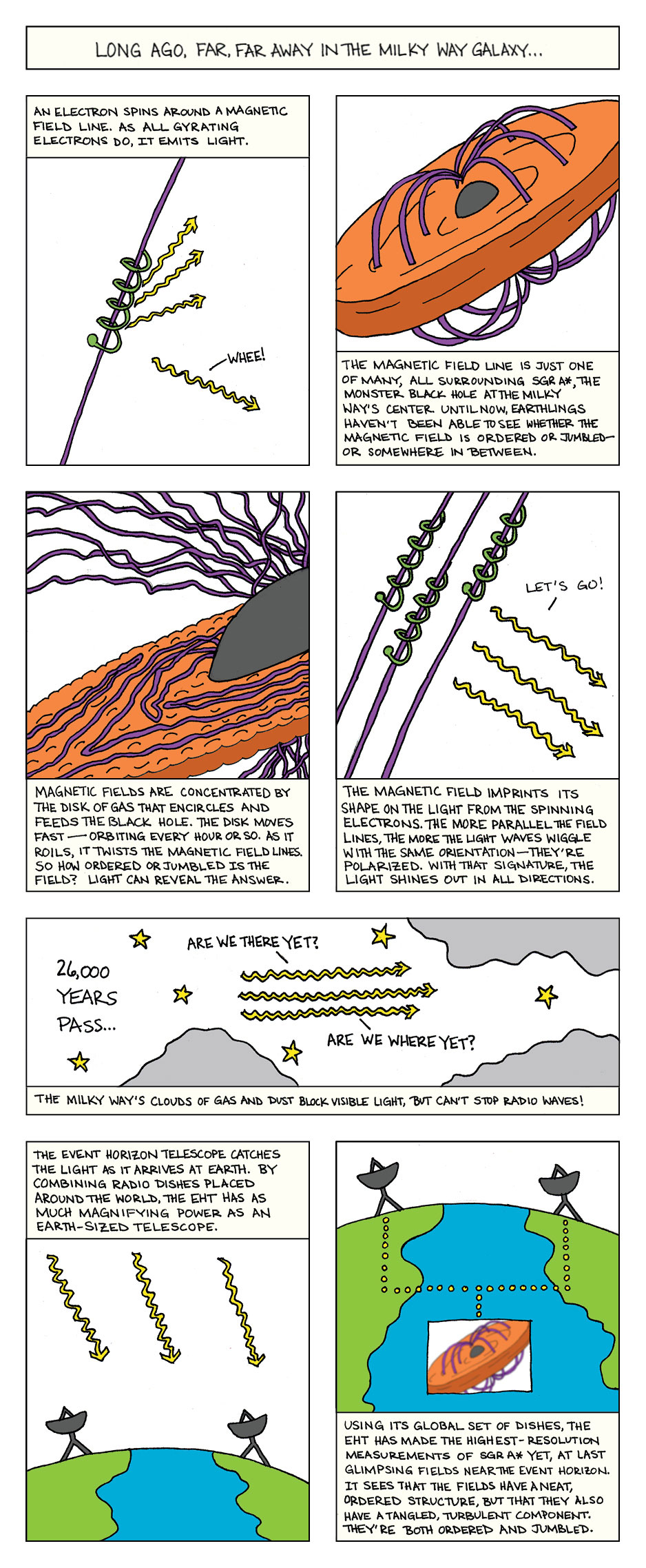
This feat was achieved using the Event Horizon Telescope (EHT) — a global network of radio telescopes that link together to function as one giant telescope the size of Earth. Since larger telescopes can provide greater detail, the EHT ultimately will resolve features as small as 15 micro-arcseconds. (An arcsecond is 1/3600 of a degree, and 15 micro-arcseconds is the angular equivalent of seeing a golf ball on the moon.)
Such resolution is needed because a black hole is the most compact object in the universe. The Milky Way’s central black hole, Sgr A* (Sagittarius A-star), weighs about 4 million times as much as our Sun, yet its event horizon spans only 8 million miles — smaller than the orbit of Mercury. And since it’s located 25,000 light-years away, this size corresponds to an incredibly small 10 micro-arcseconds across. Fortunately, the intense gravity of the black hole warps light and magnifies the event horizon so that it appears larger in the sky — about 50 micro-arcseconds, a region that the EHT can easily resolve.
The Event Horizon Telescope made observations at a wavelength of 1.3 mm. The team measured how that light is linearly polarized. On Earth, sunlight becomes linearly polarized by reflections, which is why sunglasses are polarized to block light and reduce glare. In the case of Sgr A*, polarized light is emitted by electrons spiraling around magnetic field lines. As a result, this light directly traces the structure of the magnetic field.
Sgr A* is surrounded by an accretion disk of material orbiting the black hole. The team found that magnetic fields in some regions near the black hole are disorderly, with jumbled loops and whorls resembling intertwined spaghetti. In contrast, other regions showed a much more organized pattern, possibly in the region where jets would be generated.
They also found that the magnetic fields fluctuated on short time scales of only 15 minutes or so.
“Once again, the galactic center is proving to be a more dynamic place than we might have guessed,” says Johnson. “Those magnetic fields are dancing all over the place.”
These observations used astronomical facilities in three geographic locations: the Submillimeter Array and the James Clerk Maxwell Telescope (both on Mauna Kea in Hawaii), the Submillimeter Telescope on Mt. Graham in Arizona, and the Combined Array for Research in Millimeter-wave Astronomy (CARMA) near Bishop, California. As the EHT adds more radio dishes around the world and gathers more data, it will achieve greater resolution with the goal of directly imaging a black hole’s event horizon for the first time.
“The only way to build a telescope that spans the Earth is to assemble a global team of scientists working together. With this result, the EHT team is one step closer to solving a central paradox in astronomy: why are black holes so bright?” states Doeleman.
Reference: “Resolved magnetic-field structure and variability near the event horizon of Sagittarius A*” by Michael D. Johnson, Vincent L. Fish, Sheperd S. Doeleman, Daniel P. Marrone, Richard L. Plambeck, John F. C. Wardle, Kazunori Akiyama, Keiichi Asada, Christopher Beaudoin, Lindy Blackburn, Ray Blundell, Geoffrey C. Bower, Christiaan Brinkerink, Avery E. Broderick, Roger Cappallo, Andrew A. Chael, Geoffrey B. Crew, Jason Dexter, Matt Dexter, Robert Freund, Per Friberg, Roman Gold, Mark A. Gurwell, Paul T. P. Ho, Mareki Honma, Makoto Inoue, Michael Kosowsky, Thomas P. Krichbaum, James Lamb, Abraham Loeb, Ru-Sen Lu, David MacMahon, Jonathan C. McKinney, James M. Moran, Ramesh Narayan, Rurik A. Primiani, Dimitrios Psaltis, Alan E. E. Rogers, Katherine Rosenfeld, Jason SooHoo, Remo P. J. Tilanus, Michael Titus, Laura Vertatschitsch, Jonathan Weintroub, Melvyn Wright, Ken H. Young, J. Anton Zensus and Lucy M. Ziurys, 4 December 2015, Science.
DOI: 10.1126/science.aac7087
EHT research at CfA and MIT is supported by grants from the National Science Foundation and from the Gordon and Betty Moore Foundation. The Submillimeter Array (SMA) is a joint project between the Smithsonian Astrophysical Observatory and the Academia Sinica Institute of Astronomy and Astrophysics. The Submillimeter Telescope is part of the Arizona Radio Observatory, which is partially supported through the NSF University Radio Observatories program. The James Clerk Maxwell Telescope was operated by the Joint Astronomy Center on behalf of the Science and Technology Facilities Council of the UK, the Netherlands Organization for Scientific Research, and the National Research Council of Canada. Funding for CARMA development and operations was supported by NSF and the CARMA partner universities.
Never miss a breakthrough: Join the SciTechDaily newsletter.
Follow us on Google and Google News.
1 Comment
Sagittarius constellation curves to the center of the Milky Way Galaxy, where the concentration of Dark Matter should be more. Gravitation between two light matter will always be attractive whereas the the gravitational force between Light Matter and Dark Matter is bound to be repulsive. This is the reason for the Dark Matter in the center of the galaxy preventing all stars to clump together at the center and they are thrown out in spiral wings around the center. By the same argument, it should be possible to throw out the light (Electromagnetic wave) from the galaxies in gravitational lensing effect by the intervening Dark Matter. In the Black Hole the neutron stars are crumbling and their high energy emitted including light, X-rays and Gamma rays towards its Dark Matter center should be thrown out when the high density neutrons attract and absorb the electromagnetic rays. This phenomena results in these spectacular view of Magnetic fields forming a lotus array at the center. Thank You.