
Close Menu
    Facebook X (Twitter) Instagram
    SciTechDaily
    • Biology
    • Chemistry
    • Earth
    • Health
    • Physics
    • Science
    • Space
    • Technology
    Facebook X (Twitter) Pinterest YouTube RSS
    SciTechDaily
    Home»Space»Astronomers Reveal ‘Orphaned Protostars’
    Space

    Astronomers Reveal ‘Orphaned Protostars’

    By Harvard-Smithsonian Center for AstrophysicsJuly 26, 2016No Comments3 Mins Read
    Facebook Twitter Pinterest Telegram LinkedIn WhatsApp Email Reddit
    Share
    Facebook Twitter LinkedIn Pinterest Telegram Email Reddit
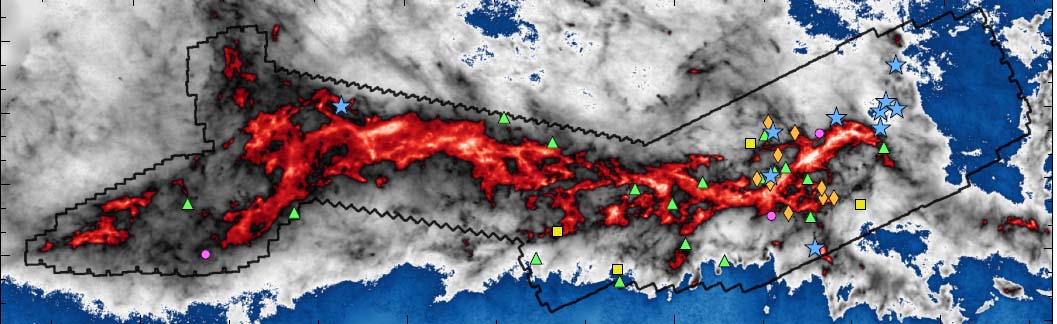
    Protostars at Low Extinction in Orion A
    A far-infrared dust map of the star formation region in Orion showing protostellar candidates (of various types) with very low extinction using blue and green markers. The background color corresponds to the infrared brightness; the black line represents one survey region. Astronomers have confirmed that ten of these candidate objects are true protostars even though, contrary to expectations, they are not deeply buried within their clouds.

    New research from the Harvard-Smithsonian Center for Astrophysics concludes that ten protostellar candidates are indeed protostars even though they are not presently embedded in a cloud.

    Stars form as gravity contracts the gas and dust in an interstellar cloud until clumps develop that are dense enough to coalesce into stars. Precisely how this happens, however, is very uncertain, and the processes are hard to study because they occur inside the opaque interiors of these clouds. The number of stars that form from a single clump is not well understood, for example, nor are the stellar masses. In the earliest stages of formation, the so-called protostellar stage, the newborn star is still accreting material from an envelope and is ringed by a circumstellar disk (which can develop into a system of planets). This earliest stage, which occurs when the star is the most heavily obscured, is therefore also the most mysterious.

    Infrared observations can penetrate the dust in a stellar womb, at least partially, with the reddest wavelengths being least obscured. Astronomers examining Spitzer Space Telescope infrared images of the Orion star-forming complex discovered 329 protostars in the region, and forty-four of them did not appear to be very red — and hence not deeply embedded, contrary to expectations. CfA astronomers John Lewis and Charlie Lada wondered how that could be. After re-examining the dataset with more stringent criteria, they concluded that only ten were true protostars, with the others being extragalactic objects and nebulous regions with a few unclassified sources. But these ten were still ten more than would be predicted.

    The astronomers modeled these ten protostars (including for their analysis a variety of other data) and concluded that indeed they are protostars … and they are not presently embedded in a cloud. The scientists dub them “orphan protostars,” and speculate that they have left their nursery at a young age, perhaps ejected in a gravitational interaction with a more-massive sibling. Alternative possibilities include that they just migrated away, or that somehow they were able to dissipate their immediate surroundings through winds. Additional research will narrow these choices. On the one hand, these new results make the class of protostars even more varied, but on the other hand, they confirm that the general theory is steadily improving even though the range of conditions has increased.

    Reference: “Protostars at Low Extinction in Orion A” by John Arban Lewis and Charles J. Lada, 6 July 2016, The Astrophysical Journal.
    DOI: 10.3847/0004-637X/825/2/91
    arXiv:1605.02732

    Never miss a breakthrough: Join the SciTechDaily newsletter.
    Follow us on Google and Google News.

    Astronomy Astrophysics Harvard-Smithsonian Center for Astrophysics Protostar
    Share. Facebook Twitter Pinterest LinkedIn Email Reddit

    Related Articles

    ALMA Discovers a Weak and Wildly Disorganized Magnetic Field Near a Protostar

    New Models of Star-Forming Filamentary Clouds

    Astronomers Discover a Massive Outburst in a Star-Forming Cloud

    Two Planets Separated by Less Than 5 Earth Moon Distances

    Study Challenges Prevailing Ideas About How Supermassive Black Holes Grow

    Calculations Show the Ideal Time to Study the Cosmos

    Using Infrared Images from Hubble & Spitzer, Scientists Discover 25 Distant Galaxies

    Supernova Shock Wave Breaks Through a Cocoon of Gas

    Origins of Type Ia Supernovae

    Leave A Reply Cancel Reply

    • Facebook
    • Twitter
    • Pinterest
    • YouTube

    Don't Miss a Discovery

    Subscribe for the Latest in Science & Tech!

    Trending News

    First-of-Its-Kind Discovery: Homer’s Iliad Found Embedded in a 1,600-Year-Old Egyptian Mummy

    Beyond Inflammation: Scientists Uncover New Cause of Persistent Rheumatoid Arthritis

    A Simple Molecule Could Unlock Safer, Easier Weight Loss

    Scientists Just Built a Quantum Battery That Charges Almost Instantly

    Researchers Unveil Groundbreaking Sustainable Solution to Vitamin B12 Deficiency

    Millions of People Have Osteopenia Without Realizing It – Here’s What You Need To Know

    Researchers Discover Boosting a Single Protein Helps the Brain Fight Alzheimer’s

    World-First Study Reveals Human Hearts Can Regenerate After a Heart Attack

    Follow SciTechDaily
    • Facebook
    • Twitter
    • YouTube
    • Pinterest
    • Newsletter
    • RSS
    SciTech News
    • Biology News
    • Chemistry News
    • Earth News
    • Health News
    • Physics News
    • Science News
    • Space News
    • Technology News
    Recent Posts
    • After Decades, MIT Researchers Capture the First 3D Atomic View of a Mysterious Material
    • Your Favorite Fishing Spot Is Turning Brown – and the Fish Are Changing
    • 380-Million-Year-Old Fish Fossil Reveals Secrets of Life’s First Steps Onto Land
    • Mezcal “Worm” in a Bottle Mystery: DNA Testing Reveals a Surprise
    • Scientists Turn Red Lettuce Green, Unlocking Hidden Nutrients
    Copyright © 1998 - 2026 SciTechDaily. All Rights Reserved.
    • Science News
    • About
    • Contact
    • Editorial Board
    • Privacy Policy
    • Terms of Use

    Type above and press Enter to search. Press Esc to cancel.