
Astrophysicists from the Harvard-Smithsonian Center for Astrophysics examine orbit flips in exoplanet systems, presenting a previously unidentified mechanism whereby such interactions can completely flip the planet from normal to counter-rotating.
The orbits of the planets in our solar system are almost circular (Kepler made the case for their actually being ellipses). This nearly circular, concentric property helps keep the solar system stable, since highly elliptical orbits could occasionally bring planets close enough together for their gravitational interactions to disrupt their paths. Orbital shapes are quantified by their eccentricity, a measure of the closest distance of a planet from the Sun compared to its largest distance (thus helping determine the annual variations in stellar illumination); the Earth’s eccentricity is small, 0.0167, and in December the Earth is only about 3% closer to the Sun than in June.
The northern hemisphere is cooler in December (not June) because the Earth’s axis of rotation is tilted with respect to its orbital motion, and in December the north pole is pointed slightly away from the Sun. The size of this tilt (called the obliquity) is 23.4 degrees, and it was likely produced in a cataclysmic impact between the Earth and another large body about 4.5 billion years ago. The impact is also thought to have formed the moon, whose presence plays the important role of stabilizing the value of the tilt which otherwise might wobble. Mars, for example, has no large moon, and its obliquity – currently 25 degrees – wobbles by up to tens of degrees on time scales of only hundreds of thousands of years, driving profound climate changes on the planet as detected in the structure of its polar ice caps. Eccentricity and obliquity are thus key planetary parameters, and they are not necessarily constant but can evolve in time.
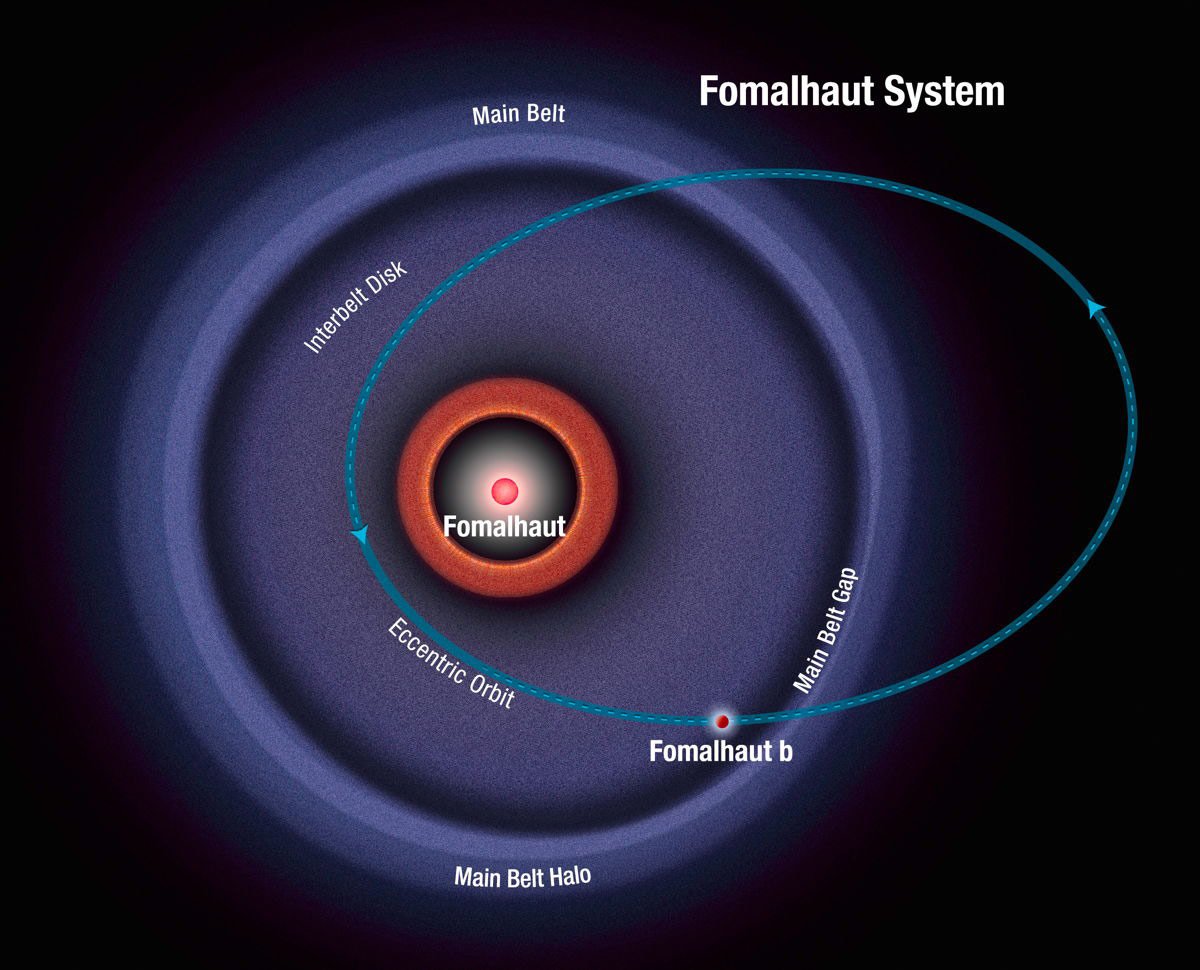
There are currently about 1783 confirmed exoplanets and of this group, forty-one are estimated to have eccentricities like the Earth’s or smaller. The others have larger values – sometimes much larger, with a few known exoplanets varying their distances from their star periodically by ten or more times. CfA astronomers Gongjie Li, Smadar Naoz, Bence Kocsis, and Avi Loeb have examined what happens to a system of three or more bodies (for example a star with two planets), when the orbits are elliptical (and/or when some other conditions pertain). They were prompted in part by the fact that in some unusual exoplanetary systems a planet orbits in a sense opposite to the star’s spin (a counter-orbit); in other systems the orbit is in the same direction, but the planet’s spin (its obliquity) is 180 degrees so that its north pole points “down.”
The astronomers show that the gravitational perturbations that can result from close encounters in systems with elliptical orbits can induce complex processes that result in such odd behaviors. They present a previously unidentified mechanism whereby such interactions can, in a relatively short time period (just a few thousand years!), completely flip the planet from normal to counter-rotating. The new paper not only helps to explain why some exoplanet systems are weird, it provides new insights into the planet-making processes while helping us appreciate our own planetary system.
Reference: “Eccentricity Growth and Orbit Flip in Near-Coplanar Hierarchical Three-Body Systems” by Gongjie Li, Smadar Naoz, Bence Kocsis and Abraham Loeb, 2 April 2014, The Astrophysical Journal.
DOI: 10.1088/0004-637X/785/2/116
arXiv: 1310.6044
Never miss a breakthrough: Join the SciTechDaily newsletter.
Follow us on Google and Google News.
1 Comment
Let me quote from the article the lines “They were prompted in part by the fact that in some unusual exo-planetary systems a planet orbits in a sense opposite to the star’s spin (a counter-orbit); in other systems the orbit is in the same direction, but the planet’s spin (its obliquity) is 180 degrees so that its north pole points “down.”. A planet spinning counter to its mother star is not a weird thing. Generally, the planets would spin with the same direction of star. i.e for all the planets it would be rise of the star in east and set in the west as in our case depending on the sense of direction of star spinning as in our Sun’s case. But we should not forget that closer a planet is to a star, the spinning would be locked by gravitation of the star concerned and it will cease to spin, or gradually lose its speed. We know that our close to sun planet mercury is almost locked and it even spins in opposite direction. If the sun’s spin rate is 24 days it has almost controlled the moon to go in its orbit close to its rate as 29.531 days and 27.32 days in absolute terms. Moreover, it is a known fact that our moon is locked by our giant earth relatively due to its proximity and it is showing only one side always to the earth. The moon in fact ceases to spin. Farther from the sun, even the giant Jupiter is spinning in just 10 hours and more so for still farther planets. Gravity of the star has its role in weakening beyond greater distances so that the farther planets are at liberty to spin uncontrollably. They are also making a longer elliptical orbit with more eccentricity. Now coming to the fact about the obliquity of planets in exo-planets, it is also natural that more of the planets will be oblique than near straight vertical spinning planets and their precession of axes will also be more. Nature has made the planets for different atmospheres and complexion by itself. Collision of planets or big asteroids are also common in cosmos, since galaxy is not homogeneous in structure but chaotic only. Thank you.