
Close Menu
    Facebook X (Twitter) Instagram
    SciTechDaily
    • Biology
    • Chemistry
    • Earth
    • Health
    • Physics
    • Science
    • Space
    • Technology
    Facebook X (Twitter) Pinterest YouTube RSS
    SciTechDaily
    Home»Biology»Corals Emit Chemical Alarm to Summon Friendly Fish When Attacked
    Biology

    Corals Emit Chemical Alarm to Summon Friendly Fish When Attacked

    By SciTechDailyNovember 12, 2012No Comments2 Mins Read
    Facebook Twitter Pinterest Telegram LinkedIn WhatsApp Email Reddit
    Share
    Facebook Twitter LinkedIn Pinterest Telegram Email Reddit
    gobiodon-histrio-coral
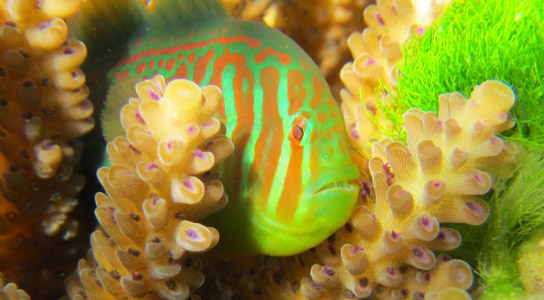
    Gobies rescue the coral they live on from toxic seaweed after responding to a chemical cue. Credit: Danielle Dixson

    When Acropora nasuta corals come into contact with the toxic seaweed Chlorodesmis fastigiata, they emit a chemical that summons gobies, inch-long fish live in the crevices and crannies of the coral.

    The scientists published their findings in the journal Science. They were able to summon gobies within minutes of the contact of seaweed. The researchers observed that corals with resident gobies saw a 30% decline in seaweed abundance after three days, whereas no change was seen in control corals.
    goby-fish
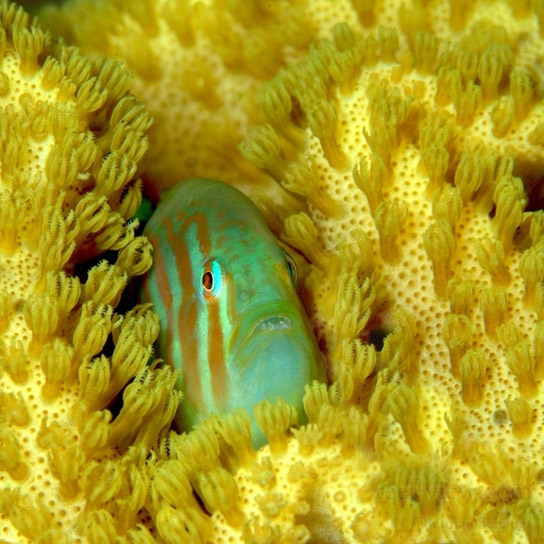
    Gobiodon histrio

    One species, Gobiodon histrio ate the seaweed, while Paragobiodon echinocephalus trimmed it back. G. histrio also gained the benefit of becoming more toxic to predators which ate them in turn.

    To test whether the corals were actively alerting their residents to the threat, the researchers exposed gobies to water from a selection of locations. Water around the seaweed failed to generate any response. Water from the points where seaweed was in contact with coral caused the gobies in 20 separate coral colonies to move towards that source.

    Damselfish exposed to chemical alarm simply abandoned their corals within 48 hours. It could also be possible that the fish are responding to a chemical that corals release to some kind of stress. Gobies often spend their entire lives in the same coral colony and many plants are known to release signals when they are under attack from herbivorous pests to attract predators of these same pests.

    Finding the link remains difficult. “The sensory basis for ecological interactions remains enigmatic, especially in marine habitats,” says Richard Zimmer, who studies chemical signaling between organisms at the University of California, Los Angeles. This research helps bridge the gap between cause and the effect on the ecosystem.

    Reference: “Corals Chemically Cue Mutualistic Fishes to Remove Competing Seaweeds” by Danielle L. Dixson and Mark E. Hay, 9 November 2012, Science.
    DOI: 10.1126/science.1225748

    Never miss a breakthrough: Join the SciTechDaily newsletter.
    Follow us on Google and Google News.

    Coral Reefs Ecosystems Marine Biology Seaweed
    Share. Facebook Twitter Pinterest LinkedIn Email Reddit

    Related Articles

    Why Is a Floating Seaweed Taking Over an Entire Ocean? Researchers Have the Answer

    Scientists Were Misled for Decades – New Study Unveils the Deceptive Role of Seaweed in Reef Health

    Maximizing Genetic Diversity and Adaptability: First-Ever “Family Tree” for Aquarium-Bred Corals

    The Last Mass Extinction Event Occurred 66 Million Years Ago – Here’s How Ocean Ecosystems Recovered

    New Blood-Red Species of Octocoral Discovered in Panama

    Biologists Explore the Effect of Coral Restoration on Caribbean Reef Fish Communities

    Three New Species of Zoantharians Discovered Across the Indo-Pacific

    Black Band Disease Puts Great Barrier Reef at Risk

    Jacques Cousteau Predicted Detrimental Change in Coral Reefs

    Leave A Reply Cancel Reply

    • Facebook
    • Twitter
    • Pinterest
    • YouTube

    Don't Miss a Discovery

    Subscribe for the Latest in Science & Tech!

    Trending News

    Largest-Ever Study Finds Medicinal Cannabis Ineffective for Anxiety, Depression, PTSD

    250-Million-Year-Old Egg Solves One of Evolution’s Biggest Mysteries

    Living With Roommates Might Be Changing Your Gut Microbiome Without You Knowing

    Century-Old Cleaning Chemical Linked to 500% Increased Risk of Parkinson’s Disease

    What if Your Memories Never Happened? Physicists Take a New Look at the Boltzmann Brain Paradox

    One of the Universe’s Largest Stars May Be Getting Ready To Explode

    Scientists Discover Enzyme That Could Supercharge Ozempic-Like Weight Loss Drugs

    Popular Sweetener Linked to DNA Damage – “It’s Something You Should Not Be Eating”

    Follow SciTechDaily
    • Facebook
    • Twitter
    • YouTube
    • Pinterest
    • Newsletter
    • RSS
    SciTech News
    • Biology News
    • Chemistry News
    • Earth News
    • Health News
    • Physics News
    • Science News
    • Space News
    • Technology News
    Recent Posts
    • What Did Prehistoric Europeans Eat? Scientists Uncover Surprising Answers
    • Scientists Say This Overlooked Organ Could Hold the Key to Longer Life
    • Want Less Stress? Landmark Study Points to a Simple Habit
    • Scientists Reveal Eating Fruits and Vegetables May Increase Your Risk of Lung Cancer
    • AI Reveals Explosive Growth of Floating Algae Across the World’s Oceans
    Copyright © 1998 - 2026 SciTechDaily. All Rights Reserved.
    • Science News
    • About
    • Contact
    • Editorial Board
    • Privacy Policy
    • Terms of Use

    Type above and press Enter to search. Press Esc to cancel.