
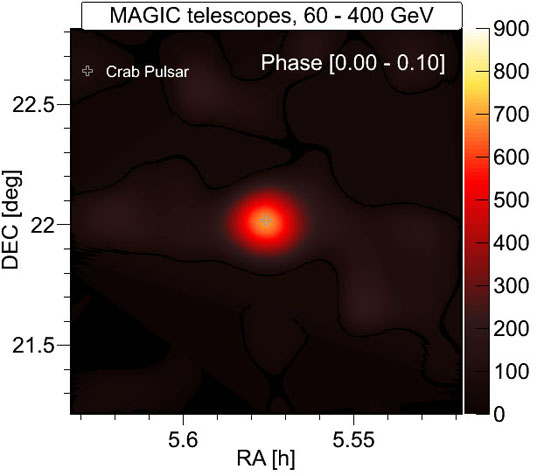
Astrophysicists knew the pulses emitted from the Crab Nebula were powerful, but what they found was 50 to 100 times higher than theorists thought possible. Using the two MAGIC Telescopes on the Canary island of La Palma, researchers observed energy gamma radiation up to 400 GeV.
The pulsar at the center of the famous Crab Nebula is a veritable bundle of energy. This was now confirmed by the two MAGIC Telescopes on the Canary island of La Palma. They observed the pulsar in the very high energy gamma radiation from 25 up to 400 gigaelectronvolts (GeV), a region that was previously difficult to access with high energy instruments, and discovered that it actually emits pulses with the maximum measurable energy of up to 400 GeV – at least 50 to 100 times higher than theorists thought possible. These latest observations are difficult for astrophysicists to explain. “There must be processes behind this that are as yet unknown”, says Razmik Mirzoyan, project head at the Max Planck Institute of Physics.
The neutron star in the Crab Nebula is one of the best-known pulsars. It rotates around its own axis 30 times every second and has a magnetic field of 100 million Tesla, over a trillion times stronger than that of Earth. The pulsar powers the surrounding famous Crab Nebula, located about 6000 light-years from Earth in the constellation of Taurus. Both the pulsar and the nebula are remnants of a supernova that exploded in July 1054 AD and was visible to the naked eye even by daylight for 23 days.
Neutron stars are extremely dense spheres made of nuclear material. Their mass is similar to that of the sun, but they have diameters of just 20 kilometers (12.4 miles). But what makes a neutron star a pulsar, of which astrophysicists have detected some 2000 in our Milky Way galaxy? Neutron stars have an extremely regular and very short rotation period or “day”, ranging from one millisecond to ten seconds. While rotating, the star constantly emits charged particles, mainly electrons and positrons (positively charged electrons) and electromagnetic radiation.
These particles move along magnetic field lines that rotate at the same speed as the neutron star itself, giving off beams almost everywhere in the electromagnetic spectrum, from radio wavelengths to gamma rays. If one of these beams crosses our line of sight, the star flashes up for a moment, just like the signal from a lighthouse.
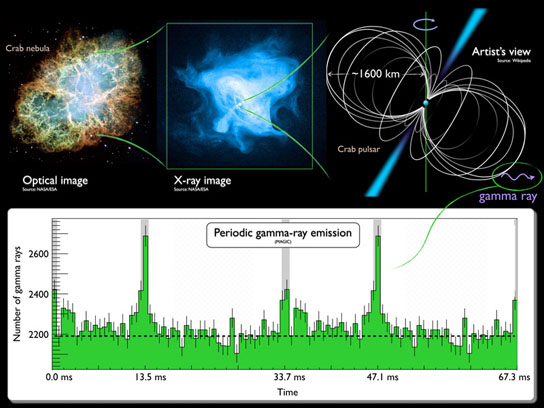
A few years ago, the MAGIC telescopes detected gamma rays of energy higher than 25 GeV from the Crab Pulsar. This was very unexpected since the available EGRET satellite data were showing that the spectrum ceases at much lower energies. However, at the very high energies, MAGIC demonstrated to have a few orders of magnitudes higher sensitivity compared to the satellite missions. At the time, scientists concluded that the radiation must be produced at least 60 kilometers above the surface of the neutron star. This is because the high-energy gamma rays are so effectively shielded by the star’s magnetic field that a source very close to the star could not be detected. As a consequence that measurement ruled out one of the main theories on high energy gamma-ray emission from the Crab pulsar.
Now the data measured by MAGIC over the past two years show that the pulsed emissions by far exceed all expectations, reaching 400 GeV in extremely short pulses of about a millisecond duration. This finding casts doubt on existing theories, since it was thought that all pulsars had significantly lower energy limits.The recent measurements by MAGIC, together with those of the orbiting Fermi satellite at much lower energies, provide an uninterrupted spectrum of the pulses from 0.1 GeV to 400 GeV. These clear observational results create major difficulties for most of the existing pulsar theories that predict significantly lower limits for highest energy emission.
A new theoretical model developed by MAGIC team associate Kouichi Hirotani of the Academia Sinica, Institute of Astronomy and Astrophysics in Taiwan explains the phenomenon with a cascade-like process which produces secondary particles that are able to overcome the barrier of the pulsar’s magnetosphere. Another possible explanation posed by Felix Aharonian of the Dublin Institute for Advanced Studies and other researchers links the puzzling emission to the similarly enigmatic physics of the pulsar wind – a current of electrons, positrons, and electromagnetic radiation which ultimately develops into the Crab Nebula.
However, even though the above models are able to provide explanations for the extremely high energy and the shortness of the pulses, further refinements are necessary for achieving a good agreement with observations. Astrophysicists hope that future observations will improve the statistical precision of the data and help solve the mystery. This could shed new light on pulsars and on the Crab Nebula itself, as one of the most studied objects in our Milky Way.
Never miss a breakthrough: Join the SciTechDaily newsletter.
Follow us on Google and Google News.
1 Comment
Oh, how they struggle to try to explain what neture is capable of doing. All those geniuses, those brlliant mathematicians and theorists. At these levels of abysmal ignorance you have to ask yourself that if the human race would cease to exist tomorrow it would be missed somewhere. I sincerely doubt it. In the end, nature is capable of anything the human can imagine and much more.