
Close Menu
    Facebook X (Twitter) Instagram
    SciTechDaily
    • Biology
    • Chemistry
    • Earth
    • Health
    • Physics
    • Science
    • Space
    • Technology
    Facebook X (Twitter) Pinterest YouTube RSS
    SciTechDaily
    Home»Space»Crab Nebula Pulsar Abrupt Acceleration is Ultrarelativistic
    Space

    Crab Nebula Pulsar Abrupt Acceleration is Ultrarelativistic

    By SciTechDailyFebruary 18, 2012No Comments3 Mins Read
    Facebook Twitter Pinterest Telegram LinkedIn WhatsApp Email Reddit
    Share
    Facebook Twitter LinkedIn Pinterest Telegram Email Reddit
    crab-nebula
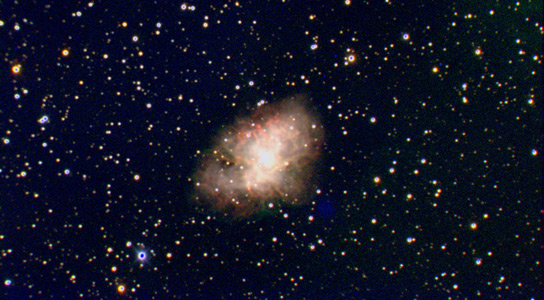
    Crab Nebula is  located 6,500 light-years away in the constellation Taurus

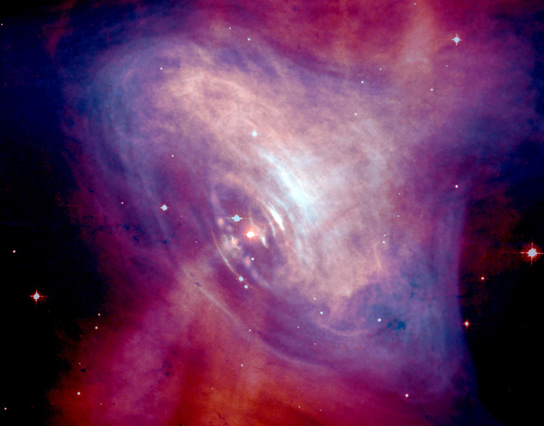
    The Crab Nebula (NGC 1952) is easily visible through small telescopes, which has allowed astronomers to observe its growth and evolution, ever since its birth in the stellar fires of the supernova that created it became visible in 1054. In 1968, a pulsar was found at the center of the nebula. The rapidly rotating neutron star is the core of the star that went supernova. A new model suggests that the areas near the pulsar are acting as rapid particle accelerators, boosting electrons and heavier particles alike to speeds close to the speed of light.
    crab-nebula-chandra-nasa-pulsar

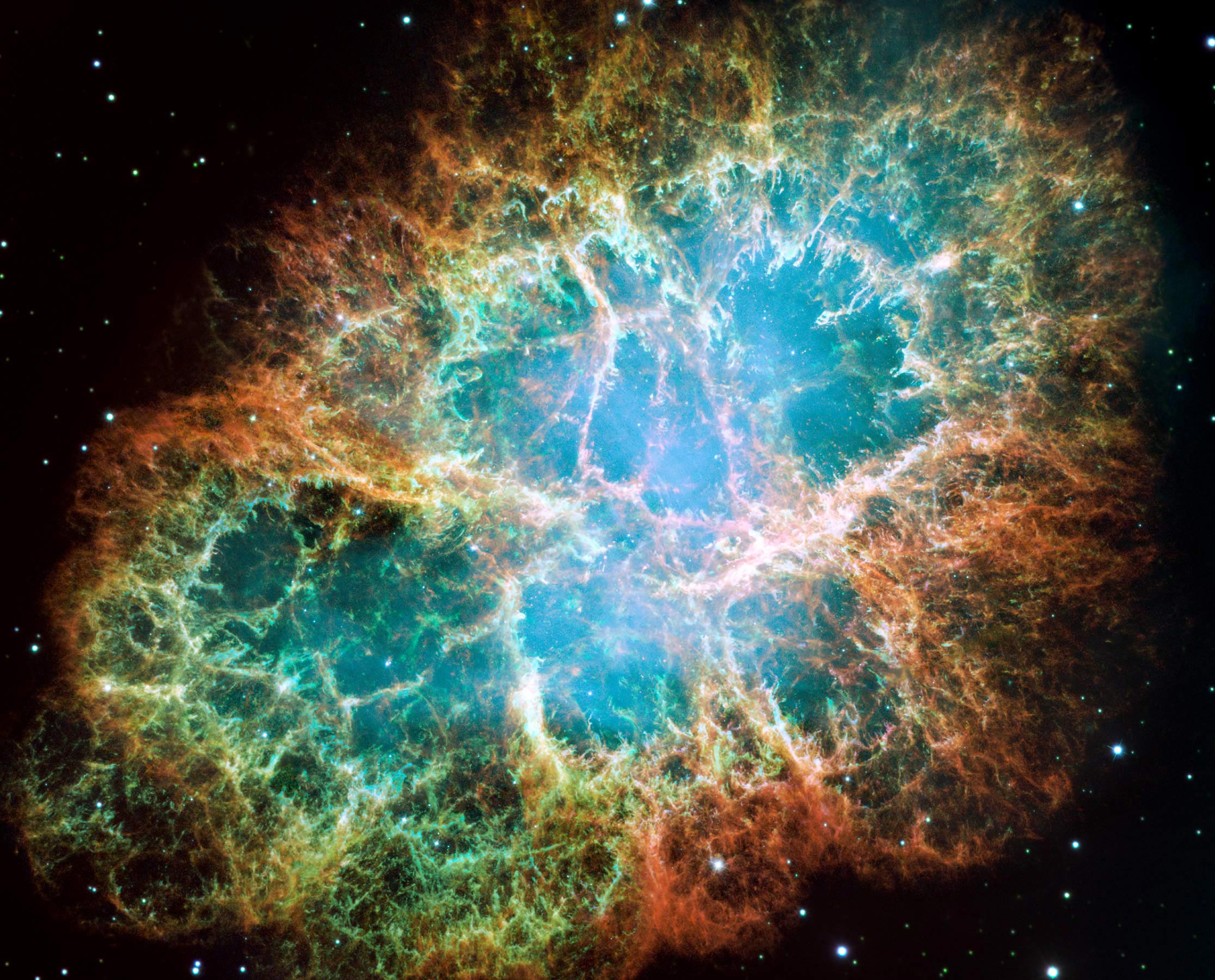
    The Crab Nebula is a supernova remnant located 6,500 light-years away in the constellation Taurus, in the Perseus Arm of the Milky Way. The Crab pulsar is one of the brightest sources of gamma rays observable from Earth.

    The new model was proposed by F. A. Aharonian, S. V. Bogovalov, and D. Khangulyan, in the journal Nature and hopes to explain some of the blanks missing in the previous models of this pulsar. The Crab pulsar is about 30 km (19 mi) in diameter, but contains nearly two solar masses (2 M☉). The intense gravitational influence and rapid rotation of pulsar allows them to carry enormous amounts of energy, which are typically only encountered in particle accelerators.
     

    Crab Nebula Messier 1
    Credit: NASA, ESA, J. Hester and A. Loll (Arizona State University)

    The pulsar wind is composed of plasma that moves very close to the speed of light. It is not yet known how the pulsar wind transitions from electromagnetic energy into the kinetic energy of fast-moving particles.

    The gamma-ray signature negates the explanation of a gradual acceleration, which is why the new model indicates a rapid acceleration that results in electrons moving at the same speed as heavier particles.

    The electrons and positrons driving the pulsar wind originate in the light cylinder around the Crab pulsar. The new model postulates that the electron-positron plasma cannot be moving rapidly close to the pulsar, since too much of the energy situated there is electromagnetic in nature. The pulsar wind gather momentum in a process that’s known as inverse Compton scattering.

    This model is plausible for the production of high-intensity gamma-ray pulses but further observations are needed to determine if the pulsar wind acceleration and region of gamma-ray production correspond to what has been proposed.

    Reference: “Abrupt acceleration of a ‘cold’ ultrarelativistic wind from the Crab pulsar” by F. A. Aharonian, S. V. Bogovalov and D. Khangulyan, 15 February 2012, Nature.
    DOI: 10.1038/nature10793

    Never miss a breakthrough: Join the SciTechDaily newsletter.
    Follow us on Google and Google News.

    Astronomy Astrophysics Nebula Neutrons Pulsars Ultrarelativistic Wind
    Share. Facebook Twitter Pinterest LinkedIn Email Reddit

    Related Articles

    Astronomers Discover New Class of Galactic Nebulae

    Unlocking the Mystery of the Early Universe Depends on Estimating the Lifespan of Neutrons

    Dense, Spinning, Dead Star Discovered by Outback Radio Telescope

    Enhanced X-ray Emissions Coincide With Giant Radio Pulses From Crab Pulsar

    Mysterious Giant Radio Pulses From Pulsars Are Hundreds of Times More Energetic Than Previously Believed

    Weird X-ray Surges Detected in Crab Pulsar’s Radio Bursts by NASA’s NICER

    New Clues About Early Universe From Black Hole Powered Cosmic Jet 13 Billion Light-Years From Earth

    Gravitational Wave Search Finds Tantalizing New Clue: Unexplained Fluctuations in Space-Time

    Milky Way’s Dark Side Revealed by Measurements of Pulsar Acceleration

    Leave A Reply Cancel Reply

    • Facebook
    • Twitter
    • Pinterest
    • YouTube

    Don't Miss a Discovery

    Subscribe for the Latest in Science & Tech!

    Trending News

    Largest-Ever Study Finds Medicinal Cannabis Ineffective for Anxiety, Depression, PTSD

    250-Million-Year-Old Egg Solves One of Evolution’s Biggest Mysteries

    Living With Roommates Might Be Changing Your Gut Microbiome Without You Knowing

    Century-Old Cleaning Chemical Linked to 500% Increased Risk of Parkinson’s Disease

    What if Your Memories Never Happened? Physicists Take a New Look at the Boltzmann Brain Paradox

    One of the Universe’s Largest Stars May Be Getting Ready To Explode

    Scientists Discover Enzyme That Could Supercharge Ozempic-Like Weight Loss Drugs

    Popular Sweetener Linked to DNA Damage – “It’s Something You Should Not Be Eating”

    Follow SciTechDaily
    • Facebook
    • Twitter
    • YouTube
    • Pinterest
    • Newsletter
    • RSS
    SciTech News
    • Biology News
    • Chemistry News
    • Earth News
    • Health News
    • Physics News
    • Science News
    • Space News
    • Technology News
    Recent Posts
    • Scientists Uncover Potential Brain Risks of Popular Fish Oil Supplements
    • Scientists Prove There Are Just Six Degrees of Separation in a Social Network
    • Bee Bacteria Could Fix a Major Flaw in Plant-Based Milk
    • Scientists Discover a Surprising Way To Make Bread Healthier and More Nutritious
    • Natural Compounds Boost Bone Implant Success While Killing Bacteria and Cancer Cells
    Copyright © 1998 - 2026 SciTechDaily. All Rights Reserved.
    • Science News
    • About
    • Contact
    • Editorial Board
    • Privacy Policy
    • Terms of Use

    Type above and press Enter to search. Press Esc to cancel.