
Close Menu
    Facebook X (Twitter) Instagram
    SciTechDaily
    • Biology
    • Chemistry
    • Earth
    • Health
    • Physics
    • Science
    • Space
    • Technology
    Facebook X (Twitter) Pinterest YouTube RSS
    SciTechDaily
    Home»Science»Stone Blades Suggest That Early Humans Passed on Technological Skills
    Science

    Stone Blades Suggest That Early Humans Passed on Technological Skills

    By SciTechDailyNovember 8, 2012No Comments2 Mins Read
    Facebook Twitter Pinterest Telegram LinkedIn WhatsApp Email Reddit
    Share
    Facebook Twitter LinkedIn Pinterest Telegram Email Reddit
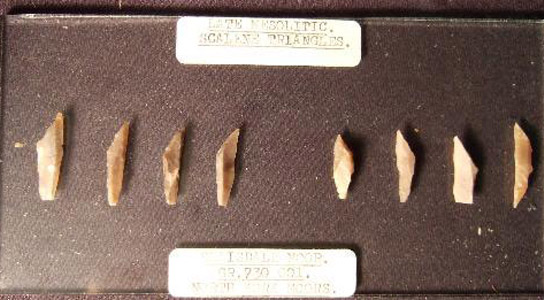
    mesolithic-microliths
    Late Mesolithic microliths.

    Archaeologists have discovered some new stone blades from a cave in South Africa that seem to indicate that early humans were already quite adept at crafting blades.

    The scientists published their findings in the journal Nature. The tiny blades are no longer than 3 cm (1.2 in)  in length and were used as tips for throwable spears or additions to spiky club-like weapons, states Curtis Marean, an archaeologist at Arizona State University, in Tempe.
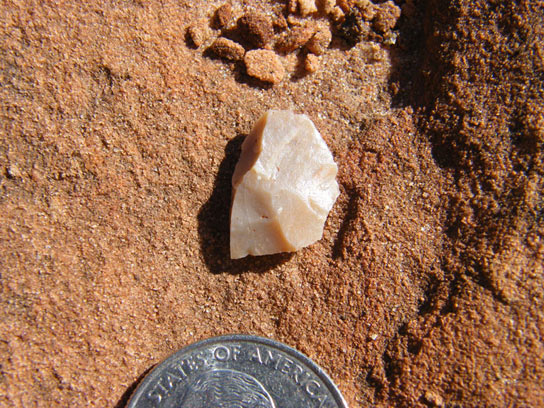
    native-american-microlith
    Native American microlith.

    Twenty-seven microliths were found in layers of sand and soil dating back 71,000 years and representing a time span of 11,000 years. This adds credence to the idea that early humans were able to pass on their ideas to the next generation.

    Evidence for early human technology is patchy at best, which is one of the reasons why continuous cultural transmission has been disputed. Some archaeologists think that human populations could have developed the ability to make such complex tools and then lost it, as the size of the population fluctuated over time.

    These tools are made using a number of steps. A silcrete rock needed to be collected, then heat-treated to make it easier to flake. A large rock would have been used to flake off sharp slivers of the rock. This makes Marean think that people had to talk to each other for such a process to be transmissible.

    However, this might not count as evidence for complex thought. Some scholars want to see evidence of art and ornaments in order to grant this.

    Since the flakes are small and light, there is the possibility that modern humans used such spear-throwing technology to outsmart Neanderthals when they spread out of Africa and into Europe some 100,000 years ago. Spear points developed by Neanderthals were too heavy to be thrown, so this could have given early humans an advantage when competing for similar resources.

    Reference: “An early and enduring advanced technology originating 71,000 years ago in South Africa” by Kyle S. Brown, Curtis W. Marean, Zenobia Jacobs, Benjamin J. Schoville, Simen Oestmo, Erich C. Fisher, Jocelyn Bernatchez, Panagiotis Karkanas and Thalassa Matthews, 7 November 2012, Nature.
    DOI: 10.1038/nature11660

    Never miss a breakthrough: Join the SciTechDaily newsletter.
    Follow us on Google and Google News.

    Anthropology Archaeology Palaeoanthropology
    Share. Facebook Twitter Pinterest LinkedIn Email Reddit

    Related Articles

    New Research Reveals Easter Island Had a Cooperative Community

    Researchers Discover Oldest Images to Date of Dogs on Leashes

    400,000 Year Old Fossil Helps Shed New Light on Human Evolution

    Tuscan Shipwreck Gives Clues of Ancient Eye Treatment

    Neolithic Pottery Reveals Cheese-Making from 7,500 Years Ago

    Jaw Structures of Fossils Seems to Suggest That Three Homo Species Roamed Africa Concurrently

    Ancient Murals in Guatemala Offer Glimpse of Mayan Astronomy

    Million-Year-Old Ash in South African Cave Yields Evidence of Cooking

    Humans Implicated in Africa’s Deforestation 3,000 Years Ago

    Leave A Reply Cancel Reply

    • Facebook
    • Twitter
    • Pinterest
    • YouTube

    Don't Miss a Discovery

    Subscribe for the Latest in Science & Tech!

    Trending News

    Scientists Discover 132-Million-Year-Old Dinosaur Tracks on South Africa’s Coast

    Scientists Uncover the Secret Ingredient Behind the Spark That May Have Started Life on Earth

    Physicists Observe Matter in Two Places at Once in Mind-Bending Quantum Experiment

    Stanford Scientists Discover Hidden Brain Circuit That Fuels Chronic Pain

    New Study Reveals Why Ozempic Works Better for Some People Than Others

    Climate Change Is Altering a Key Greenhouse Gas in a Way Scientists Didn’t Expect

    New Study Suggests Gravitational Waves May Have Created Dark Matter

    Scientists Discover Why the Brain Gets Stuck in Schizophrenia

    Follow SciTechDaily
    • Facebook
    • Twitter
    • YouTube
    • Pinterest
    • Newsletter
    • RSS
    SciTech News
    • Biology News
    • Chemistry News
    • Earth News
    • Health News
    • Physics News
    • Science News
    • Space News
    • Technology News
    Recent Posts
    • New “Nanozyme Hypothesis” Could Rewrite the Story of Life’s Origins
    • Anatomy Isn’t Finished: The Human Body Still Holds Secrets
    • Researchers Discover Long-Lost Words of Ancient Greek Philosopher After 2,000 Years
    • New Study Warns: Asia’s Lifeline Water Source Is Rapidly Draining
    • 100 Times Worse? Thawing Permafrost May Be More Dangerous Than Previously Thought
    Copyright © 1998 - 2026 SciTechDaily. All Rights Reserved.
    • Science News
    • About
    • Contact
    • Editorial Board
    • Privacy Policy
    • Terms of Use

    Type above and press Enter to search. Press Esc to cancel.